组成图示
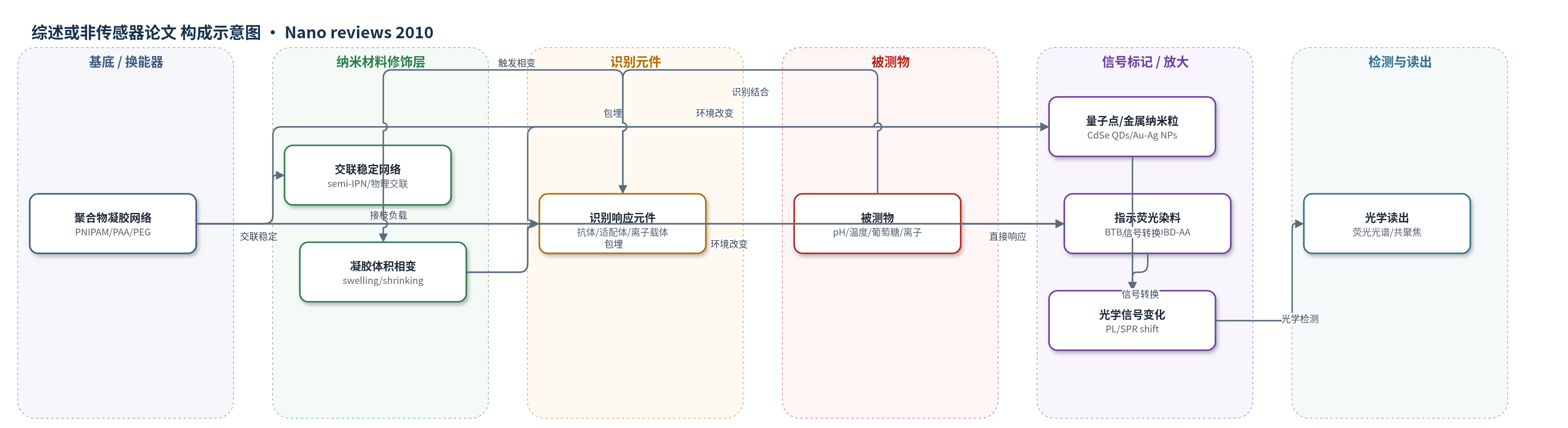
点击图片查看大图 · 依据论文自动绘制
传感器类型
综述或非传感器论文
检测对象
pH(H+)、温度(temperature)、葡萄糖(glucose)、金属离子(Cu2+、Ca2+、Mg2+、K+、Na+、Zn2+等)、阴离子(Cl-)、活性氧(ROS)、生物分子(DNA/蛋白);样品基质:缓冲液、血液、生物反应器流体、食品、活细胞胞质/肿瘤细胞。
检测原理
杂化微/纳米凝胶光学传感按识别机制分为三类。Type 1中抗体、适配体等识别元件与目标结合,引起探针共定位或光学编码变化,用于多路识别。Type 2中指示染料、共轭聚合物等光学组分直接响应被测物:离子交换或质子化改变染料吸收/发射,FRET在供体与受体间转移能量,使荧光强度或波长随浓度变化。Type 3中刺激响应凝胶网络在pH、温度、葡萄糖等刺激下发生体积相变,改变纳米粒周围折射率、非辐射衰减路径和表面态,导致量子点荧光或金属纳米粒等离子体峰红移/增强;高负载光学组分邻近相互作用可放大信号。
检测灵敏度
原文未报告LOD、线性范围、灵敏度斜率或R^2。
效应效果
综述指出杂化微/纳米凝胶具有尺寸可调、比表面积大、网络稳定、响应快、生物相容性好等优点,可用于血液、生物反应器流体和食品等复杂样品。化学交联网络比物理交联更稳定;物理交联chitosan-PMAA-CdSe纳米凝胶在pH升高时32 h内发生链排出,不适合可靠传感。吸收负载QDs在反复溶胀/收缩中可能泄漏并造成信号失真,原位合成或核壳结构可改善可逆性。QD编码珠识别准确率可达99.99%;细胞内温度探针在27–33°C范围内分辨率0.29–0.5°C,且无明显沉淀或细胞组分干扰。作者认为其有望实现传感、成像与治疗一体化。
传感器的构成
- 基底/换能器基质:无电极;PNIPAM、PAA、PMAA、PEG、chitosan等聚合物凝胶网络,作为光学传感基质与刺激响应载体
- 纳米材料修饰层:CdSe/ZnS QDs、CdS QDs、ZnO QDs、Au/Ag/Ag-Au NMNPs,作为荧光或等离子体信号发射体
- 识别元件:抗体、适配体、离子载体、葡萄糖氧化酶、苯硼酸基团,用于目标识别或刺激响应
- 信号标记物:BTB、C6、NR、DBD-AA、DAEAM、PTEBS,作为荧光/共轭聚合物信号接收与FRET组分
- 交联/稳定层:化学交联semi-IPN、chitosan-PMAA物理交联,维持网络稳定与可逆体积相变
- 读出层:荧光光谱、UV-Vis、共聚焦显微镜,用于读取荧光强度、波长或等离子体峰变化
中文摘要
杂化微/纳米凝胶因其尺寸可调、比表面积大、内部网络结构稳定且响应时间短,在多种应用中日益重要。本文综述了杂化微/纳米凝胶在pH、温度、葡萄糖、离子及其他物种光学传感以及细胞内成像方面的最新进展与挑战。作为光学探针,它们可用于血液、生物反应器流体等复杂样品中化学参数的连续监测,并可用于化学研究、工业和食品质量控制。其细胞内探测能力可实时监测活细胞在时间和空间上的生物化学与生物物理变化,有助于解释复杂生物学过程并发展新型诊断方法。与多数探针不同,杂化微/纳米凝胶还可将多种功能整合到单一探针中。合理设计杂化微/纳米凝胶不仅能改善探测应用,还能拓展新领域;随着生物纳米技术发展,其有望实现同步传感、成像诊断与治疗,面向临床应用。
英文摘要
Hybrid micro-/nanogels are playing an increasing important part in a diverse range of applications, due to their tunable dimensions, large surface area, stable interior network structure, and a very short response time. We review recent advances and challenges in the developments of hybrid micro-/nanogels toward applications for optical sensing of pH, temperature, glucose, ions, and other species as well as for intracellular imaging. Due to their unique advantages, hybrid micro-/nanogels as optical probes are attracting substantial interests for continuous monitoring of chemical parameters in complex samples such as blood and bioreactor fluids, in chemical research and industry, and in food quality control. In particular, their intracellular probing ability enables the monitoring of the biochemistry and biophysics of live cells over time and space, thus contributing to the explanation of intricate biological processes and the development of novel diagnoses. Unlike most other probes, hybrid micro-/nanogels could also combine other multiple functions into a single probe. The rational design of hybrid micro-/nanogels will not only improve the probing applications as desirable, but also implement their applications in new arenas. With ongoing rapid advances in bionanotechnology, the well-designed hybrid micro-/nanogel probes will be able to provide simultaneous sensing, imaging diagnosis, and therapy toward clinical applications.