组成图示
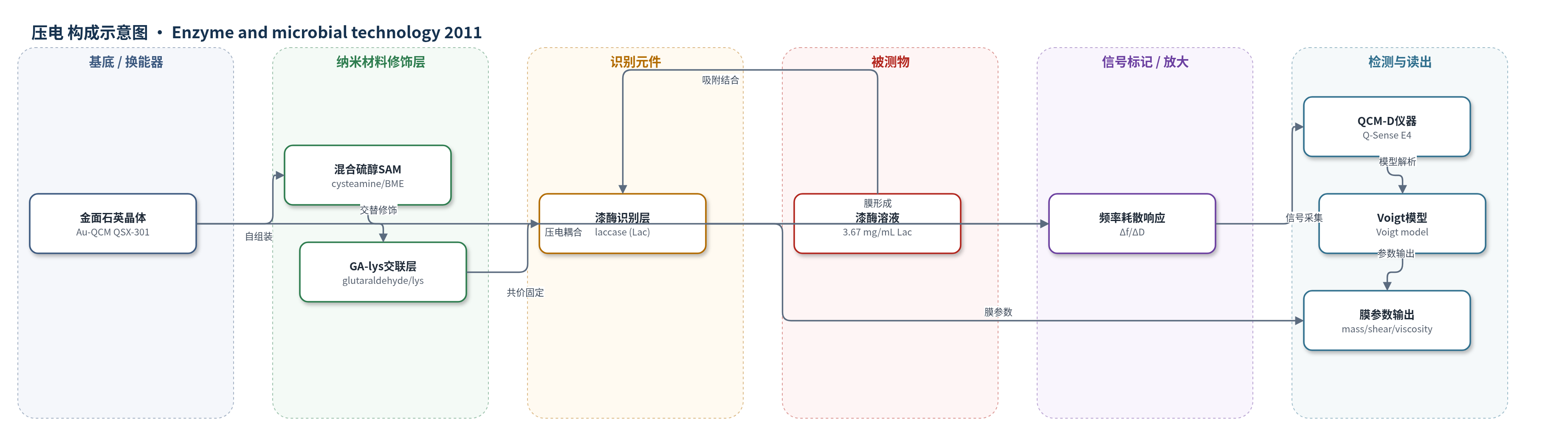
点击图片查看大图 · 依据论文自动绘制
传感器类型
压电(QCM)生物传感器
检测对象
固定化漆酶膜(immobilized laccase film, Lac)的质量与流变参数;样品基质:0.025 M 琥珀酸-乳酸缓冲液(SLB, pH 4.5)。文中关联的第二部分分析物为对苯二酚(hydroquinone, HQ),但本文未直接检测。
检测原理
QCM-D 以金面石英晶体为压电换能器,在液体中维持振荡。漆酶溶液流经表面后,漆酶通过物理吸附或戊二醛-赖氨酸共价键结合到 SAM 上,形成酶膜。结合质量与膜黏弹性改变晶体的共振频率和耗散:质量增加使 Δf 下降,黏弹性/耦合水增加使 ΔD 上升。对刚性薄膜可用 Sauerbrey 方程估算质量;对蛋白黏弹性膜则用 Voigt 模型从多个倍频的 Δf 和 ΔD 计算厚度、剪切模量与粘度。SDS 短洗去除非共价蛋白后,保留共价结合膜。共价固定和更高半胱胺密度增加交联与刚性,使剪切/粘度升高;赖氨酸间隔臂增大酶与表面距离,增加湿质量并降低单位质量剪切/粘度,提示构象扰动较小。
检测灵敏度
原文未报告 LOD、线性范围、灵敏度斜率或相关系数。
效应效果
实验至少三次重复,以均值±标准差报告,未报告选择性、RSD、回收率或方法对比。SDS 洗脱后,SAM1.1 与 SAM2.1 平均结合质量约 280 ng cm−2,Au 与 SAM1 约 173 ng cm−2;SAM2.1 的 V.I. 为 44.1×10^6 Hz,高于 SAM1.1 的 35.6×10^6 Hz。共价固定使剪切与粘度高于物理吸附,如 SAM1.1 洗脱后剪切约 6.69×10^5 N m−3、粘度约 6.6×10⁻³ N s m−3,SAM1 约 0.16×10^5 N m−3 和 2.5×10⁻³ N s m−3。增加半胱胺密度提高刚性;赖氨酸间隔臂增加湿质量并降低单位质量剪切/粘度,提示酶构象扰动较小,QCM-D 可用于优化识别层。
传感器的构成
- 基底/换能器:AT-cut 金面石英晶体(QSX-301, Au-QCM)与钛质 QCM-D 流动池,提供压电振荡及频率/耗散读出
- 自组装单分子层(SAM):半胱胺(cysteamine)与 β-巯基乙醇(β-mercaptoethanol)混合硫醇,在 Au 表面形成不同结合位点密度
- 交联/间隔层:戊二醛(glutaraldehyde, GA)与 L-赖氨酸(L-lysine, lys)交替修饰,形成共价连接并调节酶与表面距离
- 识别/催化元件:漆酶(laccase, Lac,来自 Trametes versicolor),物理吸附或经 GA 共价固定于 SAM 表面
- 清洗/稳定处理:0.3% SDS 溶液短洗去除非共价吸附蛋白,保留共价结合酶膜
- 缓冲介质:0.025 M 琥珀酸-乳酸缓冲液(SLB, pH 4.5),维持 QCM-D 测量环境
中文摘要
酶固定化是分析与工业应用中的持续研究热点,固定化方法对固定化生物分子功能性的影响尤为关键。本文利用带耗散的石英晶体微天平(QCM-D)研究漆酶单分子层固定在不同自组装单分子层(SAM)表面的质量与流变参数。所研究 SAM 在结合残基横向密度和距石英表面高度上不同,采用半胱胺与 β-巯基乙醇混合硫醇构建,并用戊二醛和 L-赖氨酸交替修饰形成共价连接与间隔臂。作者测量了各表面的质量增益和黏弹性参数,并将趋势与第二部分中电化学评估的固定化漆酶表观酶动力学进行比较。结果显示,与物理吸附蛋白相比,共价固定使剪切模量和粘度升高;提高 SAM 上蛋白结合位点密度会增加膜剪切/粘度;引入赖氨酸间隔臂使酶与电极距离增大,降低剪切/粘度,同时增加膜的湿质量。剪切和粘度可能反映酶变性与蛋白横向堆积增强,因此加入间隔臂可减少固定化过程中的构象扰动,有利于优化生物传感器识别层。
英文摘要
Enzyme immobilization is an ever-growing research-area for both analytical and industrial applications. Of critical importance in this area are the effects of immobilization procedures upon the functionality of the immobilized biomolecules. Both beneficial and detrimental effects can be conferred through the selection and tuning of the immobilization procedure. Quartz-crystal microbalance with dissipation (QCM-D) has been previously used to great effect in tracking alterations to thin films of biomolecules immobilized onto quartz transducers. In this study, we investigate the ability of QCM-D to track and monitor film parameters of a monolayer of laccase immobilized on a series of self-assembled monolayers (SAMs), differing in lateral density of binding residues on the SAM and height of the SAM from the quartz surface. Both mass gains and rheological parameters for these varying surfaces were measured and trends later compared to the apparent enzyme kinetics of the immobilized laccase films, assessed electroanalytically (Paper II in this two part study). For covalent attachment of proteins, both shear and viscosity were increased relative to physically adsorbed proteins. An increase in lateral density of protein-binding surface of the SAM components was shown to increase the shear/viscosity of the resultant film while an increase in distance from the electrode (through incorporation of lysine linkers) was shown to decrease the shear/viscosity while simultaneously increasing the wet mass gain of the films. Shear and viscosity may be indicative of both enzyme denaturation and increased lateral protein packing within the film structure hence it is assumed that less distortion occurs with the inclusion of linkers which allow for more optimal protein immobilization.