组成图示
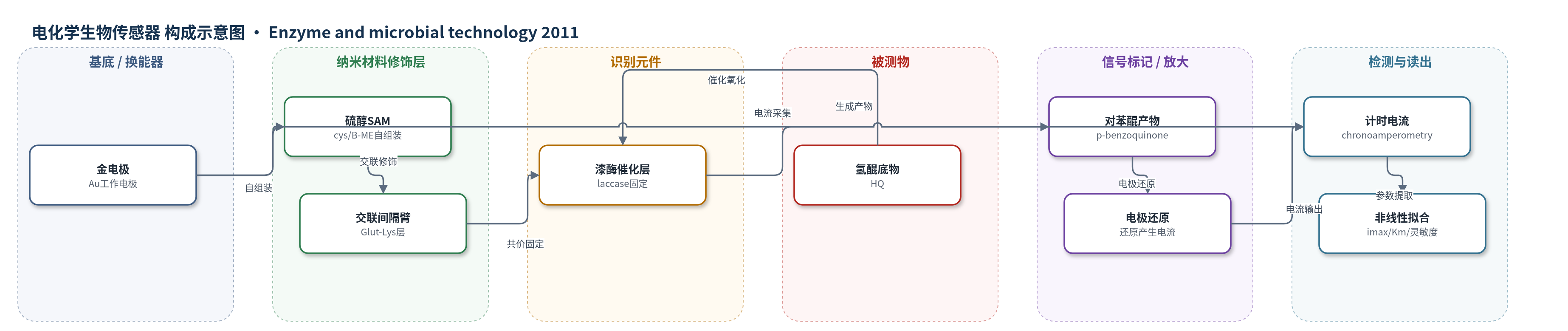
点击图片查看大图 · 依据论文自动绘制
传感器类型
电化学生物传感器
检测对象
氢醌(hydroquinone, HQ);样品基质:0.1 M 琥珀酸-乳酸缓冲液(SLB, pH 4.5)搅拌水相
检测原理
该传感器以固定化漆酶为生物催化识别层。当氢醌(HQ)扩散进入漆酶膜时,漆酶催化其氧化生成电活性产物对苯醌(p-benzoquinone),同时漆酶将电子传递给氧。对苯醌在接近电极的表面被还原,重新生成氢醌,形成催化循环。电极在 -0.05 V(vs Ag/AgCl)下记录稳态电流,电流大小取决于对苯醌还原速率,并随 HQ 浓度增加而升高。由于酶层厚度小于 30 nm 且 HQ 扩散系数较高,产物可快速到达电极,响应时间较短。电流-浓度关系采用 Briggs–Haldane/Michaelis–Menten 型方程 I=Imax[S]/(Km+[S]) 进行非线性回归,提取最大电流 imax、表观 Km 和线性灵敏度。该体系未使用核酸或纳米酶放大,主要依靠酶催化循环和电活性产物的直接电化学检测实现信号。
检测灵敏度
线性范围: 0–40 μM HQ;灵敏度斜率: Au 3.94 ± 0.53、SAM 1 2.59 ± 0.29、SAM 1.1 4.77 ± 0.86、SAM 1.2 8.42 ± 0.49、SAM 1.3 11.8 ± 0.75、SAM 2.1 2.32 ± 0.17、SAM 2.2 4.52 ± 0.40、SAM 2.3 5.30 ± 0.29 nA μM−1 cm−2;imax: 404–1404 nA cm−2;Km: 95–224 μM;R^2 > 0.99(灵敏度与 imax/Km 线性相关)
效应效果
论文未报告选择性、抗干扰、长期稳定性、实际样品加标回收率或与 ELISA/HPLC/qPCR 的对比。重现性方面,各表面参数由至少 3 次独立测量获得,例如 SAM 1.3 灵敏度为 11.8 ± 0.75 nA μM−1 cm−2,imax 为 1404 ± 105 nA cm−2,Km 为 101 ± 3 μM。性能上,增加间隔臂长度可显著降低表观 Km 并提高灵敏度;降低间隔臂横向密度可提高 imax 和灵敏度。SAM 1.3 的 HQ 灵敏度约为 SAM 2.1 的近 6 倍,且高于物理吸附表面 3 倍以上。结合 QCM-D 数据,作者认为膜粘度升高会降低性能,而提高刚性蛋白膜水合水平可改善灵敏度,因此流变参数与电化学动力学结合可用于指导固定化酶生物传感器设计。
传感器的构成
- 基底/换能器电极:金电极(Au),导电基底与电流换能器
- 自组装单分子层:半胱胺(cysteamine, cys)与β-巯基乙醇(β-mercaptoethanol, B-ME)混合 SAM,提供氨基间隔臂并控制横向密度
- 交联间隔臂层:戊二醛(glutaraldehyde, Glut)与 L-赖氨酸(L-lysine, Lys)交替层,共价连接漆酶并调节间隔臂长度
- 识别/催化元件:漆酶(laccase,Trametes versicolor),催化氧化氢醌
- 信号标记/电活性产物:对苯醌(p-benzoquinone),在电极表面还原产生电流
- 反应介质:琥珀酸-乳酸缓冲液(SLB, pH 4.5),维持酶催化反应
- 检测系统:Autolab PGSTAT 30 电化学工作站、Ag/AgCl 参比电极与铂丝辅助电极,计时电流读出
中文摘要
蛋白质固定化方法显著影响其整体构象及功能,因此深入理解固定化过程中蛋白质所经历的变化,是优化固定化策略、在生物传感器设计中保留固定化优势并降低其劣势的关键。作为两篇系列论文的第二篇,本文评估了共价连接至不同间隔臂长度和横向间隔臂密度的自组装单分子层(SAM)上的薄层漆酶单层的动力学参数。研究采用计时电流法,并以电活性产物对苯醌为信号,通过非线性回归模型提取相关参数。最后,将本文获得的动力学参数与同一固定化方式下漆酶单层在系列第一篇中获得的流变参数进行比较。结果显示,随着连接臂长度增加,多数表面的最大酶催化电流 imax、表观 Michaelis–Menten 常数 Km 和表观生物传感器灵敏度均有所改善;降低间隔臂横向密度也普遍改善这些参数,这归因于功能蛋白发生多点固定化的程度降低。进一步比较流变数据与动力学数据表明,蛋白膜粘度对附着蛋白层具有负面影响,而通过压电方法评估的蛋白水合水平提高则对由刚性结合蛋白层构成的表面具有正面作用。
英文摘要
The method of immobilization of a protein has a great influence on the overall conformation, and hence, functioning of the protein. Thus, a greater understanding of the events undergone by the protein during immobilization is key to manipulating the immobilization method to produce a strategy that influences the advantages of immobilization while minimizing their disadvantages in biosensor design. In this, the second paper of a two-part series, we have assessed the kinetic parameters of thin-film laccase monolayers, covalently attached to SAMs differing in spacer-arm length and lateral density of spacer arms. This was achieved using chronoamperometry and an electroactive product (p-benzoquinone), which was modeled in a non-linear regressional fashion to extract the relevant parameters. Finally, comparisons between the kinetic parameters presented in this paper and the rheological parameters of laccase monolayers immobilized in the same manner (Part I of this two paper series) were performed. Improvements in the maximal enzyme-catalysed current, i(max), the apparent Michaelis-Menten constant, K(m) and the apparent biosensor sensitivity were noted for most of the surfaces with increasing linker length. Decreasing the lateral density of the spacer-arms brought about a general improvement in these parameters, which is attributed to the decrease in multiple points of immobilization undergone by functional proteins. Finally, comparisons between rheological data and kinetics data showed that the degree of viscosity exhibited by protein films has a negative influence on attached protein layers, while enhanced protein hydration levels (assessed piezoelectrically from data obtained in Paper 1) has a positive effect on those surfaces comprising rigidly bound protein layers.