组成图示
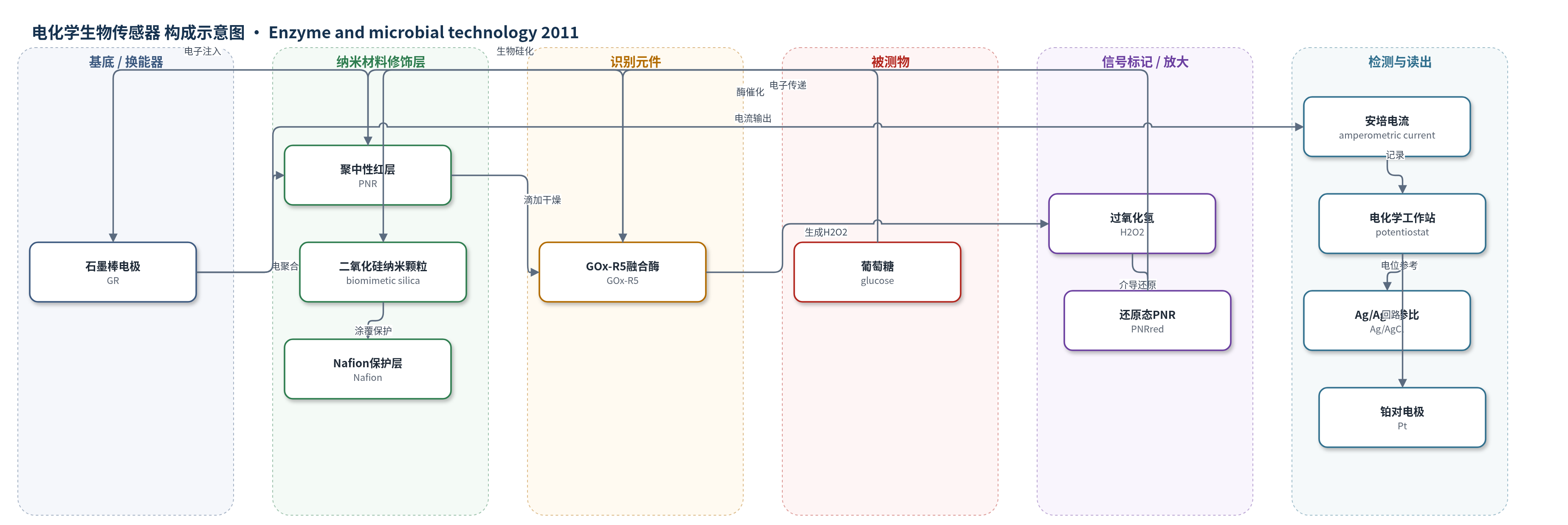
点击图片查看大图 · 依据论文自动绘制
传感器类型
电化学生物传感器
检测对象
葡萄糖(glucose),样品基质:磷酸盐缓冲液/KCl混合溶液及含干扰分子的混合样品(模拟血液葡萄糖检测)
检测原理
葡萄糖扩散至工作电极表面,被GOx–R5中的GOx催化氧化为葡萄糖酸,同时生成过氧化氢(H2O2)。R5融合肽诱导TMOS在pH 5柠檬酸缓冲液中发生生物硅化,使GOx自包埋于PNR表面的二氧化硅纳米颗粒中,Nafion层限制介体扩散。在-0.5 V(vs. Ag/AgCl)下,PNR作为氧化还原介体参与H2O2的还原/氧化循环,将电子传递至石墨棒电极,产生安培电流。葡萄糖浓度越高,生成的H2O2越多,稳态电流越大,因此电流响应与葡萄糖浓度呈线性关系。
检测灵敏度
LOD: 0.67 mM (S/N = 3);线性范围: 1 mM–11 mM;灵敏度: 1.58 μA/mM cm2;相关系数: 0.99
效应效果
该传感器在-0.5 V下对葡萄糖的稳态电流响应在15 s内达到稳定,1 mM葡萄糖产生1.58 μA cm−1电流,线性范围为1–11 mM,相关系数0.99,检出限0.67 mM(S/N=3),覆盖正常人血糖4–8 mM范围。抗干扰测试中,0.1 mM抗坏血酸和0.05 mM对乙酰氨基酚对5 mM葡萄糖检测的干扰可忽略,低电位有助于选择性检测。扫描电镜证实PNR/GOx复合结构形成。作者认为GOx–R5自包埋固定化方法简单、无需额外催化剂,可推广至其他生物分子固定化及葡萄糖检测应用。
传感器的构成
- 基底/换能器电极:石墨棒电极(graphite rod electrode, GR),直径6.0 mm,有效面积0.28 cm2,侧表面用石蜡膜密封,作为工作电极基底。
- 电子介体修饰层:聚中性红(poly(neutral red), PNR),由中性红(neutral red, NR)在石墨棒表面电聚合形成,介导电子传递。
- 识别元件:葡萄糖氧化酶–R5融合蛋白(GOx–R5),由毕赤酵母分泌,含His标签和GGGS连接肽,催化葡萄糖氧化并诱导硅化。
- 纳米包埋层:生物模拟二氧化硅纳米颗粒(biomimetic silica nanoparticles),由TMOS在pH 5柠檬酸缓冲液中经R5诱导形成,自包埋GOx。
- 保护层/封闭剂:Nafion(5% w/t酒精溶液),涂覆于PNR/GOx表面,防止PNR快速释放并保护酶层。
- 参比电极:Ag/AgCl电极(饱和KCl),提供稳定电位参考。
- 对电极:铂丝对电极(platinum counter electrode),完成三电极电化学回路。
- 信号读出装置:电位/电流计(potentiostat/galvanostat, 273A),在-0.5 V下记录安培电流。
中文摘要
本研究在毕赤酵母中构建并表达了由硅蛋白R5与葡萄糖氧化酶(GOx)组成的融合蛋白GOx–R5。R5是硅藻硅蛋白的多肽组分,可诱导体外硅化。利用GOx–R5的自包埋特性,在pH 5柠檬酸缓冲液中以四甲氧基硅烷为硅源,将GOx通过生物硅化固定在石墨棒电极上。所制备的电化学生物传感器由Ag/AgCl参比电极、铂对电极和修饰有聚中性红(PNR)/GOx/Nafion的工作电极组成。GOx通过融合蛋白固定在PNR上,并用Nafion覆盖以限制扩散。扫描电镜证实PNR/GOx复合结构形成。在-0.5 V下,1 mM葡萄糖使电流增至1.58 μA cm−1,信号来自PNR对GOx氧化葡萄糖产生的过氧化氢的还原。检出限为0.67 mM(S/N=3)。该传感器可在含干扰分子的混合样品中检测不同浓度葡萄糖,并首次报道了真核细胞中R5与GOx融合表达及其在葡萄糖生物传感器中的应用。
英文摘要
We constructed a fusion protein (GOx-R5) consisting of R5 (a polypeptide component of silaffin) and glucose oxidase (GOx) that was expressed in Pichia pastoris. Silaffin proteins are responsible for the formation of a silica-based cell matrix of diatoms, and synthetic variants of the R5 protein can perform silicification in vitro[1]. GOx secreted by P. pastoris was self-immobilized (biosilicification) in a pH 5 citric buffer using 0.1M tetramethoxysilane as a silica source. This self-entrapment property of GOx-R5 was used to immobilize GOx on a graphite rod electrode. An electric cell designed as a biosensor was prepared to monitor the glucose concentrations. The electric cell consisted of an Ag/AgCl reference electrode, a platinum counter electrode, and a working electrode modified with poly(neutral red) (PNR)/GOx/Nafion. Glucose oxidase was immobilized by fused protein on poly(neutral red) and covered by Nafion to protect diffusion to the solution. The morphology of the resulting composite PNR/GOx/Nafion material was analyzed by scanning electron microscopy (SEM). This amperometric transducer was characterized electrochemically using cyclic voltammetry and amperometry in the presence of glucose. An image produced by scanning electron microscopy supported the formation of a PNR/GOx complex and the current was increased to 1.58 μA cm(-1) by adding 1mM glucose at an applied potential of -0.5 V. The current was detected by way of PNR-reduced hydrogen peroxide, a product of the glucose oxidation by GOx. The detection limit was 0.67mM (S/N=3). The biosensor containing the graphite rod/PNR/GOx/Nafion detected glucose at various concentrations in mixed samples, which contained interfering molecules. In this study, we report the first expression of R5 fused to glucose oxidase in eukaryotic cells and demonstrate an application of self-entrapped GOx to a glucose biosensor.