组成图示
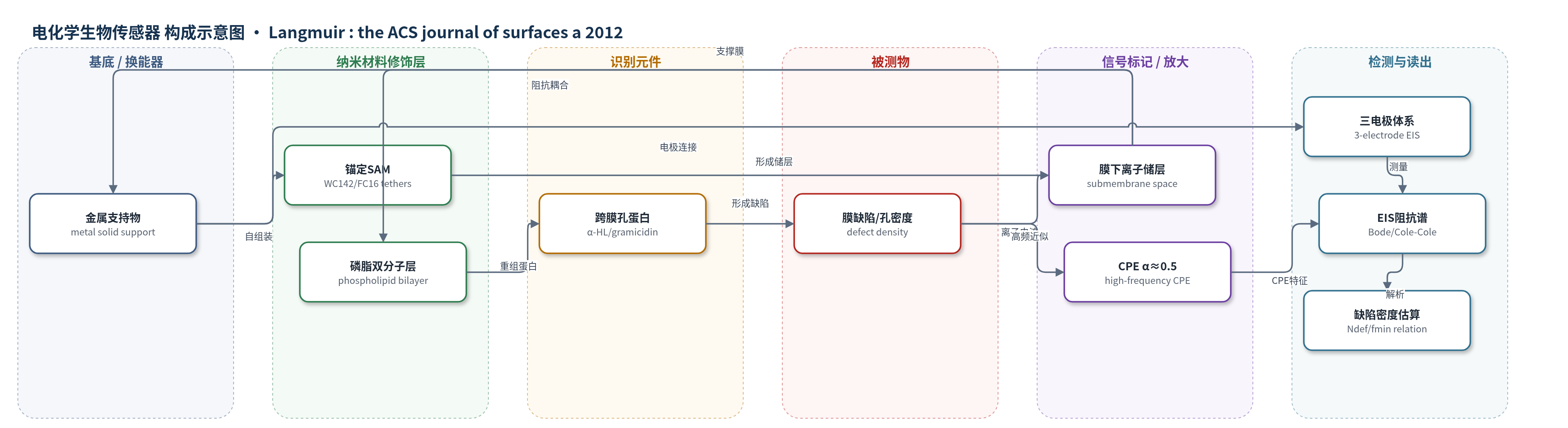
点击图片查看大图 · 依据论文自动绘制
传感器类型
电化学生物传感器
检测对象
膜缺陷/跨膜孔(membrane defects/membrane-spanning pores)、离子通道(ion channels,如 α-HL、gramicidin);样品基质:tBLM 界面及 0.1 M KCl 磷酸盐缓冲液(pH 7.5,可含 PEG 1000)
检测原理
tBLM 由金属电极上的锚定 SAM 支撑磷脂双分子层构成,跨膜孔蛋白或自发缺陷在绝缘膜中形成导电通路。施加交流信号后,电流经膜缺陷进入受限膜下离子储层,再经 Helmholtz 层到达金属。膜下储层具有径向分布式电阻-电容网络,其阻抗不能用常规等效电路元件表示,解析解由复变量 Hankel 函数描述。缺陷密度、尺寸和电导改变缺陷支路阻抗:高频下膜下储层近似为 CPE(α≈0.5),大缺陷使该行为移向低频;低频下多缺陷响应呈电容性,相位极值频率 fmin 随缺陷密度近似对数线性变化(lg Ndef≈0.93 lg fmin−lg k−0.2 lg r0−const)。通过 Bode/Cole-Cole 谱的模量拐点、相位极值、半圆抬升等可定量缺陷密度、通道电导并区分均匀分布与聚集。
检测灵敏度
原文未报告 LOD、线性范围、相关系数;lg Ndef–lg fmin 局部斜率: ≈0.93
效应效果
该文以理论建模为主,未报告 RSD、稳定性、回收率或方法对比。模型显示 EIS 对缺陷密度高度敏感:密度从 0.003 增至 0.3 μm^-2 时,相位极值频率由约 0.025 Hz 移至 3.3 Hz;增至 30 μm^-2 时移至 516 Hz,lg Ndef–lg fmin 局部斜率约 0.93;式(34)估算相对误差为 2.0%–32.1%。实验上,α-HL 通道 tBLM 加入 15% PEG 1000 后,高频溶液电阻增加约 1.7 倍,中频 |Ztot| 仅变化 1.17 倍,说明膜下储层阻抗与通道电导共同贡献,并估计 Fsub≈(5–9)×10^4 Ω·cm,比 0.1 M KCl 体相高约 3 个数量级。作者认为可用于 tBLM 生物传感器、定量孔形成毒素活性及区分缺陷均匀分布与聚集。
传感器的构成
- 基底/换能器电极:金属固体支持物(metal solid support),提供导电基底与等电位面
- 锚定自组装单分子层:硫醇脂质 tether(thiolipid tethers,如 WC142、FC16)/锚定 SAM(anchor SAM),将磷脂双分子层固定于金属表面
- 膜下离子储层:受限电解质储层(submembrane ionic reservoir,dsub≈1.6 nm),决定缺陷周围径向阻抗
- 磷脂双分子层:磷脂双分子层(phospholipid bilayer,如 diphytanoyl phosphocholine/DPhPC、palmitoyl oleoyl phosphatidylcholine/POPC),构成仿生绝缘膜
- 功能/识别元件:跨膜孔蛋白/离子通道(membrane-spanning pores/ion channels,如 α-HL、gramicidin),形成导电缺陷
- 外部电解质溶液:0.1 M KCl + 0.01 M phosphate buffer(pH 7.5,可含 PEG 1000),提供离子导电环境
- 信号读出:电化学阻抗谱(EIS)三电极体系(working-reference-auxiliary electrode),测量阻抗与复数电容
中文摘要
本文分析了锚定双分子膜(tethered bilayer membranes, tBLMs)的电化学阻抗谱(EIS),并推导了含天然或人工引入缺陷的膜谱响应的解析解。结果表明,单个膜缺陷的 EIS 特征不能用常规电路元件建模,主要原因是磷脂层与固体支持物之间膜下离子储层的阻抗具有复杂分布式参数特性。对于径向对称缺陷,其 EIS 响应可由复变量 Hankel 函数描述,因此膜下储层阻抗和 tBLM 总阻抗均不能用界面等效电路的常规元件表示。但在某些极限情况下,膜下空间响应可简化:高频极限下,缺陷周围膜下空间转变为恒定相元件(CPE),指数 α≈0.5;该转变起始频率受缺陷尺寸等参数影响,大缺陷使其移向低频,因此 α≈0.5 的 CPE 行为可作为此类缺陷存在的诊断标准。低频极限下,响应取决于缺陷密度,当缺陷占据面积有限时转变为电容性阻抗;缺陷密度越高,出现电容行为的频率边界越高。该分析为评估 tBLM 缺陷密度提供了实用工具,可用于 tBLM 生物传感器应用;若已知缺陷(如离子通道)直径和电导,还可估算膜下储层厚度与电导。此外,EIS 可区分膜缺陷均匀分布与聚集状态,有助于阐明蛋白与膜相互作用机制。
英文摘要
The electrochemical impedance spectra (EIS) of tethered bilayer membranes (tBLMs) were analyzed, and the analytical solution for the spectral response of membranes containing natural or artificially introduced defects was derived. The analysis carried out in this work shows that the EIS features of an individual membrane defect cannot be modeled by conventional electrical elements. The primary reason for this is the complex nature of impedance of the submembrane ionic reservoir separating the phospholipid layer and the solid support. We demonstrate that its EIS response, in the case of radially symmetric defects, is described by the Hankel functions of a complex variable. Therefore, neither the impedance of the submembrane reservoir nor the total impedance of tBLMs can be modeled using the conventional elements of the equivalent electrical circuits of interfaces. There are, however, some limiting cases in which the complexity of the EIS response of the submembrane space reduces. In the high frequency limit, the EIS response of a submembrane space that surrounds the defect transforms into a response of a constant phase element (CPE) with the exponent (α) value of 0.5. The onset of this transformation is, beside other parameters, dependent on the defect size. Large-sized defects push the frequency limit lower, therefore, the EIS spectra exhibiting CPE behavior with α ≈ 0.5, can serve as a diagnostic criterion for the presence of such defects. In the low frequency limit, the response is dependent on the density of the defects, and it transforms into the capacitive impedance if the area occupied by a defect is finite. The higher the defect density, the higher the frequency edge at which the onset of the capacitive behavior is observed. Consequently, the presented analysis provides practical tools to evaluate the defect density in tBLMs, which could be utilized in tBLM-based biosensor applications. Alternatively, if the parameters of the defects, e.g., ion channels, such as the diameter and the conductance are known, the EIS data analysis provides a possibility to estimate other physical parameters of the system, such as thickness of the submembrane reservoir and its conductance. Finally, current analysis demonstrates a possibility to discriminate between the situations, in which the membrane defects are evenly distributed or clustered on the surface of tBLMs. Such sensitivity of EIS could be used for elucidation of the mechanisms of interaction between the proteins and the membranes.