组成图示
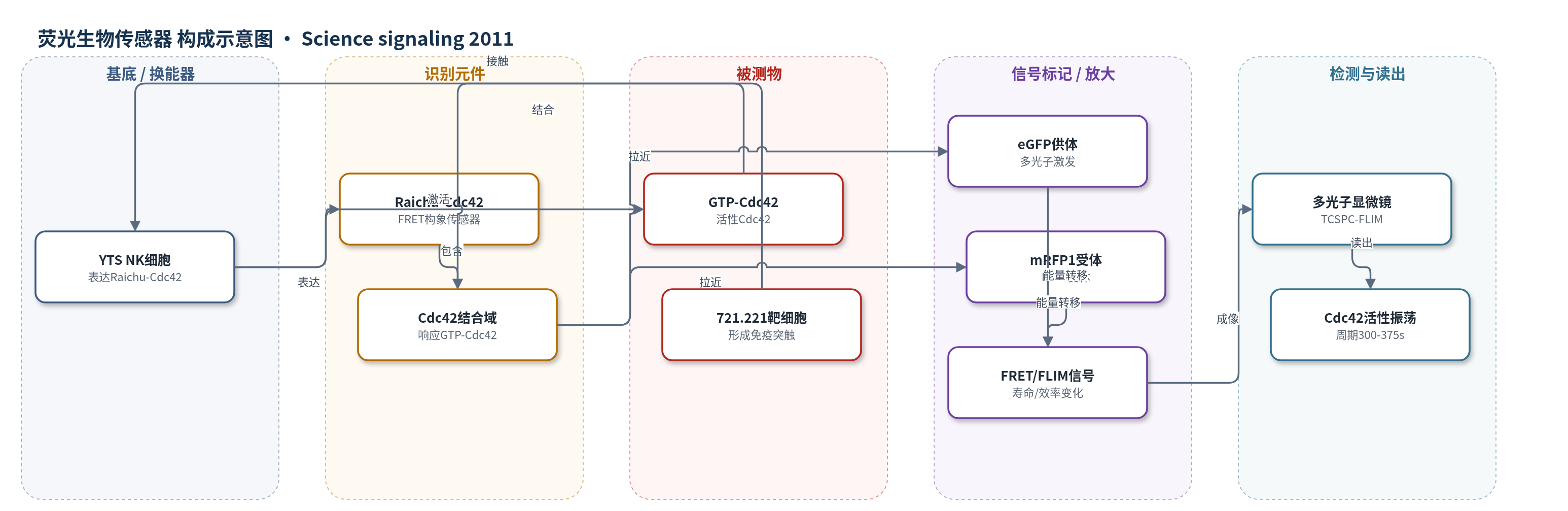
点击图片查看大图 · 依据论文自动绘制
传感器类型
荧光生物传感器
检测对象
Cdc42 活性(Cdc42 GTPase activity,GTP-Cdc42);样品基质:活人 YTS NK 样细胞/721.221 靶细胞共培养体系(免疫突触)
检测原理
Raichu-Cdc42 由 eGFP-Cdc42 结合域-mRFP1 组成,表达于活 NK 细胞内。当 Cdc42 被 GEF 激活并结合 GTP 时,传感器构象改变,使 eGFP 与 mRFP1 距离缩短,FRET 效率升高。多光子激发 eGFP 后,TCSPC 测量 eGFP 荧光寿命;FRET 增强导致供体寿命缩短,FLIM 将寿命/FRET 效率映射为 Cdc42 活性。NK 细胞与靶细胞形成免疫突触后,Cdc42 活性先升高,随后以约 300–375 秒周期振荡。该方法不依赖外源标记或酶放大,而是通过构象依赖的 FRET 实现活细胞内 Cdc42 活性的时空定量。
检测灵敏度
原文未报告 LOD、线性范围、灵敏度斜率或 R^2。
效应效果
该 FRET-FLIM 方法在活 NK 细胞中实现了 Cdc42 活性的时空定量。单独 NK 细胞无显著振荡,Cdc42-GFP 单独荧光寿命不随时间变化,排除成像噪声。LFA-1 阻断抗体消除免疫突触 F-actin 积累和 Cdc42 活性,作为阴性对照。siRNA 敲低 p85a 或 Akt 使 Cdc42 活性降至无靶细胞水平,并使穿孔素颗粒极化比例由 57% 降至 20% 和 15%;PI3K 抑制剂 LY294002 使 pAkt 相对强度降至 44.0±9%,并降低振荡幅度与频率。作者认为该策略可揭示免疫突触中 Cdc42 调控层级,并提示 PI3K 靶向治疗期间需监测 NK 细胞功能。
传感器的构成
- 细胞基底:YTS 人 NK 样细胞,作为传感器表达与活细胞成像基质
- 荧光供体:eGFP(增强绿色荧光蛋白),多光子激发后发射,构成 FRET 供体
- 识别元件:Cdc42 Raichu 构象开关,响应 Cdc42 GTP 结合/GEF 激活
- 荧光受体:mRFP1(单体红色荧光蛋白),作为 FRET 受体,距离变化改变能量转移
- 成像换能器:多光子 TCSPC-FLIM 显微镜,将 eGFP 荧光寿命/FRET 效率转换为 Cdc42 活性信号
中文摘要
自然杀伤(NK)细胞通过运动、识别和定向分泌等依赖细胞骨架重排的过程杀伤肿瘤和病毒感染细胞。Rho GTPase Cdc42 协调多种受体下游的细胞骨架重组。作者假设 NK 细胞与靶细胞相互作用时 Cdc42 活性可能发生振荡。利用 Cdc42 荧光共振能量转移(FRET)生物传感器和荧光寿命成像(FLIM),在活 YTS NK 细胞与 721.221 靶细胞形成免疫突触时观察到 Cdc42 活性先升高,随后以约 300–375 秒周期振荡。基于蛋白质互作网络和结构数据库,作者设计靶向 siRNA 筛选,发现鸟苷酸交换因子 RhoGEF6 和 RhoGEF7 对 NK 免疫突触中 Cdc42 激活是必需的;蛋白激酶 Akt 和磷脂酰肌醇 3-激酶(PI3K)p85a 亚基不仅调控 Cdc42 激活,还影响其振荡周期及细胞毒性囊泡向靶细胞极化。由于 PI3K 是肿瘤治疗靶点,研究提示在针对 PI3K 的靶向治疗中应监测天然免疫功能。
英文摘要
Natural killer (NK) cells kill tumor cells and virally infected cells, and an effective NK cell response requires processes, such as motility, recognition, and directional secretion, that rely on cytoskeletal rearrangement. The Rho guanosine triphosphatase (GTPase) Cdc42 coordinates cytoskeletal reorganization downstream of many receptors. The Rho-related GTPase from plants 1 (ROP1) exhibits oscillatory activation behavior at the apical plasma membrane of growing pollen tubes; however, a similar oscillation in Rho GTPase activity has so far not been demonstrated in mammalian cells. We hypothesized that oscillations in Cdc42 activity might occur within NK cells as they interact with target cells. Through fluorescence lifetime imaging of a Cdc42 biosensor, we observed that in live NK cells forming immunological synapses with target cells, Cdc42 activity oscillated after exhibiting an initial increase. We used protein-protein interaction networks and structural databases to identify candidate proteins that controlled Cdc42 activity, leading to the design of a targeted short interfering RNA screen. The guanine nucleotide exchange factors RhoGEF6 and RhoGEF7 were necessary for Cdc42 activation within the NK cell immunological synapse. In addition, the kinase Akt and the p85α subunit of phosphoinositide 3-kinase (PI3K) were required for Cdc42 activation, the periodicity of the oscillation in Cdc42 activity, and the subsequent polarization of cytotoxic vesicles toward target cells. Given that PI3Ks are targets of tumor therapies, our findings suggest the need to monitor innate immune function during the course of targeted therapy against these enzymes.