组成图示
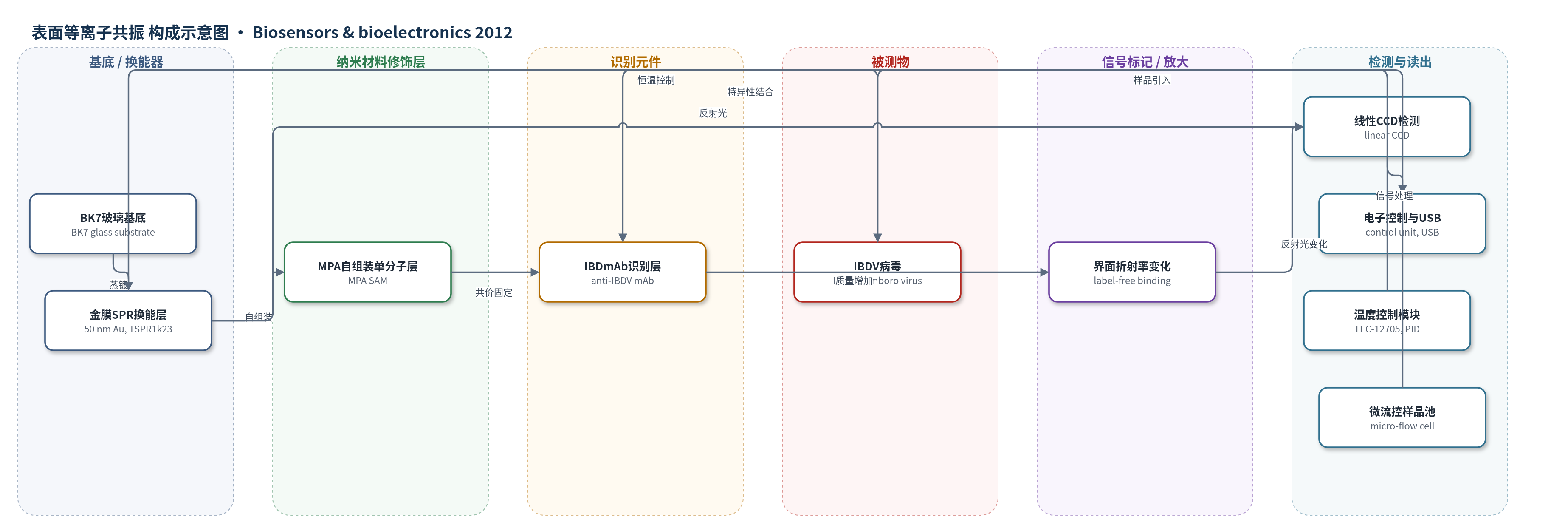
点击图片查看大图 · 依据论文自动绘制
传感器类型
表面等离子共振(SPR)生物传感器
检测对象
传染性法氏囊病病毒(IBDV, infectious bursal disease virus);样品基质:PBS稀释的IBDV标准液、感染鸡组织匀浆上清
检测原理
该传感器采用无标记SPR免疫检测原理。IBDmAb通过MPA自组装层和EDC/NHS共价固定于金膜表面,形成识别层。当含IBDV的样品经微流控池流过芯片时,IBDV与IBDmAb特异性结合,使金膜表面附近质量密度和局部折射率增加。该界面变化改变表面等离子体共振条件,导致反射光强度最小值对应的像素位置移动。线性CCD采集反射光分布,电子控制单元根据像素位置计算响应单位(RU)。IBDV浓度越高,结合量越大,ΔRU越大;在稀释因子100–1600范围内响应与浓度呈线性关系。方法无需荧光或酶标记,也不依赖核酸扩增,直接通过免疫结合事件实现定量读出。
检测灵敏度
LOD: around 2.5 ng/ml (3 S/N);线性范围: dilution factors from 100 to 1600;灵敏度: 63.607 (RU/dilution factor);R^2 = 0.97982
效应效果
系统对IBDV具有良好选择性和现场适用性,可从感染鸡组织匀浆上清中检测IBDV。400倍稀释IBDV重复检测5次,ΔRU为150、141、148、141、137,RSD为3.6%,重现性良好。与商品化IBDV诊断试纸相比,SPR系统可检测至1600倍稀释,而试纸仅能检测至100倍;两者3 S/N检测限分别约为2.5 ng/ml和46 ng/ml,SPR约为试纸的1/18。鸡组织加标回收率为100%–116.66%,背景RSD较小。若芯片预先制备,检测时间不超过30 min,部分浓度区分时间小于20 min。作者认为该方法无标记、非破坏、便携低成本,适合IBDV疫区快速定量监测和防控。
传感器的构成
- 基底/换能器:BK7玻璃基底(BK7 glass substrate)上蒸镀50 nm金膜(Au film),构成SPR换能芯片(TSPR1k23)
- 自组装修饰层:巯基丙酸(MPA, 0.04 M, pH 5.0)通过金-硫相互作用在金膜表面形成自组装单分子层,提供羧基用于抗体固定
- 识别元件:抗IBDV单克隆抗体(IBDmAb)经EDC/NHS活化后与MPA羧基共价结合,特异性识别IBDV
- 封闭剂:乙醇胺-HCl(ethanolamine-HCl, 1 M, pH 8.5)封闭未反应酯基和冗余结合位点
- 样品流路:微流控池(micro-flow cell)与微电阀/微泵(microelectric valve actuator/micro-pump)输送PBS和样品
- 信号标记物:无(label-free),不依赖荧光/酶标记,直接检测免疫结合引起的界面变化
- 读出与控制:线性CCD、光电转换装置、电子控制单元、USB接口及温度控制模块(TEC-12705, PID)用于信号采集、恒温25±0.1°C和数据输出
中文摘要
本文开发了一种基于光学表面等离子共振(SPR)的创新、特异且无标记检测方法,并用于构建可现场快速定量检测传染性法氏囊病病毒(IBDV)的生物分析仪。该分析仪由微流控池、温度调节器、集成生物传感器、光学平台、光电转换装置中的电子控制单元以及通用串行总线(USB)接口电路板组成。检测流程经过系统描述并实验验证。采用自组装技术,通过双功能交联剂使抗IBDV单克隆抗体(IBDmAb)固定于传感器芯片表面。结果表明,IBDV浓度与响应在稀释因子100至1600范围内呈线性关系,R^2为0.97982。该生物芯片可重复检测400倍稀释的IBDV,相对标准偏差(RSD)为3.6%。SPR生物芯片检测限约为IBDV诊断试纸检测限的1/18,回收试验结果令人满意。该方法在IBDV疫区现场检测中具有较大应用潜力,有助于推动有效防控策略的实施。
英文摘要
An innovative, specific and label-free detection approach based on optical surface plasmon resonance (SPR) was developed and employed in the development of a rapid and quantitative bioanalyzer for detecting infectious bursal disease virus (IBDV) in the field. A unique bioanalyzer based on this approach was established which consists of a micro-flow cell, a temperature regulator, an integrated biosensor, an optical platform, an electronic control unit incorporated into a photoelectric conversion device, and a universal serial bus (USB) interface circuit board. The procedure for detecting IBDV was systematically described, and experimentally validated. The self-assembly technology was used to make the IBDmAb adhere to the surface of the sensor chip by a bifunctional cross-linker. By this approach there exhibited a linear relationship between the IBDV concentrations and the corresponding responses in the range of dilution factors from 100 to 1600 with R(2) 0.97982. We were able to detect 400-fold diluted IBDV using this biochip repeatedly with a calculated relative standard deviation (RSD) of 3.6%. We also showed that the detection limit of the SPR biosensor biochip was around 1/18 of the detection limit of the IBDV diagnostic strip. Satisfactory recoveries were obtained from the recovery test. The approach presented here was shown to have great potential to be used in the IBDV epidemic regions and hence help to promote the effective implementation of sound control strategies against IBDV.