组成图示
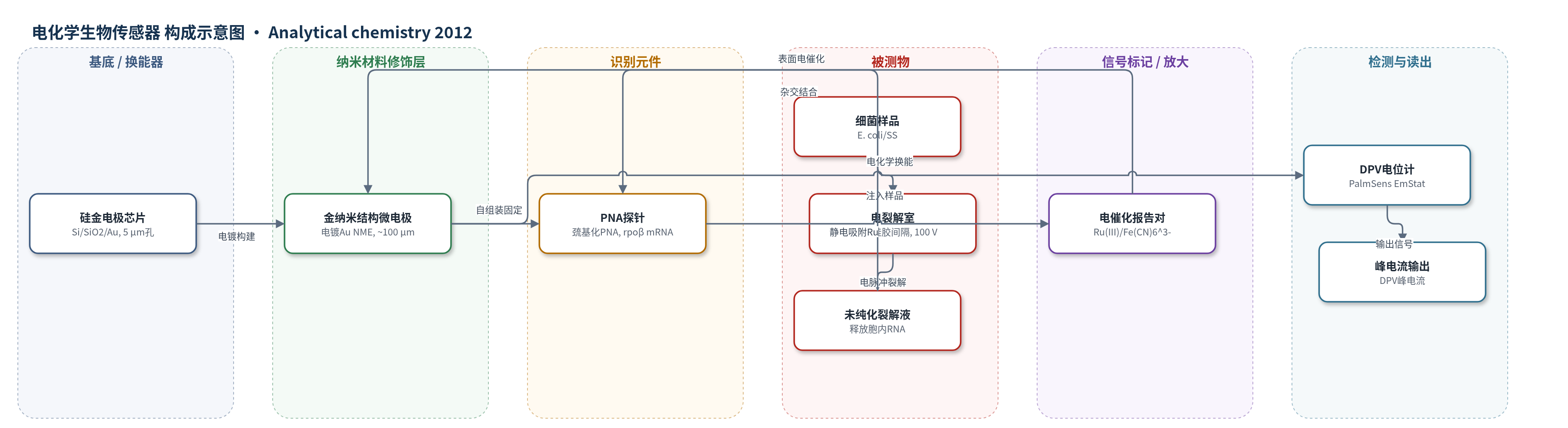
点击图片查看大图 · 依据论文自动绘制
传感器类型
电化学生物传感器
检测对象
大肠杆菌(Escherichia coli, E. coli)、腐生葡萄球菌(Staphylococcus saprophyticus, SS)的胞内rpoβ mRNA;样品基质:缓冲液、尿液(加标)
检测原理
细菌样品注入金电极/硅胶间隔电裂解室,施加100 V、10 ms直流脉冲使细胞破裂,释放胞内rpoβ mRNA。未纯化裂解液与NME芯片上巯基化PNA探针杂交,互补RNA结合后在纳米结构金微电极表面形成带负电核酸层。该核酸层静电吸附六氨合钌(III) Ru(NH3)6^3+。差分脉冲伏安法扫描时,Ru(III)在NME表面还原为Ru(II),溶液中铁氰化物 Fe(CN)6^3-将Ru(II)再氧化为Ru(III),形成电催化循环,产生与表面结合RNA量成正比的峰电流。细菌浓度越高,释放RNA越多,杂交后吸附的Ru(III)越多,电催化电流越大;非互补探针无此信号,实现选择性检测。
检测灵敏度
LOD: 1 cfu/μL
效应效果
平台实现30 min样本到答案,无需PCR和培养。直接检测缓冲液和尿液中未纯化电裂解液,成功识别E. coli和S. saprophyticus,在复杂尿液背景中仍保持特异性。检测限达1 cfu/μL,满足临床相关水平;尿液加标100 cfu/μL可检测,实时模式下约2 min获得阳性结果。多次试验(>6次)峰电流变异系数<20%,显示良好重现性。传感器抗细胞内容物污染,非互补探针背景低,可用于病原菌快速鉴定和分类,将传统培养/PCR诊断从数天缩短至分钟。
传感器的构成
- 基底/换能器电极:硅片(Si)热生长二氧化硅(SiO2)钝化层,500 nm金(Au)层,500 nm SiO2钝化,5 μm孔径暴露Au,构成工作、辅助、参比电极与电化学换能器。
- 纳米材料修饰层:在Au孔内用20 mM HAuCl4/0.5 M HCl电镀金纳米结构微电极(NME),约100 μm,增大表面积并增强电化学信号。
- 识别元件:巯基化肽核酸(PNA)探针,序列特异结合大肠杆菌/腐生葡萄球菌rpoβ mRNA,通过硫醇自组装固定于NME表面。
- 样品处理模块:金片(Au slides)与硅胶间隔(silicone spacer,约500 μm)组成电裂解室,施加100 V、10 ms直流脉冲裂解细菌并释放RNA。
- 信号标记物/电催化报告对:10 μM六氨合钌(III) Ru(NH3)6^3+ 与1 mM铁氰化物 Fe(CN)6^3-(0.1×PBS),Ru(III)静电结合核酸并被还原,Fe(CN)6^3-再氧化Ru(II)产生电流。
- 缓冲介质:25 mM NaCl用于PNA修饰,0.1×PBS用于杂交、洗涤与电化学测量。
- 读出仪器:PalmSens EmStat嵌入式电位计,差分脉冲伏安法(DPV)读取峰电流。
中文摘要
为改善感染病诊断与管理,发展快速、准确、去中心化的细菌病原检测技术具有重要意义。现有临床方法通常依赖耗时的样品培养或聚合酶链反应(PCR),难以在需求点使用。本文报道一种无需PCR的集成平台,将通用细菌电裂解方法与高灵敏纳米结构电化学生物传感器相结合,用于快速检测细菌。该裂解方法快速、有效,可释放细菌样品中的胞内RNA,并能在简单、低成本设备中与分析芯片集成。平台直接检测缓冲液和尿液中的未纯化裂解液,成功以高灵敏度和特异性检测细菌存在,实现30 min的样本到答案时间。其达到临床相关检测限1 cfu/μL,表明未培养样品可直接分析,从而将检测时间从数天缩短至分钟。
英文摘要
An important goal for improved diagnosis and management of infectious disease is the development of rapid and accurate technologies for the decentralized detection of bacterial pathogens. Most current clinical methods that identify bacterial strains require time-consuming culture of the sample or procedures involving the polymerase chain reaction. Neither of these approaches has enabled testing at the point-of-need because of the requirement for skilled technicians and laboratory facilities. Here, we demonstrate the performance of an effective, integrated platform for the rapid detection of bacteria that combines a universal bacterial lysis approach and a sensitive nanostructured electrochemical biosensor. The lysis is rapid, is effective at releasing intercellular RNA from bacterial samples, and can be performed in a simple, cost-effective device integrated with an analysis chip. The platform was directly challenged with these unpurified lysates in buffer and urine. We successfully detected the presence of bacteria with high sensitivity and specificity and achieved a sample-to-answer turnaround time of 30 min. We have met the clinically relevant detection limit of 1 cfu/μL, indicating that uncultured samples can be analyzed. This advance will greatly reduce time to successful detection from days to minutes.