组成图示
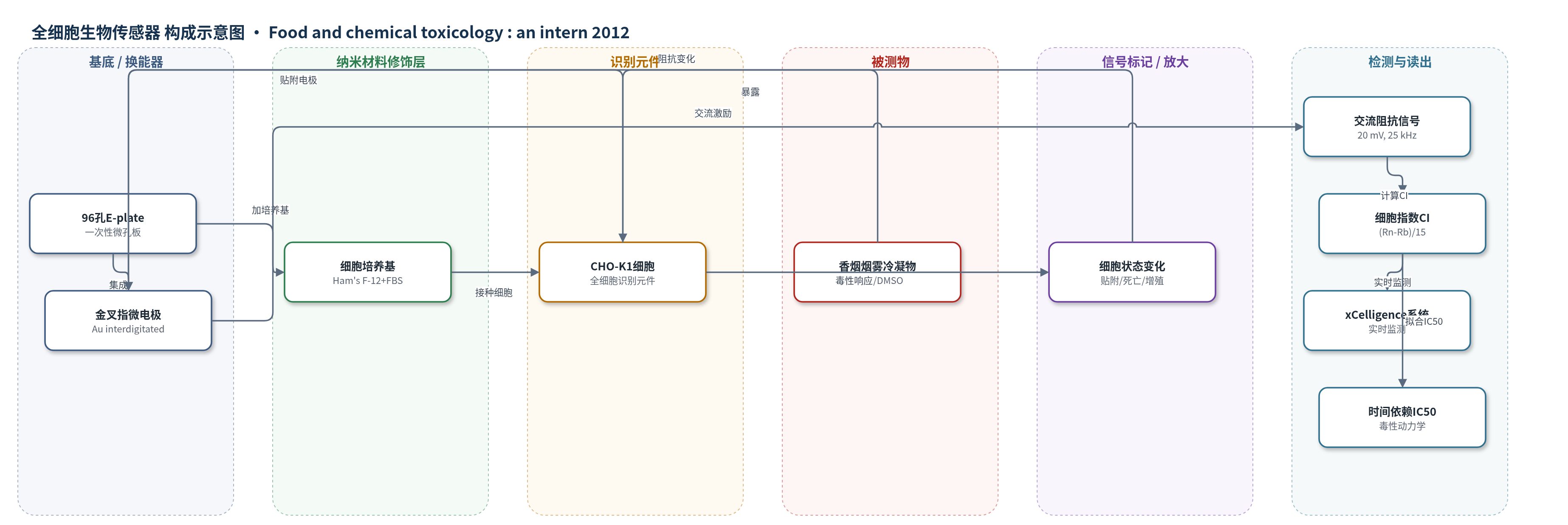
点击图片查看大图 · 依据论文自动绘制
传感器类型
全细胞生物传感器
检测对象
香烟烟雾冷凝物(CSCs, cigarette smoke condensates);样品基质:DMSO 溶解并经细胞培养基稀释的 CSCs 溶液(CHO-K1 细胞培养体系)
检测原理
CHO-K1 细胞接种于 E-plate 96 底部的金叉指微电极上,细胞贴附、铺展和增殖会改变细胞-电极界面的介电特性与离子通道状态,从而改变微电极阻抗。系统施加 20 mV 正弦交流电位,在 25 kHz 下测量阻抗,并以细胞指数 CI=(Rn-Rb)/15 表征细胞状态,其中 Rn 为含细胞孔阻抗,Rb 为仅培养基背景阻抗。加入香烟烟雾冷凝物(CSCs)后,毒性成分损伤细胞膜、抑制增殖或诱导细胞死亡,使细胞-电极界面阻抗下降,CI 随 CSCs 浓度和暴露时间降低。通过连续监测 CI 动力学,可在不同时间点计算 IC50,获得最大毒性、毒性发展速度和可逆性信息。该方法无需标记和酶促放大,依靠全细胞阻抗响应实现实时检测。
检测灵敏度
线性范围: 1000–35,000 cells/well;相关系数 > 0.99;CIB 与 NRU IC50: R^2 = 0.9878
效应效果
CIB 与 NRU 对五种香烟 CSCs 的 24 h IC50 一致,R^2=0.9878;CIB 的 CV 为 0.043、0.054、0.068、0.061、0.057,低于 NRU 的 0.075、0.074、0.103、0.110、0.086,重现性更好。细胞数校准在 1000–35,000 cells/well 线性良好,相关系数 >0.99;5000 cells/well 时 CV<2% 并稳定 4 天。CIB 对 DMSO 更敏感,0.5% 即显著降低活力,NRU 仅 2.0% 显著。时间依赖 IC50 显示 4 h 为 277.73 μg/mL,10 h 后稳定,可识别最大毒性与可逆性。作者认为其无标记、自动、高通量,可替代 NRU 用于香烟毒性评价。
传感器的构成
- 基底/换能器:一次性 96 孔 E-plate 96 微孔板,底部集成金叉指微电极(Au interdigitated microelectrodes),提供阻抗换能
- 识别/响应元件:CHO-K1 中国仓鼠卵巢细胞,接种于微电极表面,其贴附、铺展、增殖和死亡改变电极界面阻抗
- 细胞培养基:Ham's F-12 培养基,含 10% FBS、2 mM L-谷氨酰胺和 1.5 g/L 碳酸氢钠,维持细胞生长并形成背景阻抗
- 被测物/样品:香烟烟雾冷凝物(CSCs, cigarette smoke condensates),以 DMSO 溶解后稀释于培养基中,诱导细胞毒性
- 信号读出:Roche xCelligence 系统,施加 20 mV 正弦交流电位,在 25 kHz 测量阻抗并计算细胞指数 CI
中文摘要
本研究基于细胞阻抗生物传感器(CIB)建立了一种用于表征香烟烟雾冷凝物(CSCs)细胞毒性的体外检测方法。与传统终点式细胞毒性检测相比,该方法无需细胞标记,可自动、连续地监测细胞贴附、铺展、增殖和死亡过程,提供整个实验时间内的实时动力学信息,有助于理解细胞对香烟烟雾冷凝物的动态响应并推测其潜在作用机制。时间依赖的细胞反应曲线可用于优化每孔接种细胞数、进行细胞质量控制,并确定化合物处理和终点检测的最佳时间点。基于不同暴露时间计算的 IC50 值可反映香烟烟雾冷凝物毒性的最大效应及毒性效应的可逆性,而这些信息难以由传统终点检测获得。与常用中性红摄取(NRU)法相比,CIB 法所得 IC50 结果具有良好一致性,且重现性更好。该检测具有无标记、自动化、高通量和操作简便等特点,有望成为评估香烟烟雾冷凝物细胞毒性的常规方法。
英文摘要
In this study, a cytotoxicity assay was developed for profiling the cytotoxicity of cigarette smoke condensates (CSCs) base on a cellular impedance biosensor (CIB). Compared with the traditional in vitro cytotoxicity assays, this CIB-based method offered distinct advantages in real-time kinetic measurement which provided a comprehensive understanding of cellular responses for the entire duration of the experiment and prediction of the potential mechanism of action of a given treatment. The time-dependent cell response profiles provided valid evidences for optimization of cell number per well, cell quality control, and identification of the optimal time points for compound treatment and endpoint assays. According to the time dependent IC50 values, the CIB could provide dynamic information that can be used to identify maximum toxicity of cigarette smoke and reversibility of the toxic effects which are difficult to achieve by the endpoint assays. The comparative IC50 values indicated that the as-developed biosensor offered analytical results in good consistency with the commonly used NRU method. The features of the CIB-based cytotoxicity assay, such as no cell labeling, automatic detection, and easy operation, give this assay potential to become routine setting for evaluating the cytotoxicity of CSCs.