组成图示
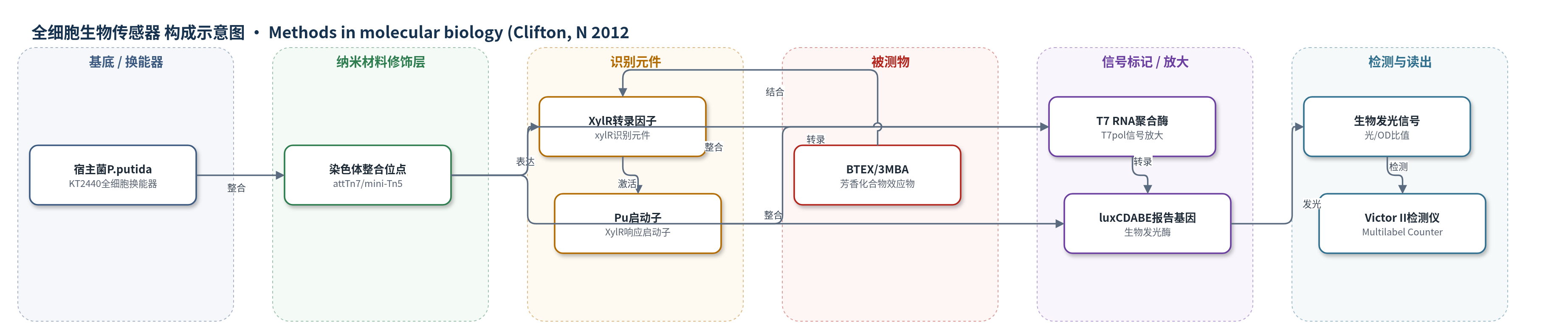
点击图片查看大图 · 依据论文自动绘制
传感器类型
全细胞生物传感器
检测对象
苯(benzene)、甲苯(toluene)、乙苯(ethylbenzene)、二甲苯(xylenes,BTEX)及3-甲基苄醇(3-methylbenzylalcohol, 3MBA,作为BTEX替代物);样品基质:环境样品(土壤/水样)及实验室培养液(LB/M9)。
检测原理
当环境样品中的BTEX或其替代物3MBA进入P. putida细胞后,XylR转录因子结合效应物并发生构象变化,随后激活Pu启动子。Pu启动子驱动T7 RNA聚合酶(T7pol)基因表达;T7pol进一步识别并转录位于PT7启动子下游的luxCDABE操纵子。Lux酶系催化细胞内底物氧化还原反应,产生生物发光。由于T7pol介导的二级转录放大,相同诱导物浓度下luxCDABE表达量高于直接Pu-lux融合,发光信号随芳香化合物浓度升高而增强,最终通过光/OD600比值读出。
检测灵敏度
未报告LOD、线性范围、灵敏度斜率或R^2。
效应效果
该工程菌将传感模块与报告基因稳定整合于染色体,并通过ParA/res和FLP/FRT位点特异性重组删除Kan、Gm等抗生素抗性标记,满足环境释放要求。在1 mM 3MBA诱导下,菌株产生明显生物发光;未诱导时发光低于检测阈值。与直接Pu-luxCDABE融合菌株相比,T7 RNA聚合酶级联使不同生长阶段的发光输出提高5–10倍,增强了信号/响应比。平台可通过替换pTn7-FRT中的转录因子/启动子模块扩展至其他环境刺激。文中未报告RSD、实际样品回收率或与ELISA/HPLC/qPCR的定量对比。
传感器的构成
- 宿主/换能器:Pseudomonas putida KT2440 全细胞,作为生物发光换能器与遗传回路载体
- 识别元件:XylR 转录调控因子(xylR),结合3MBA、甲苯、间二甲苯等BTEX效应物
- 识别启动子:Pu 启动子,受XylR激活并驱动下游T7 RNA聚合酶表达
- 信号放大元件:T7 RNA聚合酶(T7pol),由Pu启动子诱导表达,识别PT7启动子
- 报告基因:luxCDABE 操纵子,位于T7启动子(PT7)下游,产生生物发光
- 遗传整合层:mini-Tn5/mini-Tn7 转座子与attTn7位点,将回路稳定整合至染色体并删除抗生素标记
- 读出系统:Victor II 1420 Multilabel Counter,测量生物发光强度并除以OD600
中文摘要
合成生物学的核心之一是工程化基因调控网络。通过理性重构调控系统组分,可将环境刺激转化为可量化的荧光或发光输出,从而构建全细胞生物传感器。针对BTEX(苯、甲苯、乙苯和二甲苯)的检测,已有传感器多基于Pseudomonas putida mt-2 TOL途径的主要转录调控因子XylR及其Pu启动子;在间二甲苯、甲苯或3-甲基苄醇等效应物存在时,XylR激活Pu启动子驱动luxCDABE发光报告基因。本文描述一种无抗生素标记、可稳定整合于P. putida染色体的新平台,利用mini-transposon构建T7 RNA聚合酶级联放大回路:Pu启动子驱动T7 RNA聚合酶,后者再激活PT7启动子控制的luxCDABE操纵子。该简单调控架构使生物发光输出较直接Pu-lux融合显著提高,增强了传感器对XylR诱导物的响应,适用于环境芳香化合物的监测。
英文摘要
A cornerstone of Synthetic Biology is the engineering of gene regulatory networks. Construction of such biological circuits has been used not only to elucidate the dynamics of gene expression but also for designing whole-cell biosensors that translate environmental signals into quantifiable outputs. To this end, distinct components of given regulatory systems are rationally rewired in a way that translates an external stimulus (for instance, the presence of one chemical species) into a measurable readout typically fluorescence or luminescence. Various biosensors for BTEX (a mixture of benzene, toluene, ethylbenzene and xylenes) are based on XylR, the main transcriptional regulator of the TOL pathway of Pseudomonas putida mt-2. In the presence of its natural effectors (e.g., m-xylene, toluene or 3-methylbenzylalcohol), XylR triggers expression of the upper pathway genes by means of the Pu promoter. Available biosensors combine the xylR gene and a direct fusion between the cognate Pu promoter and the luxCDABE operon, all components stably integrated in the chromosome of P. putida. A versatile development of the same biosensing concept is described, aimed at increasing the sensitivity of the genetic circuit toward XylR inducers. The new platform utilizes mini-transposon vectors tailored for engineering an artificial expression cascade that operates as an amplifier of the signal/response ratio of the biosensor. This strategy was applied to the construction of a strain that carries a transcriptional fusion between the Pu promoter and T7 RNA polymerase (which becomes under the control of XylR and its effectors), along with a T7 promoter controlling expression of the luxCDABE operon. This simple regulatory architecture produced a dramatic increase of bioluminescence emission in respect to the strain that carries only the direct fusion between the Pu promoter and the luxCDABE reporter.