组成图示
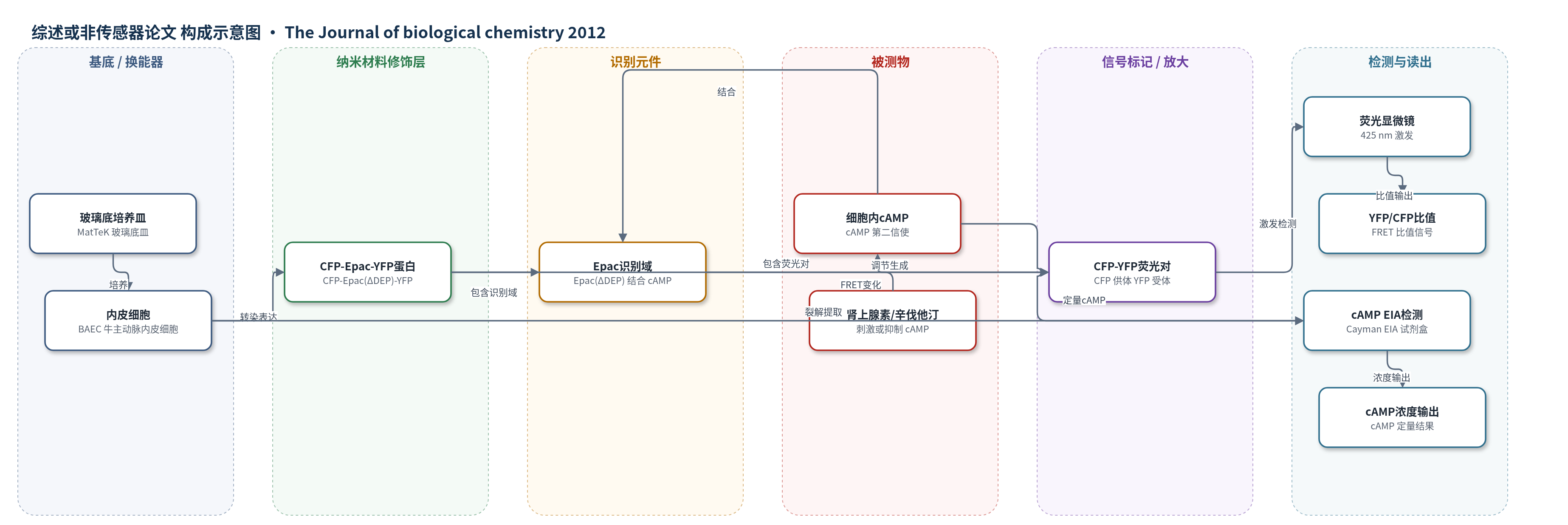
点击图片查看大图 · 依据论文自动绘制
传感器类型
综述或非传感器论文
检测对象
细胞内 cAMP(cAMP;样品基质:牛主动脉内皮细胞 BAEC 活细胞及裂解液)、Gαs 蛋白(Gαs;样品基质:内皮细胞/主动脉组织裂解液)、VASP Ser157 磷酸化(pVASP157;样品基质:内皮细胞裂解液)、Rap1 活性(Rap1-GTP;样品基质:内皮细胞裂解液)、血管舒张反应(isoproterenol-induced vasorelaxation;样品基质:小鼠股动脉离体血管)
检测原理
文中核心检测使用 CFP-Epac(ΔDEP)-YFP cAMP FRET 生物传感器。β3-肾上腺素受体被肾上腺素激活后,通过 Gαs 激活腺苷酸环化酶,使细胞内 cAMP 升高;cAMP 与 Epac(ΔDEP) 结合后引起融合蛋白构象变化,CFP 向 YFP 的 FRET 效率降低,YFP/CFP 比值下降,从而实时反映 cAMP 水平。辛伐他汀抑制 HMG-CoA 还原酶,减少 GGpp 等异戊二烯供体,经 Akt/mTOR/eIF4/4EBP 通路抑制 Gαs 翻译,降低 Gαs 丰度,使受体-cAMP 信号减弱。cAMP EIA 试剂盒则通过细胞裂解、乙醇提取和酶免疫分析定量 cAMP,与 FRET 结果互补。
检测灵敏度
原文未报告 LOD、线性范围、灵敏度斜率或相关系数。
效应效果
体内实验中,辛伐他汀使小鼠异丙肾上腺素血管舒张曲线右移,最大舒张由 36.3±3.7% 降至 24.1±6.2%(p<0.001,n=9),而卡巴胆碱舒张和内皮素收缩不受影响,显示 β-肾上腺素能选择性。细胞实验中,辛伐他汀使肾上腺素诱导 VASP Ser157 磷酸化 EC50 由 0.9±0.1 nM 增至 9.0±0.2 nM(p<0.05,n=3),并阻断 Rap1 激活;cAMP 降低约 2 倍。Gαs 降低 80±10%(p<0.05,n=3),可被甲羟戊酸或 GGpp 逆转,Fpp 不能逆转;平滑肌细胞 Gαs 不受影响。Gαs 半衰期 7.8 与 8.2 h 无差异,mRNA 升高 2.5 倍。FRET 与 EIA 相互验证。作者认为该机制可解释他汀非降脂心血管效应,并提示其与 β 受体阻滞剂可能存在相互作用。
传感器的构成
- 论文性质:非传感器论文,未报道新传感器,仅应用已有 cAMP FRET 生物传感器
- 基底/培养载体:玻璃底细胞培养皿(MatTeK)与牛主动脉内皮细胞(BAEC),承载细胞并支持荧光成像
- 识别元件:CFP-Epac(ΔDEP)-YFP 中的 Epac(ΔDEP) 结构域,结合细胞内 cAMP
- 信号标记物:CFP 供体与 YFP 受体荧光蛋白对,cAMP 结合后 FRET 降低
- 读出装置:荧光显微镜与 Semrock FRET-CFP/YFP-B 滤光片组(425 nm 激发;475±10 nm CFP、540±10 nm YFP 发射),输出 YFP/CFP 比值
- 辅助检测:cAMP EIA 试剂盒(Cayman),用于生化定量细胞 cAMP
中文摘要
本研究探讨辛伐他汀对血管内皮细胞 cAMP 依赖性 β-肾上腺素能信号的影响。此前发现辛伐他汀处理内皮细胞可显著降低 PKA 介导的 VASP Ser157 磷酸化。作者发现,小鼠长期辛伐他汀处理使异丙肾上腺素诱导的血管舒张减弱,但不影响内皮素诱导的血管收缩或卡巴胆碱诱导的血管舒张。在内皮细胞中,辛伐他汀剂量依赖地抑制 PKA 激活和 Epac 介导的 Rap1 激活,且这些效应可被甲羟戊酸和 GGpp 完全逆转,提示异戊二烯化修饰是关键环节。利用 cAMP FRET 生物传感器和生化检测显示,辛伐他汀显著抑制肾上腺素诱导的细胞内 cAMP 积累。进一步发现,辛伐他汀选择性降低 Gαs 蛋白丰度,而不影响其他 Gα 亚基;Gαs 蛋白稳定性不变,mRNA 水平反而升高。机制上,辛伐他汀通过抑制 Akt/mTOR/eIF4/4EBP 通路抑制 Gαs 翻译。这些结果揭示了辛伐他汀通过降低 Gαs 丰度调节血管内皮 β-肾上腺素能信号的新机制,可能解释其独立于降脂的心血管治疗作用。
英文摘要
These studies explore the effects of statins on cyclic AMP-modulated signaling pathways in vascular endothelial cells. We previously observed (Kou, R., Sartoretto, J., and Michel, T. (2009) J. Biol. Chem. 284, 14734-14743) that simvastatin treatment of endothelial cells leads to a marked decrease in PKA-modulated phosphorylation of the protein VASP. Here we show that long-term treatment of mice with simvastatin attenuates the vasorelaxation response to the β-adrenergic agonist isoproterenol, without affecting endothelin-induced vasoconstriction or carbachol-induced vasorelaxation. We found that statin treatment of endothelial cells dose-dependently inhibits PKA activation as assessed by analyses of serine 157 VASP phosphorylation as well as Epac-mediated Rap1 activation. These effects of simvastatin are completely reversed by mevalonate and by geranylgeranyl pyrophosphate, implicating geranylgeranylation as a critical determinant of the stain response. We used biochemical approaches as well as fluorescence resonance energy transfer (FRET) methods with a cAMP biosensor to show that simvastatin treatment of endothelial cells markedly inhibits cAMP accumulation in response to epinephrine. Importantly, simvastatin treatment significantly decreases Gα(s) abundance, without affecting other Gα subunits. Simvastatin treatment does not influence Gα(s) protein stability, and paradoxically increases the abundance of Gα(s) mRNA. Finally, we found that simvastatin treatment inhibits Gα(s) translation mediated by Akt/mTOR/eIF4/4EBP. Taken together, these findings establish a novel mechanism by which simvastatin modulates β-adrenergic signaling in vascular wall, and may have implications for cardiovascular therapeutics.