组成图示
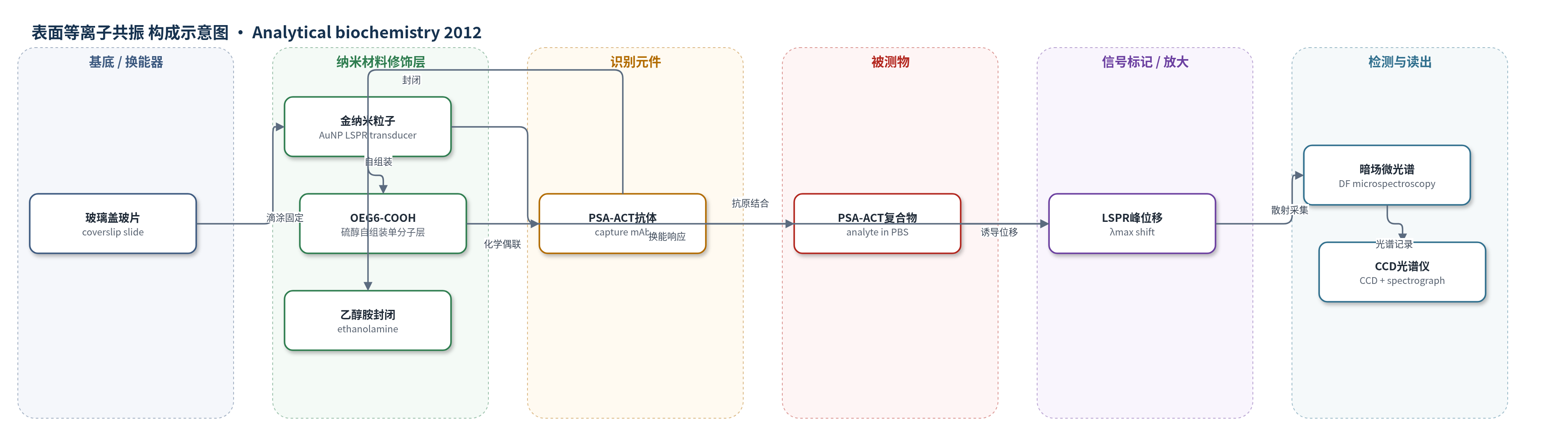
点击图片查看大图 · 依据论文自动绘制
传感器类型
表面等离子共振(SPR)生物传感器
检测对象
前列腺特异性抗原-α1-抗糜蛋白酶复合物(PSA-ACT complex),样品基质为 PBS 缓冲液(pH 7.4);非特异结合测试涉及 BSA、IgG、纤维蛋白原(人血清常见蛋白)。
检测原理
传感器以单个金纳米粒子(AuNP)作为局域表面等离子共振(LSPR)换能器。AuNP 表面经 OEG6-COOH 硫醇自组装层修饰,并通过 EDC/NHS 化学偶联 PSA-ACT 单克隆抗体作为识别元件。当 PBS 中的 PSA-ACT 复合物与捕获抗体结合时,AuNP 表面附近介电环境/折射率升高,导致 LSPR 共振峰向长波方向移动。粒径越小,电磁场越局域,单位结合分子引起的相对折射率变化越大,因此 21 nm AuNP 峰移最大、灵敏度最高;43 和 81 nm AuNP 峰移较小但饱和浓度更高,可覆盖更高浓度。暗场微光谱系统采集单个 AuNP 的共振瑞利散射光谱,经 Lorentzian 拟合得到 λmax,并以结合前后峰位差 Δλmax 定量分析物浓度。该方法无标记、无酶放大,依靠单颗粒低背景散射和 LSPR 折射率敏感性实现检测。
检测灵敏度
LOD: 0.1 pg/ml;线性范围: 10^-4 to 10 ng/ml(总范围);21 nm: 10^-4 to 10^-1 ng/ml;43 nm: 10^-3 to 100 ng/ml;81 nm: 10^-2 to 10^1 ng/ml;斜率: 3.690 nm/(ng/ml)(21 nm)、2.993 nm/(ng/ml)(43 nm)、2.170 nm/(ng/ml)(81 nm);R^2 = 0.994(21 nm)、0.993(43 nm)、0.994(81 nm);0.1 pg/ml 对应 LSPR kmax shift 约 2.95 nm
效应效果
在 21 nm AuNP 传感器上,0.1 ng/mL 的 BSA、IgG 和纤维蛋白原等非目标蛋白仅引起小于 1.0 nm 的 LSPR 峰移,显著低于 PSA-ACT 特异性结合响应,表明乙醇胺封闭后非特异吸附可忽略,选择性良好。四种重复实验以误差棒表示相对标准偏差,但原文未给出具体 RSD 数值。21 nm AuNP 的 LOD 为 0.1 pg/mL,对应约 2.95 nm 峰移;总线性范围为 10^-4–10 ng/mL。与商用 PSA 检测(0.05–0.005 ng/mL)、SPR(0.15–18.1 ng/mL)、表面等离子荧光(3 pg/mL)和免疫 PCR(0.1 pg/mL)相比,作者认为该单颗粒 LSPR 平台具有超灵敏、无标记、简单、稳健和宽动态范围优势,可用于多种疾病相关蛋白及生物相互作用检测。
传感器的构成
- 基底:玻璃盖玻片(coverslip slide, 22×40×0.1 mm),用于滴涂固定 AuNPs 并提供暗场成像支撑。
- 换能器:球形金纳米粒子(AuNPs, 平均直径约21.1±1.9、42.9±4.1、81.2±6.2 nm),通过静电吸附固定于玻璃表面,作为 LSPR 光学换能器。
- 修饰层:OEG6-COOH(HS(CH2)11(OCH2CH2)6OCH2COOH)硫醇自组装单分子层,修饰 AuNP 表面并提供羧基偶联位点。
- 识别元件:PSA-ACT 单克隆抗体(PSA-ACT mAb),经 EDC/NHS 活化后偶联至 OEG6-COOH 末端,特异性捕获 PSA-ACT 复合物。
- 封闭层:乙醇胺(ethanolamine, 0.2 M),封闭未反应羧基,降低非特异蛋白吸附。
- 读出系统:暗场微光谱系统(dark-field microspectroscopy,含 100 W 钨灯、暗场聚光镜、100×物镜、光谱仪和 CCD),采集单个 AuNP 的共振瑞利散射光谱并计算 LSPR 峰位位移。
中文摘要
本文报道利用不同尺寸单颗粒金纳米粒子(AuNPs)的等离子体响应分析生物分子识别,并描述粒径与受体及目标分析物结合所诱导等离子体响应之间的关系。为研究 AuNPs 的等离子体响应,采用暗场微光谱系统采集单个 AuNP 的瑞利散射光谱。以前列腺特异性抗原(PSA)为模型,获得 10^-4 至 10 ng/mL 的线性动态范围,最低可检测浓度为 0.1 pg/mL,对应局域表面等离子共振(LSPR)最大波长移动约 2.95 nm。该结果表明,单个 AuNP 可用于开发非常灵敏、稳健、简单且无标记的生物传感器,以检测蛋白质生物标志物。此外,该方法在监测其他生物相互作用方面具有很大潜力。
英文摘要
We report the use of plasmonic responses of single gold nanoparticles (AuNPs) with various sizes for the analysis of biomolecular recognition. We also describe the relationship between particle size and plasmonic response induced by the binding of receptors and target analytes. To investigate the plasmonic response of AuNPs, Rayleigh light scattering spectra were collected from individual AuNPs using a dark-field microspectroscopy system. Using prostate-specific antigen (PSA) as a model, the linear dynamic range was obtained in the concentration range of 10(-4) to 10 ng/ml, with the smallest detectable concentration at 0.1 pg/ml corresponding to localized surface plasmon resonance (LSPR) λ(max) shifts of approximately 2.95 nm. This result indicates that individual AuNPs can be used for development of a very sensitive, robust, simple, and label-free biosensor to detect protein biomarkers. Furthermore, the method possesses great potential for monitoring other biological interactions.