组成图示
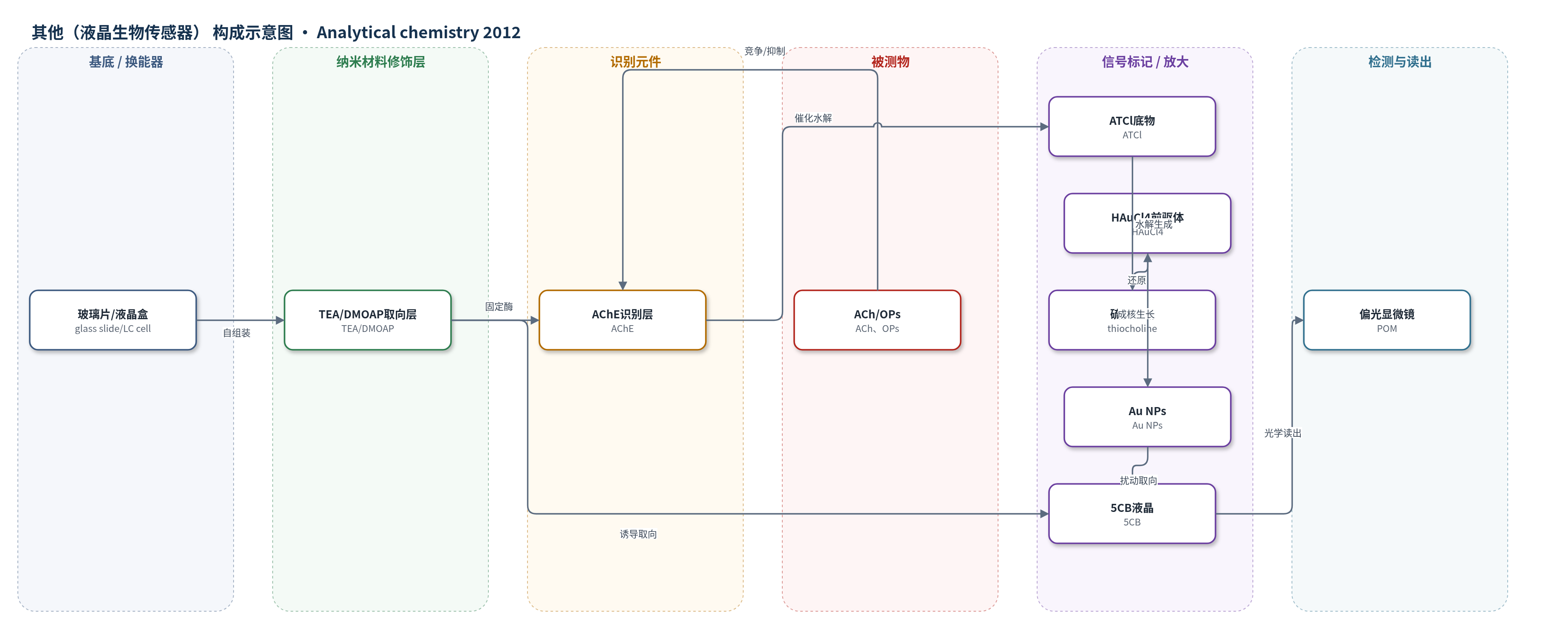
点击图片查看大图 · 依据论文自动绘制
传感器类型
其他(液晶生物传感器)
检测对象
乙酰胆碱(ACh)、有机磷农药(OPs,马拉硫磷 malathion);样品基质:PBS缓冲液/标准溶液
检测原理
传感器以玻璃片为基底,TEA/DMOAP自组装层诱导5CB液晶垂直取向,AChE通过醛胺反应固定于该层。检测时,AChE催化ATCl水解生成硫代胆碱,硫代胆碱将HAuCl4还原为Au NPs,即生物金属化。原位生成的Au NPs显著改变表面形貌,使5CB由垂直取向转为倾斜/马赛克取向,交叉偏振下出现双折射亮纹。ACh与ATCl竞争结合AChE,或OPs不可逆磷酸化AChE活性位点,均抑制ATCl水解,减少Au NPs生成,双折射纹理减弱。因此,被测物浓度越高,光学信号越弱,实现负相关检测。
检测灵敏度
LOD: 15 μmol/L (ACh);LOD: 0.3 nmol/L (OPs)
效应效果
该传感器具有可视化输出、无需电源和分子标记、操作简便等特点。对ACh的检出限为15 μmol/L,对OPs的检出限为0.3 nmol/L,作者认为其OPs检测灵敏度与近期电化学OPs传感器相当。重复性方面,对ACh(15 μmol/L–1.5 mmol/L)和OPs(0.3–3000 nmol/L)三次重复测量,相同浓度双折射纹理相似,重现性良好。稳定性方面,液晶盒室温储存数天后双折射纹理无明显变化。文中未报告实际样品加标回收率、选择性矩阵或与ELISA/HPLC/qPCR的直接对比,但强调该方法是首个基于LC酶传感检测ACh和AChE抑制剂的示例,并提供有效信号放大策略。
传感器的构成
- 基底/换能器:玻璃片(glass slide)与液晶盒(LC cell),承载取向层并容纳液晶介质
- 取向修饰层:TEA/DMOAP自组装单分子层(thiethoxysilybutylaldehyde/N,N-dimethyl-N-octadecyl(3-aminopropyl) trimethoxysilyl chloride),诱导5CB垂直取向并提供醛基
- 识别元件:乙酰胆碱酯酶(AChE),通过氨基与TEA/DMOAP醛基结合固定,催化ATCl水解
- 底物/前驱体:乙酰硫代胆碱(ATCl)与氯金酸(HAuCl4),ATCl被水解后生成还原剂,HAuCl4被还原为Au NPs
- 信号放大元件:金纳米颗粒(Au NPs),由生物金属化原位生成,改变表面形貌并扰动液晶取向
- 光学换能介质:5CB液晶(5CB),其取向变化在交叉偏振下产生双折射光学信号
- 读出装置:偏光显微镜/交叉偏振器(POM/cross polarizer),观察双折射纹理变化
中文摘要
本文报道了一种基于金纳米颗粒酶促生长的乙酰胆碱酯酶(AChE)液晶(LC)生物传感器,用于放大检测乙酰胆碱(ACh)和AChE抑制剂。该方法中,AChE催化乙酰硫代胆碱(ATCl)水解生成硫代胆碱,后者无需金纳米种子即可将AuCl4−还原为金纳米颗粒(Au NPs)。这一生物金属化过程因Au NPs尺寸较大,可显著破坏液晶分子的取向排列,从而大幅增强LC生物传感器光学信号。另一方面,ACh或有机磷农药(OPs,AChE抑制剂)存在时,ATCl水解受到抑制,Au NPs催化生长减少,液晶取向响应降低。基于该抑制机制,该AChE LC生物传感器可有效检测ACh和AChE抑制剂。结果显示,传感器对ACh的检出限为15 μmol/L,对OPs的检出限为0.3 nmol/L。该研究提供了一种简单、灵敏的AChE LC生物传感方法,并为酶LC生物传感器的信号增强策略提供了有效途径。
英文摘要
A novel acetylcholinesterase (AChE) liquid crystal (LC) biosensor based on enzymatic growth of gold nanoparticles (Au NPs) has been developed for amplified detection of acetylcholine (ACh) and AChE inhibitor. In this method, AChE mediates the hydrolysis of acetylthiocholine (ATCl) to form thiocholine, and the latter further reduces AuCl(4)(-) to Au NPs without Au nanoseeds. This process, termed biometallization, leads to a great enhancement in the optical signal of the LC biosensor due to the large size of Au NPs, which can greatly disrupt the orientational arrangement of LCs. On the other hand, the hydrolysis of ATCl is inhibited in the presence of ACh or organophosphate pesticides (OPs, a AChE inhibitor), which will decrease the catalytic growth of Au NPs and, as a result, reduce the orientational response of LCs. On the basis of such an inhibition mechanism, the AChE LC biosensor can be used as an effective way to realize the detection of ACh and AChE inhibitors. The results showed that the AChE LC biosensor was highly sensitive to ACh with a detection limit of 15 μmol/L and OPs with a detection limit of 0.3 nmol/L. This study provides a simple and sensitive AChE LC biosensing approach and offers effective signal enhanced strategies for the development of enzyme LC biosensors.