组成图示
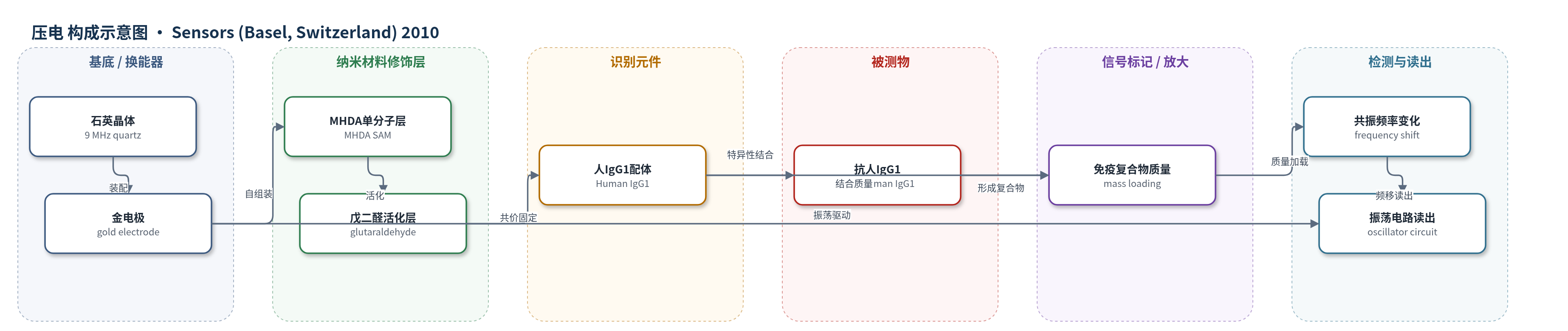
点击图片查看大图 · 依据论文自动绘制
传感器类型
压电(QCM)生物传感器
检测对象
抗人免疫球蛋白 G1(Anti-Human IgG1,PBS 缓冲液);人免疫球蛋白 G1(Human IgG1,PBS 缓冲液,固定配体)
检测原理
传感器以金电极表面固定的人 IgG1 为识别元件。PBS 中 Anti-Human IgG1 随流动到达反应面,与 Human IgG1 发生特异性抗原-抗体结合,形成复合物。结合事件使 QCM 表面质量增加,根据 Sauerbrey 方程,石英晶体共振频率下降,频移大小与表面结合质量成正比。由于微通道中分析物受对流扩散和层流入口浓度分布影响,表面浓度低于本体浓度,结合速率受传质限制;高浓度或足量样品时表面位点饱和,频移达到平台,低浓度或样品量不足时平台较低且随时间下降。通过监测频移-时间曲线可反映结合动力学和浓度变化。
检测灵敏度
原文未报告 LOD、线性范围、灵敏度斜率或相关系数。
效应效果
实验在 PBS 中测试 50、25、10、5 μg/mL Anti-Human IgG1 和 800、500、100 μL 样品量,频移随浓度和样品量增加而增大。50 μg/mL、800 μL 时约 600 s 达到饱和;100 μL 时最大频移仅为 800 μL 的 83%,5 μg/mL 时仅为 25%,说明传质和样品量显著影响响应。甘氨酸封闭用于降低非特异性结合,但论文未报告 RSD、回收率或稳定性数据。作者通过校准动力学分析获得 ka≈8×10^4 M^-1 s^-1、kd=7.17×10^-4 s^-1、KD=8.97×10^-9 M,使三维有限元模拟与实验曲线在初始斜率、饱和时间和最大频移上更一致,支持 QCM 用于实时免疫结合监测。
传感器的构成
- 基底/换能器:9 MHz 石英晶体(quartz crystal),夹于两金电极之间,通过压电振荡将表面质量变化转换为频率变化
- 金电极:gold electrode,上金电极作为反应表面并承载识别层
- 自组装单分子层:16-巯基十六烷酸(MHDA, 16-mercaptohexadecanoic acid)SAM,提供连接臂用于固定配体
- 活化层:2.5% 戊二醛(glutaraldehyde)PBS 溶液,活化连接臂以共价固定 Human IgG1
- 识别元件:人免疫球蛋白 G1(Human IgG1, I5154, Sigma),固定于反应面,特异性结合 Anti-Human IgG1
- 封闭剂:1 M 甘氨酸(glycine)PBS 溶液,封闭未结合连接臂,减少非特异性结合
- 流路系统:蠕动泵、注射阀、样品环、输送管和微通道,以 50 μL/min 输送 PBS 和分析物
中文摘要
本文研究一种基于石英晶体微天平(QCM)的免疫传感检测方法,用于在生理条件下检测人免疫球蛋白 G1(Human IgG1)与抗人 IgG1(Anti-Human IgG1)蛋白对的特异性结合反应。除实验研究外,作者采用三维时域有限元方法(FEM)对微流道中的生物分子结合反应进行模拟,特别讨论输送管中的非稳态对流扩散过程;该输送管将含有分析物分子的缓冲液输送至放置 QCM 传感器的微通道。研究发现,输送管中分析物浓度分布受流场强烈影响,导致模拟结果与实验结果出现较大差异。分析表明,传统上假设微通道入口分析物浓度均匀且不随时间变化的做法并不充分。此外,常用动力学分析从实验数据估计结合速率常数时,由于忽略从入口到反应表面的扩散过程,会低估这些速率常数。为此,作者提出一种校准程序,以补充基本动力学分析,从而获得与实验更好一致的结果。
英文摘要
We investigate a immunoassay biosensor that employs a Quartz Crystal Microbalance (QCM) to detect the specific binding reaction of the (Human IgG1)-(Anti-Human IgG1) protein pair under physiological conditions. In addition to experiments, a three dimensional time domain finite element method (FEM) was used to perform simulations for the biomolecular binding reaction in microfluidic channels. In particular, we discuss the unsteady convective diffusion in the transportation tube, which conveys the buffer solution containing the analyte molecules into the micro-channel where the QCM sensor lies. It is found that the distribution of the analyte concentration in the tube is strongly affected by the flow field, yielding large discrepancies between the simulations and experimental results. Our analysis shows that the conventional assumption of the analyte concentration in the inlet of the micro-channel being uniform and constant in time is inadequate. In addition, we also show that the commonly used procedure in kinetic analysis for estimating binding rate constants from the experimental data would underestimate these rate constants due to neglected diffusion processes from the inlet to the reaction surface. A calibration procedure is proposed to supplement the basic kinetic analysis, thus yielding better consistency with experiments.