组成图示
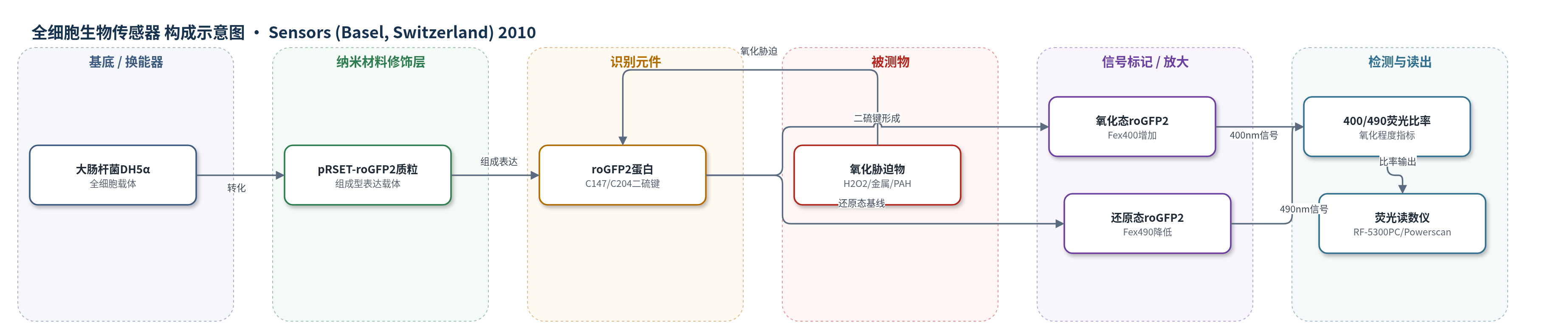
点击图片查看大图 · 依据论文自动绘制
传感器类型
全细胞生物传感器
检测对象
过氧化氢(H2O2)、甲萘醌(menadione)、亚硒酸钠(sodium selenite/SeO3^2−)、吡硫鎓锌(zinc pyrithione/ZnPT)、三苯基锡(triphenyltin/TPT)、萘(naphthalene)、镉(Cd2+)、铜(Cu2+)、铅(Pb2+)、锌(Zn2+)、亚砷酸钠(sodium arsenite/AsO2−);样品基质:水溶液/环境样品(Milli-Q水或DMSO稀释后加入细胞悬浮液)
检测原理
氧化胁迫物进入大肠杆菌后,通过产生 ROS、消耗 GSH 或直接配位巯基改变胞内氧化还原电位。组成型表达的 roGFP2 中 C147 与 C204 两个关键半胱氨酸在氧化条件下形成二硫键,使发色团周围电子/构象环境改变,激发光谱由还原态 490 nm 向氧化态 400 nm 移动。仪器同时读取 Fex400 与 Fex490,计算 Fex400/Fex490 比率;比率随氧化程度和毒物浓度升高而增大。双波长比率法可抵消蛋白浓度、光漂白和细胞厚度差异。重金属还可通过与半胱氨酸/GSH 配位直接干扰 roGFP2 构象,导致不规则动力学。该策略未采用 HCR/RCA 等核酸放大,而依赖全细胞代谢与组成型高表达蛋白实现快速、近实时氧化信号读出。
检测灵敏度
LOEC(原文报告,ppm): 1.0 × 10⁻⁷ (arsenite), 1.0 × 10⁻⁴ (naphthalene), 1.0 × 10⁻⁴ (Cu2+), 3.8 × 10⁻⁴ (H2O2), 1.0 × 10⁻³ (Cd2+), 1.0 × 10⁻³ (Zn2+), 1.0 × 10⁻² (menadione), 1.0 (triphenyltin), 1.56 (zinc pyrithione), 3.1 (selenite) and 6.3 (Pb2+)
效应效果
该传感器 96 孔板每 30 s 测量,10 s 可检出,多数化合物 80–210 s 达最大,较传统基因诱导细菌传感器更快。LOEC(ppm):AsO2− 1.0×10⁻⁷、naphthalene/Cu2+ 1.0×10⁻⁴、H2O2 3.8×10⁻⁴、Cd2+/Zn2+ 1.0×10⁻³、menadione 1.0×10⁻²、TPT 1.0、ZnPT 1.56、SeO3^2− 3.1、Pb2+ 6.3。H2O2、menadione、SeO3^2−、AsO2−、ZnPT、TPT、naphthalene 呈 S 形;Cd2+、Cu2+、Pb2+、Zn2+ 因巯基配位不规则。GSH 实验显示 Cd2+、Pb2+、menadione 分别降低 4.0–16.8%、16.8–14.2%、16.8–24.0%。未报告 RSD、加标回收率及 ELISA/HPLC/qPCR 对比;作者认为可用于环境水样/生态毒理高通量筛查。
传感器的构成
- 细胞基底/换能器:大肠杆菌 DH5α 全细胞,作为生物识别与信号转导载体,维持胞内氧化还原环境
- 遗传表达元件:质粒 pRSET-roGFP2,携带 roGFP2 基因,实现组成型表达;氨苄青霉素维持质粒
- 识别/传感元件:roGFP2 氧化还原敏感绿色荧光蛋白(C48S/S147C/Q204C/S65T/Q80R),关键半胱氨酸 C147/C204 形成二硫键,响应氧化还原电位变化
- 信号标记/读出:roGFP2 荧光比率(400/490 nm 激发,525/528 nm 发射),氧化态 Fex400 增加、还原态 Fex490 降低
- 样品/缓冲基质:5 mM HEPES 缓冲液含 171 mM NaCl(pH 7.0)或 50 mM HEPES pH 7.9/300 mM NaCl/10% glycerol,用于细胞悬浮和荧光测量
- 检测仪器:RF-5300PC 荧光分光光度计或 Powerscan HT 多检测微孔板读数仪,双波长比率读出
中文摘要
本研究利用大肠杆菌组成型表达的氧化还原敏感绿色荧光蛋白 roGFP2,构建高特异性、高通量化学诱导细胞氧化细菌生物传感器(E. coli-roGFP2)。通过双波长比率法评估 roGFP2 两个关键半胱氨酸残基间二硫键形成。与传统细菌氧化应激传感器相比,该传感器仅需数分钟即可检测氧化。过氧化氢、甲萘醌、亚硒酸钠、吡硫鎓锌、三苯基锡和萘诱导的氧化在 10 s 后可检出,80–210 s 达最大;Cd2+、Cu2+、Pb2+、Zn2+ 和亚砷酸钠则立即达最大。最低可观察效应浓度(ppm)为:亚砷酸盐 1.0×10⁻⁷、萘 1.0×10⁻⁴、Cu2+ 1.0×10⁻⁴、H2O2 3.8×10⁻⁴、Cd2+ 1.0×10⁻³、Zn2+ 1.0×10⁻³、甲萘醌 1.0×10⁻²、三苯基锡 1.0、吡硫鎓锌 1.56、亚硒酸盐 3.1、Pb2+ 6.3。重金属响应模式不清晰,其他化合物呈浓度依赖 S 形曲线。体内 GSH 与体外 roGFP2 氧化实验表明,roGFP2 对环境胁迫诱导的氧化还原电位变化及巯基修饰敏感,可快速综合检测诱导细胞氧化的毒物。
英文摘要
A highly specific, high throughput-amenable bacterial biosensor for chemically induced cellular oxidation was developed using constitutively expressed redox-sensitive green fluorescent protein roGFP2 in E. coli (E. coli-roGFP2). Disulfide formation between two key cysteine residues of roGFP2 was assessed using a double-wavelength ratiometric approach. This study demonstrates that only a few minutes were required to detect oxidation using E. coli-roGFP2, in contrast to conventional bacterial oxidative stress sensors. Cellular oxidation induced by hydrogen peroxide, menadione, sodium selenite, zinc pyrithione, triphenyltin and naphthalene became detectable after 10 seconds and reached the maxima between 80 to 210 seconds, contrary to Cd(2+), Cu(2+), Pb(2+), Zn(2+) and sodium arsenite, which induced the oxidation maximum immediately. The lowest observable effect concentrations (in ppm) were determined as 1.0 × 10(-7) (arsenite), 1.0 × 10(-4) (naphthalene), 1.0 × 10(-4) (Cu(2+)), 3.8 × 10(-4) (H(2)O(2)), 1.0 × 10(-3) (Cd(2+)), 1.0 × 10(-3) (Zn(2+)), 1.0 × 10(-2) (menadione), 1.0 (triphenyltin), 1.56 (zinc pyrithione), 3.1 (selenite) and 6.3 (Pb(2+)), respectively. Heavy metal-induced oxidation showed unclear response patterns, whereas concentration-dependent sigmoid curves were observed for other compounds. In vivo GSH content and in vitro roGFP2 oxidation assays together with E. coli-roGFP2 results suggest that roGFP2 is sensitive to redox potential change and thiol modification induced by environmental stressors. Based on redox-sensitive technology, E. coli-roGFP2 provides a fast comprehensive detection system for toxicants that induce cellular oxidation.