组成图示
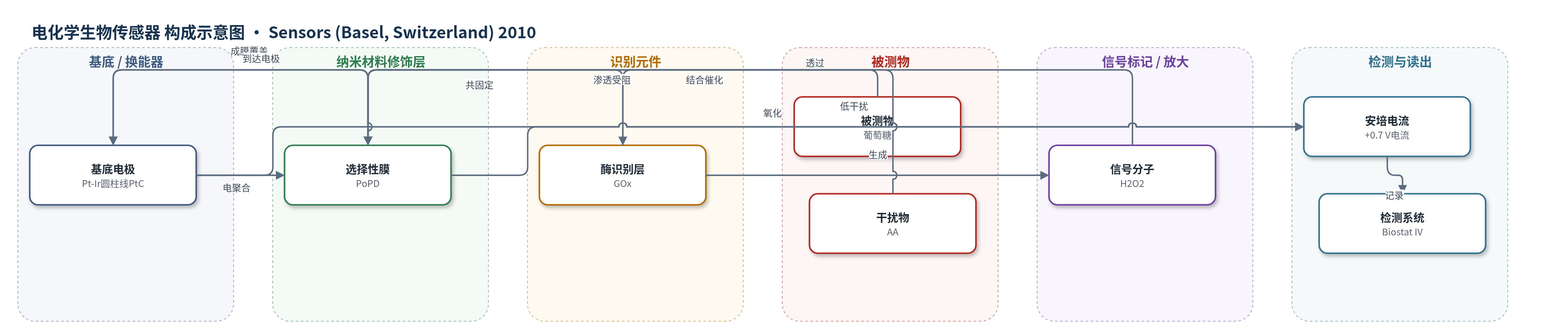
点击图片查看大图 · 依据论文自动绘制
传感器类型
电化学生物传感器
检测对象
葡萄糖(glucose);样品基质:PBS(pH 7.4)校准液,目标应用为脑细胞外液/脑组织体内监测。
检测原理
该传感器为第一代安培型酶电极。葡萄糖氧化酶(GOx)识别并催化β-D-葡萄糖与O2反应,生成D-葡萄糖-δ-内酯和H2O2。H2O2作为信号分子扩散穿过电聚合聚邻苯二胺(PoPD)膜,在铂铱(Pt-Ir)工作电极+0.7 V vs SCE处发生两电子氧化,产生与H2O2浓度成正比的安培电流。PoPD膜对H2O2高通透、对AA等电活性干扰物低通透,从而抑制干扰;无背景电解质电聚合减少聚合物中离子陷阱,提高AA排斥。葡萄糖响应呈Michaelis-Menten型,低浓度近似线性,线性斜率LRS≈Jmax/KM,随GOx活性负载和PoPD结构变化。
检测灵敏度
线性范围: 0–10 mM(原文:linear regression up to 10 mM glucose;KM = 16 ± 2 mM;无背景电解质优化 KM = 10 ± 1 mM);灵敏度斜率: LRS = 5.0 ± 0.4 µA cm−2 mM−1(无背景电解质优化: LRS = 6.5 ± 0.6 µA cm−2 mM−1);R^2 = 0.998(非线性,n=8);R^2 = 0.996(线性区,n=8)
效应效果
该传感器在PBS中抗干扰性强:1 mM AA屏蔽99.8%,P(AA)%为0.24±0.04%;无背景电解质优化后P(AA)%降至0.11±0.02%,SG%为2±1%,较PBS条件提高约3倍,且不低于近期多层聚合物双层膜设计(等效P(AA)%约0.13±0.02%)。葡萄糖t90%为1.7±0.1 s,H2O2为1.3±0.1 s。共固定设计SG%比其他设计低4–50倍。数据以均值±SEM报告(n=4–19),未提供RSD、实际样品回收率或ELISA/HPLC/qPCR对比。作者认为该低边缘密度PtC/PoPD-GOx适合脑内葡萄糖监测,并可为谷氨酸、乙酰胆碱等低浓度神经递质传感器提供参考。
传感器的构成
- 基底/换能器电极:125 µm直径Teflon包覆Pt-Ir(90:10)圆柱线电极(PtC),剥离1 mm Teflon暴露裸Pt,作为工作电极并氧化H2O2。
- 识别元件:葡萄糖氧化酶(GOx),催化β-D-葡萄糖和O2生成D-葡萄糖-δ-内酯和H2O2。
- 修饰/离子选择性膜:电聚合聚邻苯二胺(PoPD),由邻苯二胺(oPD)在+0.7 V vs SCE电合成,允许H2O2透过并阻挡AA等干扰物。
- 交联固定层:戊二醛(GA)蒸气,用于PtC/PoPD/GOx-GA设计,交联GOx增强固定。
- 信号分子:H2O2,酶反应产物,在+0.7 V vs SCE发生两电子氧化产生安培电流。
- 读出系统:三电极恒电位安培装置,SCE参比、不锈钢辅助电极、Biostat IV电位计,记录电流密度。
中文摘要
为开发适用于体内监测的生物传感器表征策略,作者在直径125 µm的铂圆柱线电极(PtC)上固定葡萄糖氧化酶(GOx),构建葡萄糖生物传感器。采用三种固定策略:在电合成聚邻苯二胺(PoPD)前、后或过程中共固定;PoPD同时作为离子选择性膜。以H2O2(酶反应信号分子)、葡萄糖及典型干扰物抗坏血酸(AA)校准,测定聚合物渗透性和表观Michaelis-Menten参数,并用多种选择性参数评价灵敏度与抗干扰平衡。在中性缓冲条件下,将GOx包埋于PoPD层中的PtC/PoPD-GOx设计具有最高葡萄糖线性灵敏度(5.0±0.4 µA cm−2 mM−1)、良好线性范围(KM=16±2 mM)、快速响应(<2 s)和最强AA屏蔽(1 mM AA屏蔽99.8%)。进一步在无添加背景电解质条件下电聚合,使葡萄糖选择性提高约3倍,AA排斥性能不低于近期多层聚合物双层设计。研究还发现酶蛋白对低、高浓度AA的离子选择性影响相反,说明干扰浓度依赖性研究的重要性。
英文摘要
In an ongoing programme to develop characterization strategies relevant to biosensors for in-vivo monitoring, glucose biosensors were fabricated by immobilizing the enzyme glucose oxidase (GOx) on 125 μm diameter Pt cylinder wire electrodes (Pt(C)), using three different methods: before, after or during the amperometric electrosynthesis of poly(ortho-phenylenediamine), PoPD, which also served as a permselective membrane. These electrodes were calibrated with H(2)O(2) (the biosensor enzyme signal molecule), glucose, and the archetypal interference compound ascorbic acid (AA) to determine the relevant polymer permeabilities and the apparent Michaelis-Menten parameters for glucose. A number of selectivity parameters were used to identify the most successful design in terms of the balance between substrate sensitivity and interference blocking. For biosensors electrosynthesized in neutral buffer under the present conditions, entrapment of the GOx within the PoPD layer produced the design (Pt(C)/PoPD-GOx) with the highest linear sensitivity to glucose (5.0 ± 0.4 μA cm(-2) mM(-1)), good linear range (K(M) = 16 ± 2 mM) and response time (< 2 s), and the greatest AA blocking (99.8% for 1 mM AA). Further optimization showed that fabrication of Pt(C)/PoPD-GOx in the absence of added background electrolyte (i.e., electropolymerization in unbuffered enzyme-monomer solution) enhanced glucose selectivity 3-fold for this one-pot fabrication protocol which provided AA-rejection levels at least equal to recent multi-step polymer bilayer biosensor designs. Interestingly, the presence of enzyme protein in the polymer layer had opposite effects on permselectivity for low and high concentrations of AA, emphasizing the value of studying the concentration dependence of interference effects which is rarely reported in the literature.