组成图示
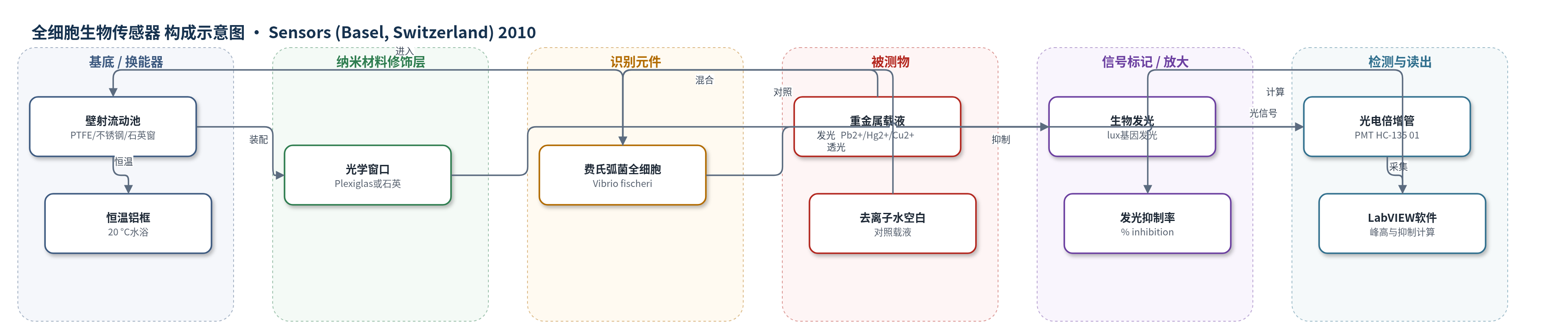
点击图片查看大图 · 依据论文自动绘制
传感器类型
全细胞生物传感器
检测对象
铅离子(Pb2+)、汞离子(Hg2+)、铜离子(Cu2+)及水样总毒性;样品基质:水样/载液(去离子水或人工海水重悬体系)
检测原理
该传感器以费氏弧菌(Vibrio fischeri)全细胞为识别与响应元件。细菌含有lux基因,在正常代谢下产生生物发光,发光强度反映细胞代谢活性和膜完整性。当含Pb2+、Hg2+或Cu2+的载液与菌悬液在混合线圈中接触时,重金属毒性会抑制细菌代谢或损伤细胞,使生物发光强度下降。系统先注入去离子水空白获得峰高Peak1,再注入毒性载液获得Peak2,光电倍增管(PMT)将光信号转换为电信号,软件按% inhibition=(Peak1−Peak2)×100/Peak1计算抑制率。重金属浓度越高,发光抑制越强,从而实现水毒性半定量评估。
检测灵敏度
LOD: Pb2+ 1.0 × 10⁻⁴ M;Cu2+ 1.0 × 10⁻⁴ M;Hg2+ 1.0 × 10⁻⁵ M;停流15 min后检测限可降至10−7 M(依金属化合物);有效浓度范围: 1.0 × 10⁻² M–1.0 × 10⁻⁵ M
效应效果
系统可快速评估水样中重金属毒性,Hg2+的毒性高于Pb2+和Cu2+,且三种金属均呈浓度相关抑制。峰高测量在10次重复进样中RSD为0.7%,单峰周转时间约40 s,100 μL菌悬液可完成12次进样,8 mL菌悬液可完成16次进样。流动注射参数优化为1.5 mL/min、100 cm混合线圈,分散度为4.52。pH 5–10范围内生物发光受促进,pH 3–10测试显示pH会影响信号,但金属盐溶液仍呈现可区分抑制。作者认为该全细胞生物传感器可用于水毒性筛查,后续将扩展至多种毒性化合物和真实样品。
传感器的构成
- 换能器:光电倍增管(PMT,Hamamatsu HC-135 01),将生物发光转换为电信号
- 流动池:壁射流动池(wall-jet flow cell),不锈钢板、PTFE管、Plexiglas/石英光学窗口,内体积160 μL,供菌体与载液混合后光检测
- 温控模块:恒温铝框与水浴(20 °C),维持Vibrio fischeri最佳温度
- 识别元件:费氏弧菌(Vibrio fischeri,NRRL-11177)全细胞,含lux基因,生物发光反映代谢活性
- 样品/载液:含Pb2+、Hg2+、Cu2+的载液或去离子水,人工海水重悬细胞,提供毒性刺激
- 流路系统:注射阀(IV)、混合线圈(L,100 cm)、蠕动泵、废液(W),实现自动进样与混合
- 读出系统:LabVIEW软件与PMT计数,计算生物发光抑制率
中文摘要
本文报道了一种用于水毒性评估的全自动流动注射分析仪的开发。该分析仪以费氏弧菌(Vibrio fischeri)生物发光全细胞生物传感器为核心,通过检测重金属溶液对细菌生物发光的抑制来评估毒性。实验中将100 μL费氏弧菌悬液注入含不同浓度Pb2+、Hg2+和Cu2+的载液中,菌体在混合线圈中与毒性载液混合后进入检测单元。以去离子水注入产生的生物发光为对照,记录重金属毒性导致的生物发光抑制率。结果表明,汞载液表现出比铅和铜更高的毒性,且三种重金属均呈现与浓度相关的毒性抑制。此外,测试了不同pH载液对生物传感器的影响,费氏弧菌生物发光在pH 5–10范围内受到促进。实验证明,该全细胞生物传感器在自动流体系统中能够对多种毒性溶液产生响应。
英文摘要
This paper describes the development of an automated Flow Injection analyzer for water toxicity assessment. The analyzer is validated by assessing the toxicity of heavy metal (Pb(2+), Hg(2+) and Cu(2+)) solutions. One hundred μL of a Vibrio fischeri suspension are injected in a carrier solution containing different heavy metal concentrations. Biosensor cells are mixed with the toxic carrier solution in the mixing coil on the way to the detector. Response registered is % inhibition of biosensor bioluminescence due to heavy metal toxicity in comparison to that resulting by injecting the Vibrio fischeri suspension in deionised water. Carrier solutions of mercury showed higher toxicity than the other heavy metals, whereas all metals show concentration related levels of toxicity. The biosensor's response to carrier solutions of different pHs was tested. Vibrio fischeri's bioluminescence is promoted in the pH 5-10 range. Experiments indicate that the whole cell biosensor, as applied in the automated fluidic system, responds to various toxic solutions.