组成图示
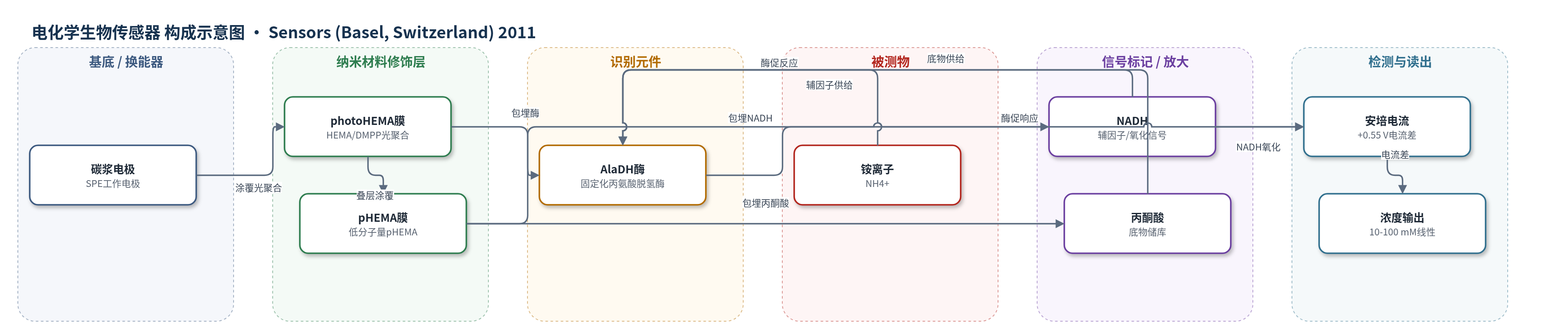
点击图片查看大图 · 依据论文自动绘制
传感器类型
电化学生物传感器
检测对象
铵离子(ammonium ion, NH4+);样品基质:河水(river water)及加标河水
检测原理
NH4+扩散进入photoHEMA酶膜后,被固定化AlaDH识别并参与酶促反应:丙酮酸在NADH存在下被氨基化为L-丙氨酸,同时生成NAD+和水,从而消耗NH4+。上层pHEMA膜持续向酶膜释放丙酮酸和NADH,避免外部加试剂。NADH在SPE表面+0.55 V发生电催化氧化,释放电子形成安培电流;在优化条件下,电流差随NH4+浓度升高而增大,并在10–100 mM内线性。该体系无HCR/RCA等额外放大,主要依赖酶催化与NADH电氧化产生信号。
检测灵敏度
LOD: 0.18 mM;线性范围: 10–100 mM;R^2 = 0.978
效应效果
传感器重现性良好,不同电极测30 mM NH4+的RSD为1.4–4.9%(n=5);同一电极重复性较差(21.7–26.4%),归因于NADH/丙酮酸流失及NADH不可逆氧化,作者将其定位为一次性现场电极。稳定性方面,4℃保存30天后仍保留约50%初始灵敏度。选择性上,Na+在1:1摩尔比无显著干扰,K+在1:1有干扰;甲胺和乙胺在0.1:1以上显著干扰,但天然水中胺类浓度通常很低。5个加标河水样品回收率为96.7–103.5%,与Nessler法t检验无显著差异。相比GLDH安培传感器,其线性范围更宽(10–100 mM),响应时间<3 min,适用于污水NH4+现场分析。
传感器的构成
- 基底/工作电极:丝网印刷碳浆电极(SPE),提供导电基底与安培换能。
- 酶膜:HEMA单体与光引发剂DMPP经UV光聚合形成photoHEMA膜,包埋L-丙氨酸脱氢酶(AlaDH)。
- 试剂膜:低分子量pHEMA膜,包埋丙酮酸(pyruvate)和NADH,作为底物与辅因子储库。
- 识别/催化元件:AlaDH,催化丙酮酸氨基化并消耗NH4+。
- 信号标记物:NADH,在+0.55 V发生电催化氧化产生安培电流。
中文摘要
利用丙氨酸脱氢酶(AlaDH)测定铵离子(NH4+)通常需要同时加入丙酮酸底物和还原型烟酰胺腺嘌呤二核苷酸(NADH),给酶生物传感器使用带来不便。为解决该问题,本文报道了一种基于丝网印刷碳浆电极(SPE)的新型无试剂安培生物传感器,用于NH4+测定。传感器采用叠层甲基丙烯酸酯膜体系:先将丙酮酸和NADH固定于低分子量聚(2-羟乙基甲基丙烯酸酯)(pHEMA)膜中,再将其沉积在含AlaDH的光固化pHEMA(photoHEMA)膜上。在AlaDH催化下,丙酮酸与NADH发生氨基化反应并消耗NH4+,使NADH在+0.55 V下的电催化氧化电流与NH4+浓度成正比。该叠层膜传感器对10–100 mM NH4+呈快速线性响应,检出限为0.18 mM,重现性RSD为1.4–4.9%。传感器无需预处理即可用于加标河水样品中NH4+的测定,并与Nessler分光光度法结果良好相关。
英文摘要
The use of the enzyme alanine dehydrogenase (AlaDH) for the determination of ammonium ion (NH(4)(+)) usually requires the addition of pyruvate substrate and reduced nicotinamide adenine dinucleotide (NADH) simultaneously to effect the reaction. This addition of reagents is inconvenient when an enzyme biosensor based on AlaDH is used. To resolve the problem, a novel reagentless amperometric biosensor using a stacked methacrylic membrane system coated onto a screen-printed carbon paste electrode (SPE) for NH(4)(+) ion determination is described. A mixture of pyruvate and NADH was immobilized in low molecular weight poly(2-hydroxyethyl methacrylate) (pHEMA) membrane, which was then deposited over a photocured pHEMA membrane (photoHEMA) containing alanine dehydrogenase (AlaDH) enzyme. Due to the enzymatic reaction of AlaDH and the pyruvate substrate, NH(4)(+) was consumed in the process and thus the signal from the electrocatalytic oxidation of NADH at an applied potential of +0.55 V was proportional to the NH(4)(+) ion concentration under optimal conditions. The stacked methacrylate membranes responded rapidly and linearly to changes in NH(4)(+) ion concentrations between 10-100 mM, with a detection limit of 0.18 mM NH(4)(+) ion. The reproducibility of the amperometrical NH(4)(+) biosensor yielded low relative standard deviations between 1.4-4.9%. The stacked membrane biosensor has been successfully applied to the determination of NH(4)(+) ion in spiked river water samples without pretreatment. A good correlation was found between the analytical results for NH(4)(+) obtained from the biosensor and the Nessler spectrophotometric method.