组成图示
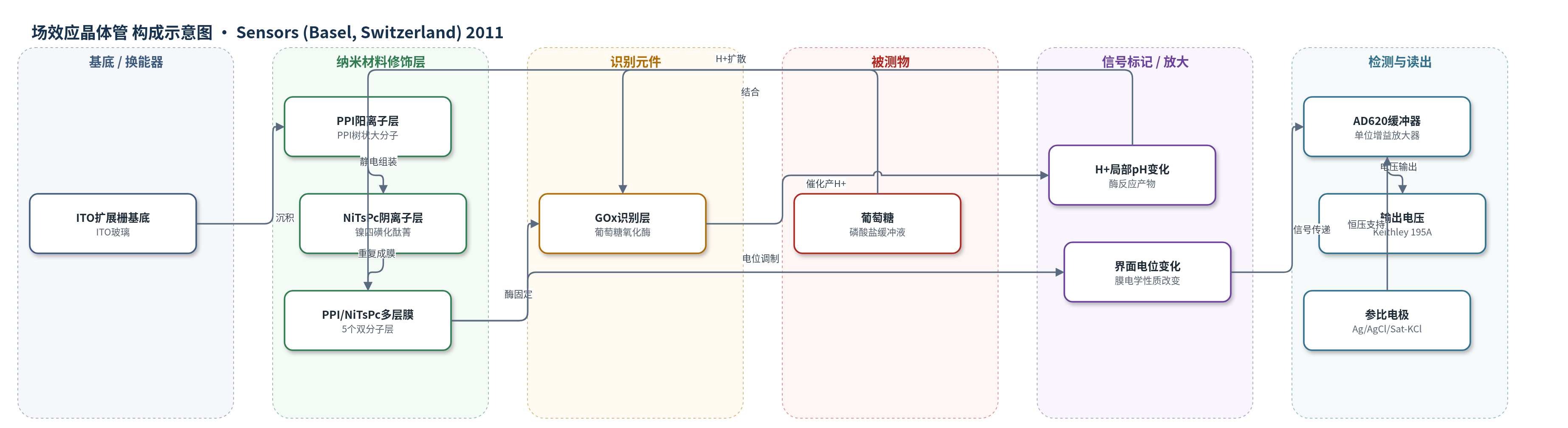
点击图片查看大图 · 依据论文自动绘制
传感器类型
场效应晶体管(FET)生物传感器
检测对象
葡萄糖(glucose);样品基质:磷酸盐缓冲液(10 mM,pH 7.5),文中亦提及稀释人血清。
检测原理
该传感器以SEGFET为换能器,ITO扩展栅表面通过LbL组装PPI/NiTsPc多层膜,末端PPI层经GA/BSA交联固定GOx。检测时,葡萄糖扩散至识别层并被GOx催化氧化,生成葡萄糖酸和H+。H+在PPI/NiTsPc纳米孔膜中扩散并改变膜/ITO界面局部pH与电荷分布,使扩展栅界面电位发生调制。SEGFET将该电位变化转换为输出电压变化,经AD620单位增益缓冲后由Keithley 195A记录。葡萄糖浓度越高,产H+越多,输出电压变化越大。NiTsPc在本体系中主要作为LbL反离子,未表现出对H2O2的催化放大作用。
检测灵敏度
LOD: 0.027 mM;线性范围: 最高0.4 mM
效应效果
BSA存在可增强输出信号,因较少GOx分子参与交联,酶活性位点暴露更充分;无BSA时响应时间略短,但信号较低。缓冲浓度2.5–30 mM中2.5 mM响应最大,但为维持离子强度选择10 mM;pH 5.5–8中pH 7.5信号最大。对0.5 mM葡萄糖响应时间约7 min。连续测量中恢复时间约50 min,信号仅有小损失。4°C缓冲液保存20天,早期平均信号约95 mV,长期后最多下降18.5%。原文未报告选择性、抗干扰、RSD和实际样品回收率。作者认为该器件成本低、可重复使用,并能检测稀释人血清,具有临床应用潜力;但动态范围受限于约1 mM,NiTsPc未催化H2O2。
传感器的构成
- 基底/扩展栅电极:ITO玻璃(160 nm ITO),作为分离扩展栅导电基底并连接AD620放大器。
- 第一修饰层:PPI树状大分子(阳离子,第3代,1 mg/mL),提供NH3+基团和纳米孔结构,参与LbL组装。
- 第二修饰层:NiTsPc镍四磺化酞菁(阴离子,0.5 mg/mL),作为反离子与PPI静电组装,形成pH敏感膜。
- 多层膜:PPI/NiTsPc 5个双分子层,作为pH敏感扩展栅膜,允许H+扩散并传递界面电位变化。
- 识别/固定层:末端PPI层(NH3+终止),提供GOx固定位点。
- 识别元件:葡萄糖氧化酶GOx(50 mg/mL),催化葡萄糖氧化产生H+。
- 交联/封闭剂:戊二醛GA(2.5%)和BSA(20 mg/mL),交联固定GOx,BSA减少酶参与交联并暴露活性位点。
- 信号读出电路:AD620放大器作为单位增益缓冲器,Ag/AgCl/Sat-KCl参比电极,Keithley 195A记录输出电压。
中文摘要
分离扩展栅场效应晶体管(SEGFET)因结构稳健、制备简单、成本低且可将FET与化学环境隔离,被用作离子传感器或生物传感器。本文采用层层自组装(LbL)技术,在氧化铟锡(ITO)分离扩展栅上构建聚丙基亚胺(PPI)树状大分子与镍四磺化酞菁(NiTsPc)多层膜,并将葡萄糖氧化酶(GOx)固定于末端PPI层,制备FET型葡萄糖生物传感器。PPI的NH3+基团可与GOx发生静电作用或共价结合。研究分析了固定过程中的最适pH、缓冲液浓度及牛血清白蛋白(BSA)存在等参数。葡萄糖被GOx氧化后产生H+,局部pH改变影响PPI/NiTsPc膜的界面电学性质,从而改变FET输出电压。树状层提供纳米孔环境,有利于H+扩散,提高葡萄糖检测灵敏度。
英文摘要
Separative extended gate field effect transistor (SEGFET) type devices have been used as an ion sensor or biosensor as an alternative to traditional ion sensitive field effect transistors (ISFETs) due to their robustness, ease of fabrication, low cost and possibility of FET isolation from the chemical environment. The layer-by-layer technique allows the combination of different materials with suitable properties for enzyme immobilization on simple platforms such as the extended gate of SEGFET devices enabling the fabrication of biosensors. Here, glucose biosensors based on dendrimers and metallophthalocyanines (MPcs) in the form of layer-by-layer (LbL) films, assembled on indium tin oxide (ITO) as separative extended gate material, has been produced. NH(3)(+) groups in the dendrimer allow electrostatic interactions or covalent bonds with the enzyme (glucose oxidase). Relevant parameters such as optimum pH, buffer concentration and presence of serum bovine albumin (BSA) in the immobilization process were analyzed. The relationship between the output voltage and glucose concentration shows that upon detection of a specific analyte, the sub-products of the enzymatic reaction change the pH locally, affecting the output signal of the FET transducer. In addition, dendritic layers offer a nanoporous environment, which may be permeable to H(+) ions, improving the sensibility as modified electrodes for glucose biosensing.