组成图示
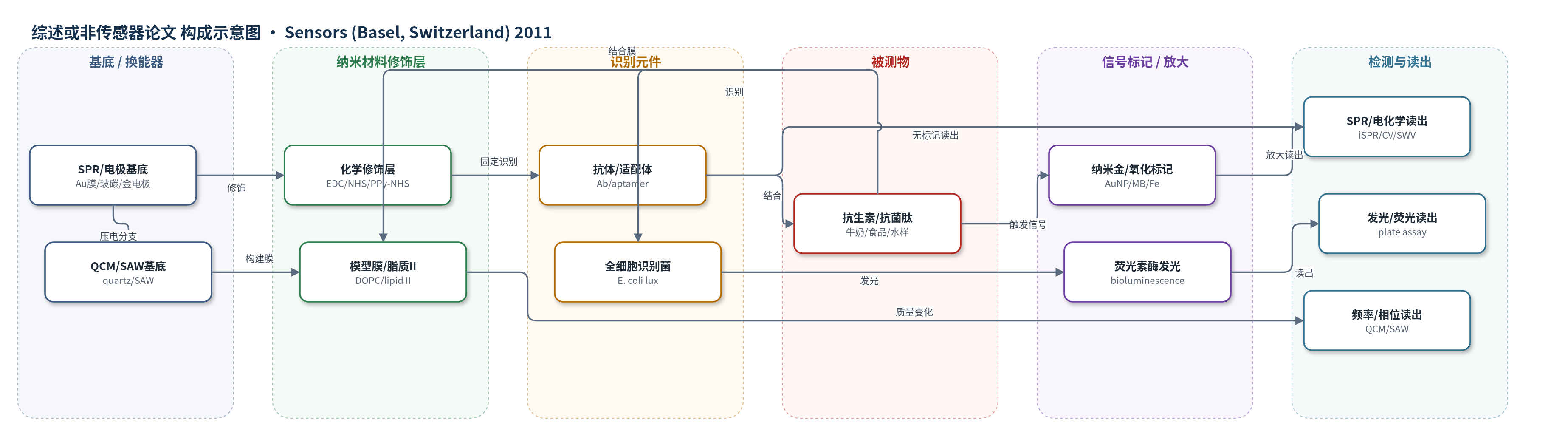
点击图片查看大图 · 依据论文自动绘制
传感器类型
综述或非传感器论文
检测对象
抗生素/抗菌药物(antibacterials/antibiotics),包括四环素(tetracycline)、氧四环素(oxytetracycline)、氨基糖苷类(aminoglycosides)、氯霉素(chloramphenicol)、磺胺类(sulfonamides)、氟喹诺酮类(fluoroquinolones)等;样品基质:牛奶、肉、蜂蜜、蛋、环境水样、血液。
检测原理
本综述涉及多种抗生素生物传感原理。免疫传感器中,固定抗体或固定抗原与样品中抗生素发生竞争性结合,结合事件改变SPR界面折射率或电化学阻抗,从而无标记读出;适配体传感器中,DNA/RNA适配体结合抗生素后改变电极表面电子转移阻力,使K3[Fe(CN)6]等氧化还原探针的CV/SWV电流下降;酶传感器中,β-内酰胺酶水解青霉素类导致pH变化,由安培法检测;全细胞传感器中,四环素诱导荧光素酶启动子表达,产生自发光;QCM/SAW则通过抗生素或抗菌肽与模型膜结合引起的质量/黏弹性变化,监测频率、相位或振幅变化。信号通常随被测物浓度增加而增强或减弱,可用于定量。
检测灵敏度
综述未报告统一LOD/线性范围;文中示例:LOD: ppb-range;LOD: low µg/kg;IC50: low ng/mL;CV: below 5%;KD: 0.27 µM vs. 1.03 µM;kass: 4,677 M−1 s −1 vs. 752 M−1 s−1;KD: 0.28 µM;KD: 0.27 µM。
效应效果
综述报道的抗生素生物传感器总体表现出与LC-MS/MS、微生物抑制试验等传统方法相近的灵敏度,并满足欧盟最大残留限量(MRL)要求。iSPR免疫传感器可多联检测七类抗生素,交叉反应低,牛奶10倍稀释后无明显基质效应,LOD达ppb级;便携六通道SPR免疫传感器重复性CV低于5%,恩诺沙星和磺胺吡啶LOD为低µg/kg,低于MRL,氯霉素略高于MRL。SPR荧光喹诺酮检测与LC-MS/MS比较显示灵敏度相似。作者认为生物传感器具有快速、简单、低成本、可现场使用且样品前处理少的优势,适合食品和环境监控,但高通量筛查潜力尚需进一步验证。
传感器的构成
- 基底/换能器:SPR金膜芯片、玻碳电极、金电极、石英晶体/SAW器件,用于光学、电化学或压电换能。
- 修饰层:EDC/NHS化学、聚吡咯-NHS膜(PPy-NHS)、硫醇自组装层、功能化金纳米颗粒(AuNP),用于固定识别元件或增强SPR/电化学信号。
- 识别元件:抗生素特异性抗体(Ab)、DNA/RNA适配体(aptamer)、β-内酰胺酶(β-lactamase)、全细胞发光大肠杆菌(E. coli lux),用于特异性结合或响应抗生素。
- 信号标记/放大:纳米金颗粒(AuNP)、血蓝素(hematein)、亚甲蓝(MB)、Fe2+/Fe3+、荧光素酶发光(bioluminescence),用于放大或转导识别事件。
- 读出系统:成像SPR(iSPR)、循环伏安(CV)、方波伏安(SWV)、安培、阻抗、荧光/发光、QCM/SAW,用于输出与抗生素浓度相关的信号。
中文摘要
抗菌药物是医疗中最重要的药物之一,但其疗效正日益受到全球范围内细菌耐药性扩散的阻碍。耐药性的加剧与人类抗菌药物使用不当、兽医领域广泛使用以及抗菌药物在环境和食品中的残留有关,同时新型抗菌药物研发不足。因此,必须加强新型抗菌药物研发,并限制抗菌药物向环境扩散。由于生物传感器技术取得根本进展,并在抗生素领域展现出应用前景,本综述首次系统概述生物传感器在该领域的应用与展望。文中讨论了多种不同设计与技术的生物传感器用于环境和食品基质中抗菌药物检测的研究,并从分析性能角度与传统技术进行比较。此外,综述还介绍了生物传感器在体外阐明抗菌药物作用机制中的应用,并批判性评估了这些模拟实验的信息价值。总体而言,生物传感器被证明是抗菌药物领域中一种创新且富有前景,但尚未被全面应用的技术。
英文摘要
Antibacterials are among of the most important medications used in health care. However, their efficacy is increasingly impeded by a tremendous and globally spread bacterial resistance phenomenon. This bacterial resistance is accelerated by inadequate application of antibacterial drugs in humans, the widespread veterinary use of antibacterials, and antibacterial occurrence in the environment and food. Further, there is a lack of development of innovative novel drugs. Therefore, the search for novel antibacterials has to be intensified and the spread of antibacterials in the environment has to be restricted. Due to the fundamental progress in biosensor development and promising applications in the antibiotic field, this review gives for the first time an overview on the use and prospects of biosensor applications in that area. A number of reports have applied biosensors of different design and techniques to search for antibacterials in environmental and foodstuff matrices. These studies are discussed with respect to the analytical values and compared to conventional techniques. Furthermore, biosensor applications to elucidate the mode of action of antimicrobial drugs in vitro have been described. These studies were critically introduced referring to the informational value of those simulations. In summary, biosensors will be illustrated as an innovative and promising, although not yet comprehensively applied, technique in the antibacterial field.