组成图示
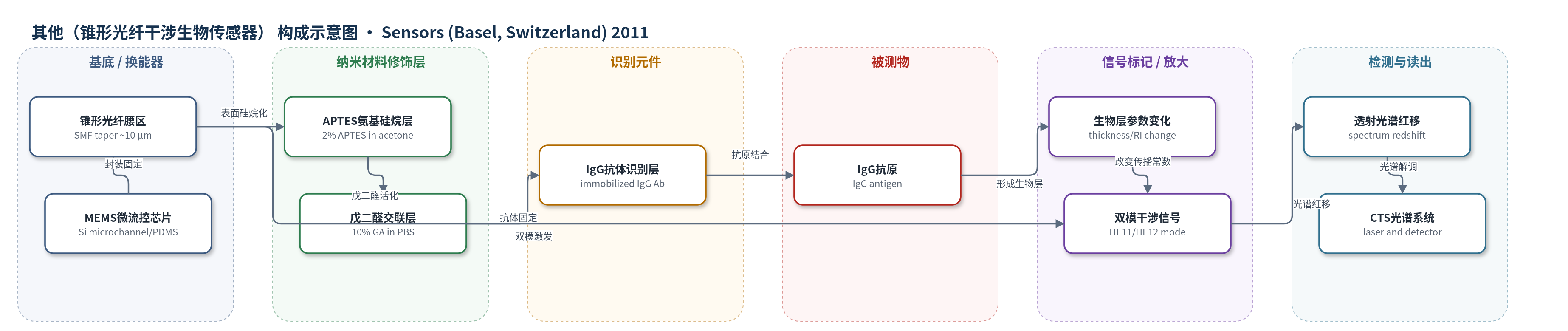
点击图片查看大图 · 依据论文自动绘制
传感器类型
其他(锥形光纤干涉生物传感器)
检测对象
IgG抗原(IgG antigen);样品基质为PBS缓冲液溶液(原文未明确具体生物基质)
检测原理
单模光纤经锥形化后,腰区可支持HE11与HE12两个传播模式。非绝热过渡区将基模耦合为双模,腰区倏逝场暴露于外部环境,两模式干涉形成透射光谱中的正弦条纹。光纤表面经APTES硅烷化、GA活化后固定IgG抗体。当IgG抗原与抗体结合时,在锥形腰区形成纳米级生物层,改变局部有效折射率和模式传播常数Δk,使干涉条纹发生相位偏移和峰值波长红移。通过CTS监测透射光谱并解调红移量,即可无标记地反映抗原结合量。该传感器无荧光或酶标记放大,灵敏度主要依赖尖锐干涉条纹和较长腰区反应区。
检测灵敏度
原文未报告LOD、线性范围、灵敏度斜率或相关系数。
效应效果
作者主张该传感器低成本、微型、快速、高灵敏且无标记。实验以IgG抗体-抗原对评估,两次重复试验分别监测到峰值波长红移1.50 nm和1.47 nm,表明可重复检测抗原结合。模拟显示,折射率1.33、厚度100 nm生物层引起3.5 nm条纹红移;纳米级厚度下相位/波长响应线性,说明可检测超薄生物层。MEMS微流控芯片精度达2 μm,可保护光纤并提供流路。原文未报告选择性、抗干扰、RSD、回收率或与ELISA/HPLC/qPCR对比。作者认为微型探针便于集成医疗工具,用于难达部位,并计划研究强度解调降低成本。
传感器的构成
- 基底/换能器:单模光纤(SMF,芯径/包层8/125 μm)锥形腰区(约10 μm),作为光波导并产生倏逝场换能
- 微流控载体:硅芯片微通道(MEMS,光刻与深干法刻蚀,精度2 μm),固定光纤并提供生物测试流路
- 密封层:聚二甲基硅氧烷(PDMS),覆盖芯片表面并保留微流道进出口
- 表面修饰层:氨丙基三乙氧基硅烷(APTES,2%丙酮溶液),硅烷化形成氨基功能化表面
- 交联活化层:戊二醛(GA,10%于50 mM PBS,pH 7.4),活化氨基并共价固定抗体
- 识别元件:免疫球蛋白G抗体(IgG antibody),固定于活化表面并特异性捕获抗原
- 被测物:IgG抗原(IgG antigen),与抗体结合形成生物层
- 信号标记物:无标记(label-free),不引入荧光、酶或纳米标记物
中文摘要
本文提出一种快速、高灵敏且低成本的锥形光纤生物传感器,可实现生物分子的无标记检测。该传感器利用锥形光纤腰区前两个传播模式之间的干涉效应,通过解调透射光谱的相位偏移来确定结合在锥形表面的生物分子。由于光谱条纹信号尖锐,且生物分子反应区相对较长,传感器表现出快速响应和高灵敏度。为深入理解不同生物分子对传感器的影响,作者对生物层厚度、折射率等参数进行了数值模拟,结果表明即使生物层厚度仅为纳米级,光谱条纹偏移仍明显可测。研究还设计并制备了微流控芯片,用于保护传感器并进行生物测试;采用微机电系统(MEMS)加工技术精确控制硅芯片上微通道的轮廓和深度,精度达2 μm。最终制备的锥形光纤生物传感器以免疫球蛋白G(IgG)抗体-抗原对进行了评估。
英文摘要
This paper presents a fast, highly sensitive and low-cost tapered optical fiber biosensor that enables the label-free detection of biomolecules. The sensor takes advantage of the interference effect between the fiber's first two propagation modes along the taper waist region. The biomolecules bonded on the taper surface were determined by demodulating the transmission spectrum phase shift. Because of the sharp spectrum fringe signals, as well as a relatively long biomolecule testing region, the sensor displayed a fast response and was highly sensitive. To better understand the influence of various biomolecules on the sensor, a numerical simulation that varied biolayer parameters such as thickness and refractive index was performed. The results showed that the spectrum fringe shift was obvious to be measured even when the biolayer was only nanometers thick. A microchannel chip was designed and fabricated for the protection of the sensor and biotesting. Microelectromechanical systems (MEMS) fabrication techniques were used to precisely control the profile and depth of the microchannel on the silicon chip with an accuracy of 2 μm. A tapered optical fiber biosensor was fabricated and evaluated with an Immune globulin G (IgG) antibody-antigen pair.