组成图示
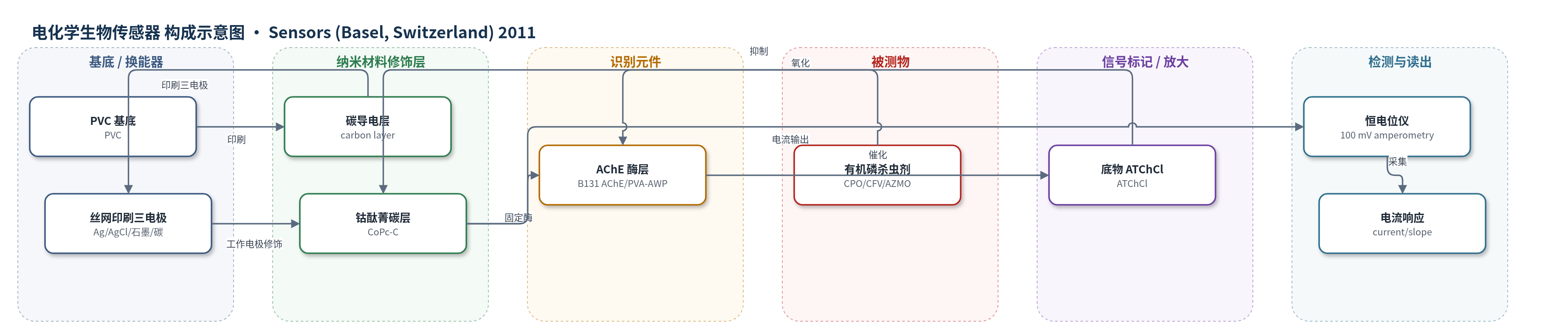
点击图片查看大图 · 依据论文自动绘制
传感器类型
电化学生物传感器
检测对象
毒死蜱氧(chlorpyrifos oxon, CPO)、chlorfenvinfos(CFV)、甲胺磷氧(azinphos methyl-oxon, AZMO);样品基质:水样/磷酸盐缓冲液(pH 7.0)
检测原理
固定在工作电极上的基因改造果蝇B131乙酰胆碱酯酶(AChE)催化底物乙酰硫代胆碱氯化物(ATChCl)水解,生成可被钴酞菁修饰碳电极氧化的产物;在自制恒电位仪施加100 mV恒电位下,产物氧化产生与酶活性相关的稳态安培电流。当有机磷杀虫剂(CPO、CFV、AZMO)在线注入时,其磷酸基团与AChE活性位点发生不可逆磷酸化,使酶活性下降,稳态电流随之降低。系统记录电流下降斜率mi,并与杀虫剂浓度关联,用于计算磷酸化常数kp。该策略以酶催化反应作为信号放大,避免孵育时间,实现在线检测。
检测灵敏度
LOD: 10 nM(摘要,CPO、CFV、AZMO);Table 2: CPO = 1.24 × 10⁻⁹ M, CFV = 1.262 × 10⁻⁶ M, AZMO = 1.48 × 10⁻⁸ M。
效应效果
MCFA流动系统在不同流速和体积下重复性RSD为1.48%–1.88%;用于三种有机磷杀虫剂检测时,采样频率为3 experiments/hour,RSD为1.58%,无需样品预处理,而对比FIA系统需过滤。恒电位仪电流检测限为2 nA,功耗4.57 mW。测得磷酸化常数kp:CPO 0.258(STD 0.922)、CFV 0.166(STD 7.208685)、AZMO 0.0459(STD 0.313976)。作者认为该系统成本低、体积小,适合水样原位在线检测,并可扩展为多传感器电子舌。
传感器的构成
- 基底:PVC 片(200×100 mm,0.5 mm),作为丝网印刷电极支撑。
- 导电碳层:碳浆(carbon layer),形成导电通道并承载参比/工作电极。
- 参比电极:Ag/AgCl 碳浆(Electrodag 418 SS),提供稳定参比电位。
- 对电极:石墨碳浆(Electrodag 423 SS),完成电化学回路。
- 工作电极:钴酞菁修饰碳浆(cobalt-phthalocyanine-modified carbon paste),作为介质催化氧化酶反应产物。
- 绝缘层:绝缘浆料,仅暴露 9 mm 银轨道用于电接触。
- 识别/酶层:基因改造果蝇 B131 乙酰胆碱酯酶(AChE)与 PVA-AWP 光交联聚合物(30%酶+70%PVA-AWP),固定酶并催化 ATChCl。
- 信号底物:乙酰硫代胆碱氯化物(ATChCl),由流动系统注入,经酶催化后产生安培信号。
中文摘要
本文提出一种抑制型生物电子舌方法,重点开发用于实验检测的自动化流动系统、用于测量酶生物传感器响应的自制恒电位仪,以及允许在线检测的抑制方案。研究选用并开发多换向流动分析(MCFA)系统,采用改进的抑制方法检测杀虫剂毒死蜱氧(CPO)、chlorfenvinfos(CFV)和甲胺磷氧(AZMO)。系统流路包括蠕动泵、由个人计算机电子接口和基于LabView®软件控制的七只电子阀,用于控制样品在检测池中的稀释与注入。抑制方法是在酶活性达到电流平台后注入杀虫剂,从而避免孵育时间。作者还开发了恒电位仪以测量酶生物传感器响应,并对CPO、CFV和AZMO实现了10 nM的低检出限。
英文摘要
An approach to an inhibition bioelectronic tongue is presented. The work is focused on development of an automated flow system to carry out experimental assays, a custom potentiostat to measure the response from an enzymatic biosensor, and an inhibition protocol which allows on-line detections. A Multi-commuted Flow Analysis system (MCFA) was selected and developed to carry out assays with an improved inhibition method to detect the insecticides chlorpyrifos oxon (CPO), chlorfenvinfos (CFV) and azinphos methyl-oxon (AZMO). The system manifold comprised a peristaltic pump, a set of seven electronic valves controlled by a personal computer electronic interface and software based on LabView® to control the sample dilutions into the cell. The inhibition method consists in the injection of the insecticide when the enzyme activity has reached the plateau of the current; with this method the incubation time is avoided. A potentiostat was developed to measure the response from the enzymatic biosensor. Low limits of detection of 10 nM for CPO, CFV, and AZMO were achieved.