组成图示
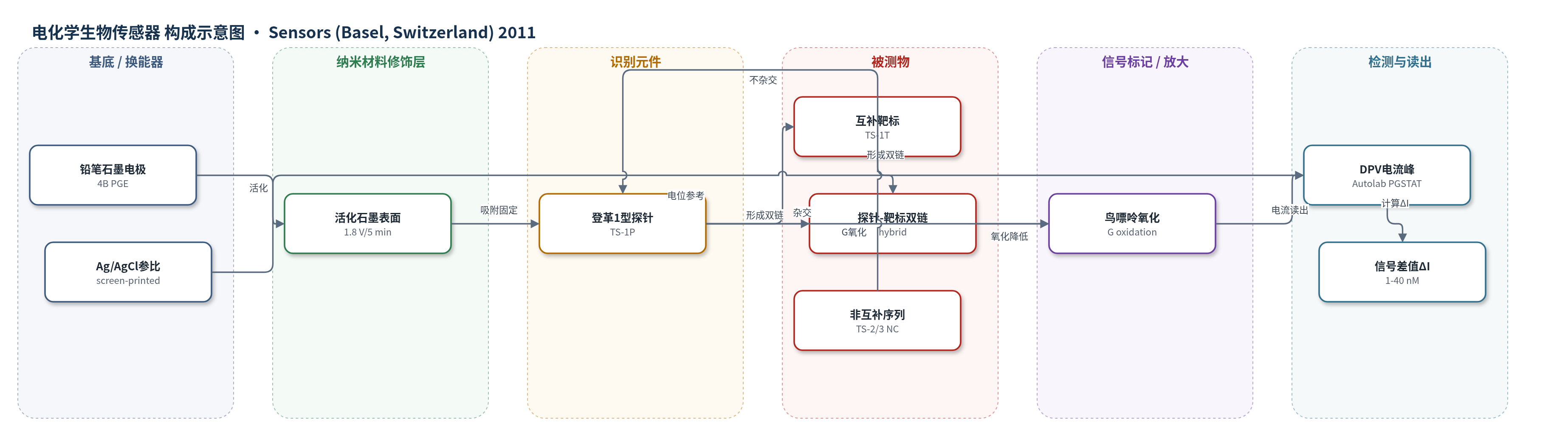
点击图片查看大图 · 依据论文自动绘制
传感器类型
电化学生物传感器
检测对象
登革病毒1型特异性寡核苷酸(Dengue virus type 1 specific oligonucleotide, TS-1T);样品基质:醋酸缓冲液/Tris-HCl缓冲液中的合成寡核苷酸溶液
检测原理
该传感器采用无标记电化学杂交检测。登革病毒1型特异性寡核苷酸探针TS-1P吸附固定在活化铅笔石墨电极(PGE)表面,探针含7个鸟嘌呤(G)。差分脉冲伏安法(DPV)在约0.97 V处检测G氧化电流峰。当互补靶标TS-1T在57 °C退火温度下与探针杂交后,探针中部分G与靶标胞嘧啶(C)配对,暴露于溶液的可氧化G减少,导致G氧化峰降低。信号差值ΔI随靶标浓度增加而增大,在1–40 nM范围内呈线性。该方法不依赖外部标记物或酶促放大,依靠核酸杂交引起的界面氧化活性变化实现检测。
检测灵敏度
LOD: 0.92 nM;线性范围: 1–40 nM;斜率: 1.6154 A/nM;相关系数: 0.9856
效应效果
该传感器对登革病毒2型和3型非互补序列以及PolyG-NC均无明显响应,互补与非互补序列混合时信号与互补靶标一致,表明非互补序列不干扰检测。在40 nM靶标下,日内和日间重现性RSD分别为0.61%和1.72%。杂交时间仅需3 min,检出限0.92 nM,优于同吸附固定条件下报道的丙型肝炎病毒(6.5 nM)和寡核苷酸传感器(9 nM),与p53突变检测(0.68 nM)相当。作者认为该无标记方法快速、低成本,可避免亚甲基蓝、金属配合物等有毒标记物,适用于登革病毒核酸快速诊断。
传感器的构成
- 工作电极基底:4B铅笔石墨电极(PGE),抛光后作为导电基底
- 活化修饰层:1.8 V电化学活化5 min的石墨表面,提高粗糙度与亲水性,促进探针吸附
- 识别元件:登革病毒1型特异性寡核苷酸探针TS-1P(18-mer ssDNA),0.5 V吸附固定5 min
- 杂交靶标:互补寡核苷酸TS-1T(18-mer),57 °C孵育3 min形成双链
- 信号标记物:无外源标记,利用探针鸟嘌呤(G)氧化作为内源电化学信号
- 参比电极:丝网印刷Ag/AgCl墨水(Electrodag-Acheson),提供电位参考
- 电解液:0.5 M醋酸缓冲液(pH 4.8/5.0)用于固定与杂交,Tris-HCl(pH 7.0)用于洗涤和DPV检测
- 信号读出:Autolab PGSTAT电位计配合GPES 4.9软件,差分脉冲伏安法(DPV)监测G氧化峰
中文摘要
本文开发了一种基于18-mer单链核酸探针吸附固定在活化铅笔石墨电极上的生物传感器,用于检测登革病毒1型特异性寡核苷酸序列。通过差分脉冲伏安法(DPV)监测鸟嘌呤氧化,研究探针与互补寡核苷酸靶标之间的杂交。工作电极采用普通4B铅笔芯,抛光表面经1.8 V、5 min活化;随后在0.5 M醋酸缓冲液(pH 5.0)中施加0.5 V、5 min将登革寡核苷酸探针固定于电极。杂交在寡核苷酸退火温度下进行。5 min和1 μM为探针固定最佳条件。实现了固定DNA探针TS-1P与靶标TS-1T退火杂交的电化学检测,靶标在1–40 nM范围内线性良好,检出限为0.92 nM。采用登革病毒2型和3型非互补序列测试了传感器特异性。
英文摘要
A biosensor that relies on the adsorption immobilization of the 18-mer single-stranded nucleic acid related to dengue virus gene 1 on activated pencil graphite was developed. Hybridization between the probe and its complementary oligonucleotides (the target) was investigated by monitoring guanine oxidation by differential pulse voltammetry (DPV). The pencil graphite electrode was made of ordinary pencil lead (type 4B). The polished surface of the working electrode was activated by applying a potential of 1.8 V for 5 min. Afterward, the dengue oligonucleotides probe was immobilized on the activated electrode by applying 0.5 V to the electrode in 0.5 M acetate buffer (pH 5.0) for 5 min. The hybridization process was carried out by incubating at the annealing temperature of the oligonucleotides. A time of five minutes and concentration of 1 μM were found to be the optimal conditions for probe immobilization. The electrochemical detection of annealing between the DNA probe (TS-1P) immobilized on the modified electrode, and the target (TS-1T) was achieved. The target could be quantified in a range from 1 to 40 nM with good linearity and a detection limit of 0.92 nM. The specificity of the electrochemical biosensor was tested using non-complementary sequences of dengue virus 2 and 3.