组成图示
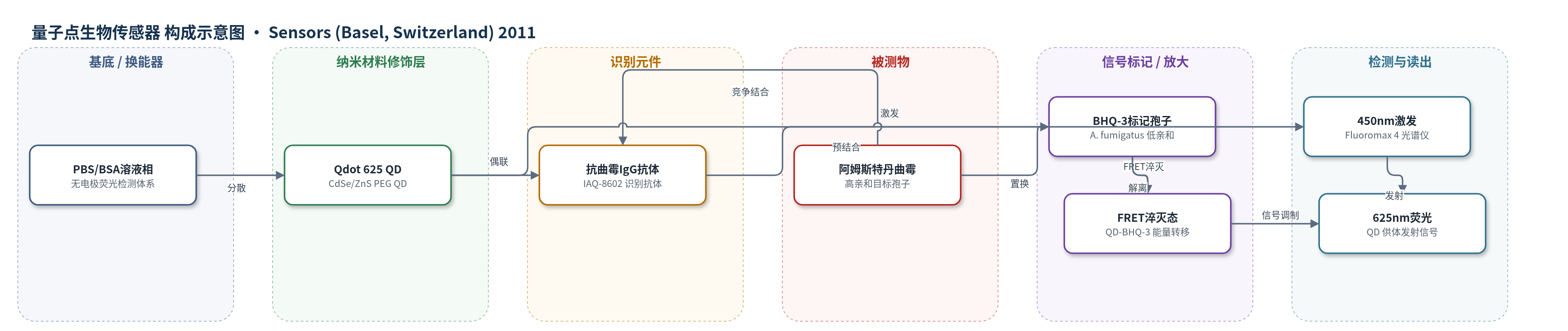
点击图片查看大图 · 依据论文自动绘制
传感器类型
量子点生物传感器
检测对象
阿姆斯特丹曲霉(Aspergillus amstelodami)孢子;样品基质:PBS 孢子悬液/溶液
检测原理
该传感器由 CdSe/ZnS Qdot 625 与抗 Aspergillus IgG 抗体经 SMCC 偶联形成。先将低亲和的 BHQ-3 标记 A. fumigatus 孢子与 QD-抗体复合物孵育,BHQ-3 作为 FRET 受体靠近 QD 供体,吸收 QD 发射能量,使 625 nm 荧光被淬灭。加入 A. amstelodami 孢子后,其表面抗原与抗体结合亲和力更高,竞争并置换 BHQ-3 标记孢子,使受体远离 QD,FRET 效率下降,QD 荧光恢复。450 nm 激发下监测 625 nm 发射,荧光强度随目标孢子浓度呈剂量依赖性增加。方法依赖抗体亲和差异和 FRET 距离依赖能量转移,无酶催化放大,但利用 QD 高量子产率和抗光漂白特性提高信噪比。
检测灵敏度
LOD: 103 spores/mL(原文上标丢失,应为 10^3 spores/mL);S/N: 1.28
效应效果
该方法在 5 min 内检测 A. amstelodami,10^4–10^5 spores/mL 样品荧光接近最大强度,10^2–10^5 spores/mL 均产生立即信号。10^5 CFU/mL 热灭活大肠杆菌 O157:H7 仅产生基线荧光,显示高选择性。平均信噪比分别为 10^5、10^4、10^3、10^2 spores/mL 的 2.82、2.09、1.28、1.12;标准差 1.20、0.67、0.17、0.15。同一批次复合物重复性较好,不同批次存在信号波动,需基线归一化。与现有侧流免疫检测需至少 15 min 且 LOD 为 10^5 spores/mL 相比,本方法更快更敏感。作者认为其可用于生物恐怖防御、临床分析和环境霉菌监测。
传感器的构成
- 溶液相基底:PBS(0.01 M,pH 7.4)与 BSA(0.1%)组成无电极荧光检测体系,用于维持抗体活性并减少非特异结合。
- 纳米供体层:CdSe/ZnS Qdot 625(PEG 胺化量子点,QD)作为 FRET 供体,450 nm 激发、625 nm 发射。
- 偶联层:SMCC 交联剂连接 QD 与 DTT 还原的抗 Aspergillus IgG 抗体,2-巯基乙醇终止反应。
- 识别元件:抗 Aspergillus IgG 抗体(IAQ-8602)识别 A. amstelodami 表面抗原,介导目标结合与置换。
- 淬灭受体/信号标记:BHQ-3 标记的 A. fumigatus 孢子作为低亲和淬灭分析物,结合抗体后通过 FRET 淬灭 QD 荧光。
- 目标分析物:A. amstelodami 孢子作为高亲和目标,置换 BHQ-3 标记孢子并恢复 QD 荧光。
- 读出层:Fluoromax 4 荧光光谱仪在 450 nm 激发、575–675 nm 发射监测 625 nm QD 荧光恢复。
中文摘要
本研究开发了一种基于荧光共振能量转移(FRET)的量子点(QD)免疫检测方法,用于检测和鉴定阿姆斯特丹曲霉(Aspergillus amstelodami)。生物传感器通过将 QD 与 IgG 抗体偶联,再与淬灭剂标记的分析物孵育形成;QD 供体能量经 FRET 转移至淬灭剂,使 QD 荧光降低。检测时,高亲和目标分析物置换淬灭剂标记分析物,使 QD 供体荧光增强。采用紫外-可见光谱和 QuantiT 蛋白法表征偶联及抗体:QD 比例。由于霉菌孢子固有自荧光导致信噪比低,作者优化激发波长、QD 和淬灭剂以获得最佳信噪比。夹心免疫法评估抗体对不同霉菌的亲和性,确定烟曲霉(A. fumigatus)为淬灭剂标记分析物、阿姆斯特丹曲霉为目标分析物。优化后的置换免疫检测可在 5 分钟内检测低至 10^3 孢子/mL 的 A. amstelodami;在 10^5 CFU/mL 热灭活大肠杆菌 O157:H7 存在时保持基线荧光,显示高特异性。该传感模式有望用于其他生物威胁因子检测,适用于生物恐怖防御和临床分析。
英文摘要
In this study, a fluorescence resonance energy transfer (FRET)-based quantum dot (QD) immunoassay for detection and identification of Aspergillus amstelodami was developed. Biosensors were formed by conjugating QDs to IgG antibodies and incubating with quencher-labeled analytes; QD energy was transferred to the quencher species through FRET, resulting in diminished fluorescence from the QD donor. During a detection event, quencher-labeled analytes are displaced by higher affinity target analytes, creating a detectable fluorescence signal increase from the QD donor. Conjugation and the resulting antibody:QD ratios were characterized with UV-Vis spectroscopy and QuantiT protein assay. The sensitivity of initial fluorescence experiments was compromised by inherent autofluorescence of mold spores, which produced low signal-to-noise and inconsistent readings. Therefore, excitation wavelength, QD, and quencher were adjusted to provide optimal signal-to-noise over spore background. Affinities of anti-Aspergillus antibody for different mold species were estimated with sandwich immunoassays, which identified A. fumigatus and A. amstelodami for use as quencher-labeled- and target-analytes, respectively. The optimized displacement immunoassay detected A. amstelodami concentrations as low as 10(3) spores/mL in five minutes or less. Additionally, baseline fluorescence was produced in the presence of 10(5) CFU/mL heat-killed E. coli O157:H7, demonstrating high specificity. This sensing modality may be useful for identification and detection of other biological threat agents, pending identification of suitable antibodies. Overall, these FRET-based QD-antibody biosensors represent a significant advancement in detection capabilities, offering sensitive and reliable detection of targets with applications in areas from biological terrorism defense to clinical analysis.