组成图示
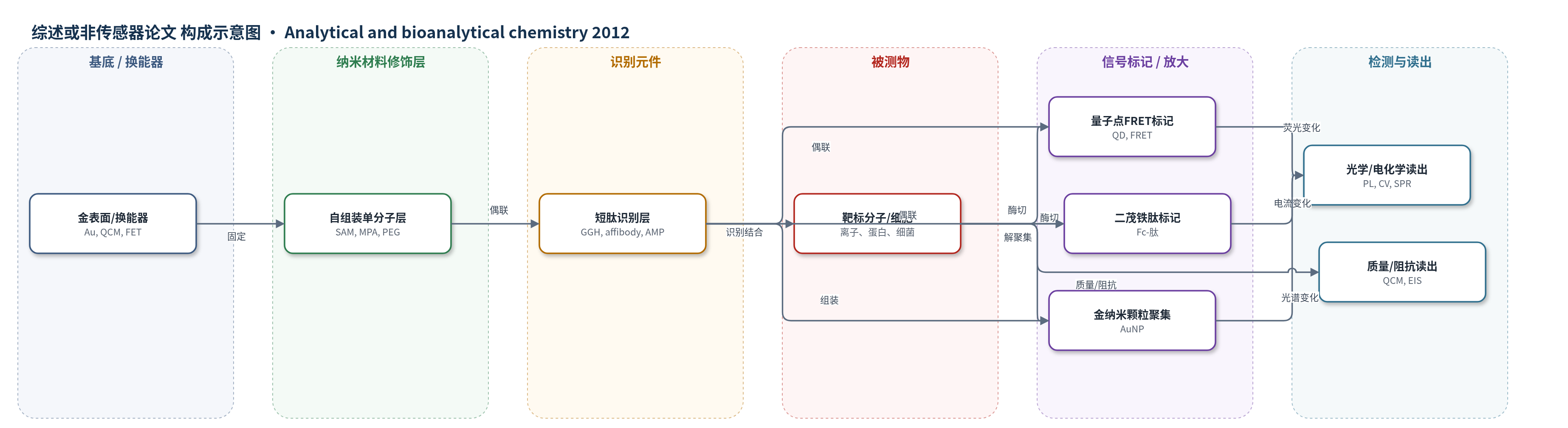
点击图片查看大图 · 依据论文自动绘制
传感器类型
综述或非传感器论文
检测对象
金属离子(Cu2+、Zn2+、Ni2+、Pb2+,溶液)、小分子(TNT、咖啡因、二噁英、VOCs,溶液/气体)、蛋白与酶(碳酐酶、蛋白酶、MMP、HIV-1 PR,缓冲液/细胞裂解液)、抗体(IgA、IgG、IgE、抗FLAG抗体,血清/缓冲液)、病原菌(大肠杆菌O157:H7、沙门氏菌、铜绿假单胞菌,水样/食品/临床样品)、毒素(肉毒毒素A/B,牛奶/溶液)
检测原理
短肽作为识别或换能元件,通过氨基酸残基与靶标形成配位、氢键、静电、疏水或酶切作用。金属离子传感器中,肽结合Cu2+/Zn2+后发生构象变化、自组装或纳米颗粒聚集,改变界面电荷、质量、荧光FRET或表面等离子共振信号;小分子结合可改变QCM质量或SPR折射率。蛋白酶检测中,肽底物被酶切后释放荧光片段或使二茂铁(Fc)标签远离电极,导致FRET效率或循环伏安电流下降;量子点(QD)-FRET体系利用酶切改变供体-受体距离实现放大。抗菌肽(AMP)结合细菌膜后改变互指电极阻抗或荧光标记细胞数量。信号随靶标浓度增加而单调变化,部分体系通过多价肽、纳米颗粒聚集或微流控富集实现放大。
检测灵敏度
LOD: 0.05 ng/ml;LOD: 5.2 pM;LOD: 0.11 μg/ml;LOD: 0.34 μg/ml;LOD: 100 pM;LOD: 12.5 mg/ml;LOD: 30 pM;LOD: 3 pM;LOD: 0.35 nM;LOD: 3.4 pM;LOD: 4 nM;LOD: 0.8 pM;LOD: 50 ng/mL;LOD: 27 ng/mL;线性范围: 1 nM to 1 mM;线性范围: 4–120 pM;线性范围: 0.1-6 μg/ml;线性范围: 0.01–10 nM;线性范围: 870 pM to 87 nM;线性范围: 1-1,000 nM
效应效果
综述指出肽基传感器选择性依赖肽序列与靶标匹配:Gly-Gly-His对Cu2+选择性优于其异构体,affibody微阵列对IgA、IgG、TNF-α等无交叉反应,AMP可区分革兰阴性菌。部分噬菌体展示肽性能优于抗体,但TNT因固定化修饰导致LOD高达12.5 mg/ml。肉毒毒素A传感器可检测至3 pg/mL,低于目标LOD十倍;肉毒毒素B在牛奶加标2 pg/mL时检出16 pg。AMP阻抗平台达到1个细菌/μL的临床相关限。QCM/SPR可实现无标记实时分析,但实际水样检测、灵敏度、选择性和器件可重复使用仍是挑战。
传感器的构成
- 基底/换能器:金表面、石英晶体微天平(QCM)、硅纳米线场效应晶体管(FET)、互指微电极阵列,提供固定平台与信号转换。
- 自组装单分子层(SAM):巯基丙酸(MPA)、烷硫醇、聚乙二醇(PEG)间隔臂,用于固定短肽并调节表面极性。
- 识别元件:短肽(Gly-Gly-His、锌指肽、affibody、螺旋-环-螺旋肽、抗菌肽AMP、细胞穿透肽CPP、肽底物SNAP-25/D-Ala-D-Ala),负责靶标识别或酶切底物结合。
- 信号标记/放大:荧光量子点(QD)、二茂铁(Fc)、荧光团/猝灭剂(FRET)、金纳米颗粒(AuNP)聚集,用于产生或放大信号。
- 微流控/界面结构:聚二甲基硅氧烷(PDMS)微通道、微阵列金垫,用于样品引入与多通道检测。
- 读出系统:电化学伏安/阻抗、荧光/发光、表面等离子共振(SPR/SPRI)、QCM、FET等,将识别事件转为电信号或光信号。
中文摘要
本综述讨论短肽(不超过50个氨基酸)作为仿生活性识别元件在传感系统中的应用。近年来,基于不同策略发展了多种肽基传感器:根据单个或少数氨基酸与靶标之间的已知相互作用设计合成肽,并关注能促使传感肽在传感器表面分子间自组装的肽基序;由此可获得高灵敏度、结构复杂的传感器,但设计肽受限于计算机辅助设计的严重困难。随机噬菌体展示短肽从大型、非聚焦且常为现成商业噬菌体展示库中随机筛选,不含设计元件;这类肽有时性能优于抗体,但当靶标为小分子时,因需对其结构进行较大修饰以便固定化而难以筛选。通过缩短已知天然受体序列至可合成且稳定的长度,可获得人工微型化受体;也可在设计稳定的肽支架上构建结合位点。短肽还可作为活性元件检测其天然受体:抗菌肽和细胞穿透肽用于检测病原菌,但实际样品检测、灵敏度与选择性提升仍是关键挑战。肽底物偶联荧光量子点可获得高灵敏度一次性蛋白酶活性传感器;二茂铁-肽偶联物用于蛋白酶活性的电化学传感。
英文摘要
This review deals with short peptides (up to 50 amino acids) as biomimetic active recognition elements in sensing systems. Peptide-based sensors have been developed in recent years according to different strategies. Synthetic peptides have been designed on the basis of known interactions between single or a few amino acids and targets, with attention being paid to the presence of peptide motifs known to allow intermolecular self-organization of the sensing peptides over the sensor surface. Sensitive and sophisticated sensors have been obtained in this way, but the use of designed peptides is limited by severe difficulties in their in silico design. Short peptides from random phage display have been selected in a random way from large, unfocussed, and often preexisting and commercially available phage display libraries, with no design elements. Such peptides often perform better than antibodies, but they are difficult to select when the target is a small molecule because of the need to immobilize it with considerable modifications of its structure. Artificial, miniaturized receptors have been obtained from the reduction of the known sequence of a natural receptor down to a synthesizable and yet stable one. Alternatively, binding sites have been created over a designed, stable peptide scaffold. Short peptides have also been used as active elements for the detection of their own natural receptors: pathogenic bacteria have been detected with antimicrobial and cell-penetrating peptides, but key challenges such as detection of bacteria in real samples, improved sensitivity, and improved selectivity have to be faced. Peptide substrates have been conjugated to fluorescent quantum dots to obtain disposable sensors for protease activity with high sensitivity. Ferrocene-peptide conjugates have been used for electrochemical sensing of protease activity.