组成图示
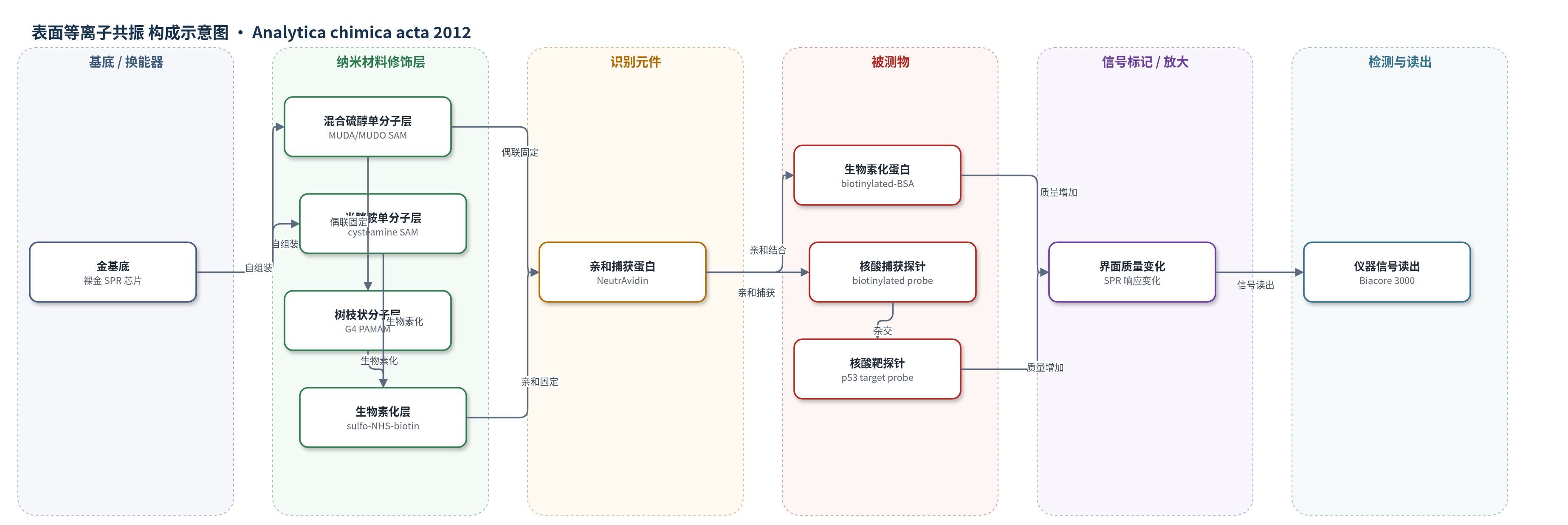
点击图片查看大图 · 依据论文自动绘制
传感器类型
表面等离子共振(SPR)生物传感器
检测对象
生物素化牛血清白蛋白(biotinylated-BSA)、单链 DNA 探针/靶 DNA(DNA probe/target DNA,p53 基因片段);样品基质:PBS 缓冲液(蛋白)、Tris-EDTA 缓冲液(DNA)
检测原理
该传感器基于表面等离子共振(SPR)原理。在裸金芯片上构建 MUDA/MUDO 或半胱胺自组装单分子层,再通过 EDC/NHS 化学固定第 4 代 PAMAM 树枝状分子或直接固定 NeutrAvidin(NA),并用 sulfo-NHS-biotin 进行生物素化。生物素化 BSA 或生物素化 DNA 捕获探针经生物素—亲和素作用结合到 NA 上,随后靶 DNA 与捕获探针发生杂交。结合事件使传感器界面质量与折射率增加,改变金膜表面等离子体共振条件,Biacore 3000 以响应单位(RU)记录结合曲线。信号大小与结合量及被测物浓度相关;方法未使用酶催化、HCR、RCA 或 CRISPR 等放大策略,主要依赖亲和捕获和 DNA 杂交特异性。
检测灵敏度
原文未报告 LOD、线性范围、灵敏度斜率或相关系数。
效应效果
选择性方面,5 μg/mL 非生物素化 BSA 非特异结合为 19–38 RU,scrambled DNA 探针非特异结合为 0。重现性方面,DNA 杂交经再生后响应一致,但未报告 RSD。NeutrAvidin 固定量在 1% MUDA 树枝状分子表面比平面表面高 1.5 倍,10% MUDA 高 1.3 倍。蛋白捕获中,biotin-BSA 在 10% MUDA 树枝状分子表面为 758±43 RU,1% MUDA 为 701±33 RU。DNA 捕获以 1% MUDA+EDC/NHS 最佳,为 559±34.6 RU;杂交响应为 320±26 RU。作者认为 1% MUDA 适合蛋白检测,1% MUDA+EDC/NHS 适合 DNA 检测。
传感器的构成
- 基底:裸金 SPR 传感器芯片(Au),作为表面等离子共振换能基底。
- 自组装单分子层:MUDA/MUDO 混合 SAM(1%、10%、100% MUDA)或半胱胺 SAM(cysteamine),提供羧基或氨基功能化界面。
- 树枝状分子修饰层:第 4 代氨基末端 PAMAM 树枝状分子(G4 amino PAMAM),经 EDC/NHS 偶联至 MUDA 羧基,增加表面功能基团密度。
- 生物素化层:sulfo-NHS-biotin 修饰 PAMAM 或半胱胺表面,提供生物素结合位点。
- 识别/捕获元件:NeutrAvidin(NA),通过生物素亲和或 EDC/NHS 胺偶联固定,用于捕获生物素化蛋白或 DNA 探针。
- 识别探针:生物素化 DNA 捕获探针与靶探针(p53 基因片段),用于杂交识别。
- 封闭剂:乙醇胺(ethanolamine)封闭剩余 EDC/NHS 活性位点;10 mM 生物素封闭剩余 NA 位点。
- 信号标记物:无外源标记,SPR 直接检测界面质量/折射率变化。
中文摘要
生物识别元件在传感器芯片表面的固定是构建生物传感器的关键步骤。多数生物传感器表面采用金属换能层,蛋白质等识别元件可直接吸附于金属或二氧化硅表面,但随机取向和界面相互作用可能导致分子变性、活性降低或丧失。自组装单分子层(SAMs)可有效隔离生物识别元件与传感器表面,实现配体的稳定固定,支持重复结合与再生,并降低非特异性吸附。本研究在表面等离子共振(SPR)传感器芯片的金表面上构建多种表面化学,用于蛋白质和 DNA 分子的固定与检测。实验采用半胱胺 SAM 以及 1%、10% 和 100% 巯基十一烷酸(MUDA)涂层,并比较有无第 4 代聚酰胺胺(PAMAM)树枝状分子修饰的影响。结果表明,与 MUDA 或半胱胺平面表面相比,树枝状分子修饰表面可显著提高 NeutrAvidin 的固定量;但在已固定的 NeutrAvidin 上进一步捕获蛋白质或 DNA 时,树枝状分子表面并未表现出相应更高的响应。
英文摘要
The immobilisation of biological recognition elements onto a sensor chip surface is a crucial step for the construction of biosensors. While some of the optical biosensors utilise silicon dioxide as the sensor surface, most of the biosensor surfaces are coated with metals for transduction of the signal. Biological recognition elements such as proteins can be adsorbed spontaneously on metal or silicon dioxide substrates but this may denature the molecule and can result in either activity reduction or loss. Self assembled monolayers (SAMs) provide an effective method to protect the biological recognition elements from the sensor surface, thereby providing ligand immobilisation that enables the repeated binding and regeneration cycles to be performed without losing the immobilised ligand, as well as additionally helping to minimise non-specific adsorption. Therefore, in this study different surface chemistries were constructed on SPR sensor chips to investigate protein and DNA immobilisation on Au surfaces. A cysteamine surface and 1%, 10% and 100% mercaptoundecanoic acid (MUDA) coatings with or without dendrimer modification were utilised to construct the various sensor surfaces used in this investigation. A higher response was obtained for NeutrAvidin immobilisation on dendrimer modified surfaces compared to MUDA and cysteamine layers, however, protein or DNA capture responses on the immobilised NeutrAvidin did not show a similar higher response when dendrimer modified surfaces were used.