组成图示
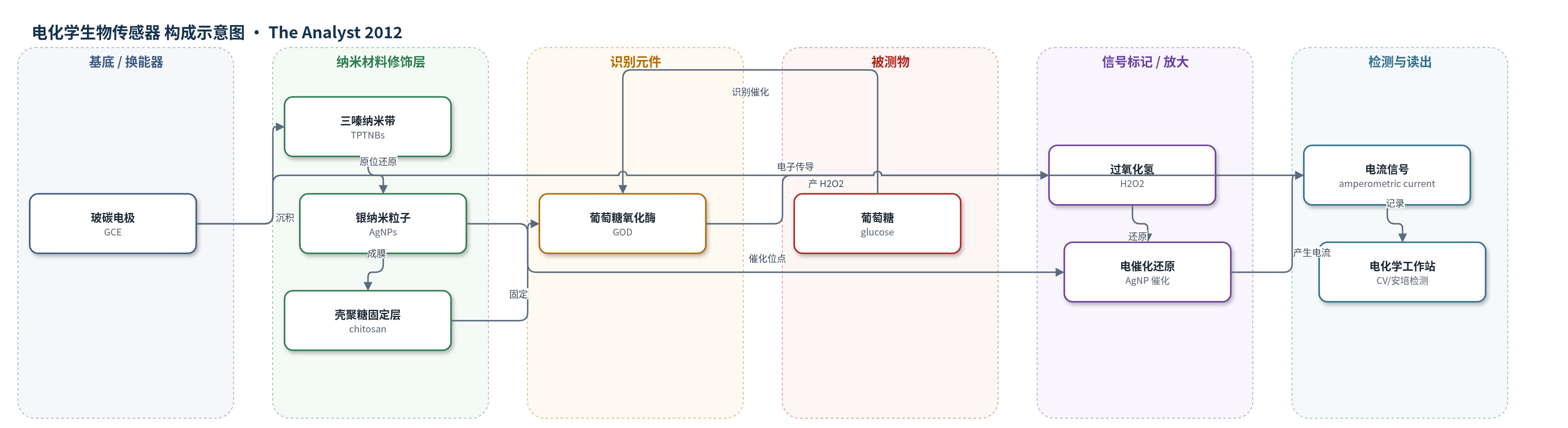
点击图片查看大图 · 依据论文自动绘制
传感器类型
电化学生物传感器
检测对象
葡萄糖(glucose,PBS 缓冲液/人血清)、过氧化氢(H2O2,PBS 缓冲液)
检测原理
葡萄糖氧化酶(GOD)特异性催化葡萄糖在氧气存在下氧化为葡萄糖酸并生成过氧化氢(H2O2),H2O2 生成量随葡萄糖浓度增加而增加。AgNP-TPTNBs 中的银纳米粒子(AgNPs)对 H2O2 还原具有电催化活性,在负电位下将 H2O2 还原为 O2、H+ 和电子,电子经玻碳电极(GCE)传递形成还原电流。TPTNBs 通过吡啶基配位吸附 Ag(I) 并原位还原形成 AgNPs,同时作为支撑层增加电极粗糙度与孔隙,改善传质。因此,葡萄糖浓度越高,产生的 H2O2 越多,AgNP 催化还原电流越大,实现电化学检测。
检测灵敏度
葡萄糖:LOD: 190 mM;线性范围: 3 mM–20 mM;r: 0.999;H2O2:LOD: 2.04 mM;线性范围: 0.1 mM–60 mM;r: 0.985
效应效果
葡萄糖传感器对 6 mM 葡萄糖 RSD 为 4.1%(5 次),Km 为 25.1 mM,接近游离酶。AA、DA、AP、UA 干扰可忽略。人血清标准加入法线性至 18 mM,结果与医院值接近(6.05/5.55、6.77/6.36、7.65/7.49 mM,RSD 2.9%–4.3%)。4 ℃ 保存 2 天保留 93%,40 天保留 73%。H2O2 传感器对 1 mM H2O2 RSD 3.9%,30 天损失 10.4%,95% 响应 2 s 内达到。作者称其线性范围、检测限和灵敏度优于已报道模型,适合生物样品与实时葡萄糖监测。
传感器的构成
- 基底/换能器电极:玻碳电极(GCE),提供电子传导与电化学检测界面
- 纳米材料修饰层:AgNP-TPTNBs(银纳米粒子修饰的 2,4,6-三(2-吡啶基)-1,3,5-三嗪纳米带),提供 H2O2 电催化还原活性并负载 GOD
- 识别元件:葡萄糖氧化酶(GOD),特异性催化葡萄糖氧化生成 H2O2
- 固定/成膜层:壳聚糖(chitosan),用于沉积固定 GOD 与 AgNP-TPTNBs 于 GCE 表面
- 信号产物:过氧化氢(H2O2),由 GOD 催化葡萄糖氧化产生,经 AgNP 电催化还原形成电流信号
中文摘要
本文首次报道通过调节溶液 pH 值制备 2,4,6-三(2-吡啶基)-1,3,5-三嗪纳米带(TPTNBs),并将硝酸银水溶液与预形成的 TPTNBs 混合,在无外加还原剂条件下合成银纳米粒子(AgNP)修饰的 TPTNBs(AgNP-TPTNBs)。所得 AgNP-TPTNBs 对过氧化氢(H2O2)还原表现出显著催化性能。基于该纳米复合材料,将葡萄糖氧化酶(GOD)固定于 AgNP-TPTNBs 修饰的玻碳电极(GCE)表面,构建了葡萄糖生物传感器。该传感器对葡萄糖具有较宽线性响应范围 3 mM–20 mM(r=0.999),检测限为 190 mM,并可用于人血清中葡萄糖检测。结果表明,AgNP-TPTNBs 可作为构建高灵敏度、良好选择性和稳定性电化学葡萄糖传感器的有效材料。
英文摘要
The present paper reports on the first preparation of 2,4,6-tris(2-pyridyl)-1,3,5-triazine nanobelts (TPTNBs) by adjusting the pH value of the solution and the subsequent synthesis of Ag nanoparticle (AgNP)-decorated TPTNBs (AgNP-TPTNBs) by mixing an aqueous AgNO(3) solution with preformed TPTNBs without use of any external reducing agent. It is found that the resultant AgNP-TPTNBs exhibit notable catalytic performance for H(2)O(2) reduction. A glucose biosensor was fabricated by immobilizing glucose oxidase (GOD) onto a AgNP-TPTNBs-modified glassy carbon electrode (GCE) for glucose detection. The constructed glucose sensor has a wide linear response range from 3 mM to 20 mM (r: 0.999) with a detection limit of 190 μM. It is further shown that this glucose biosensor can be used for glucose detection in human blood serum.