组成图示
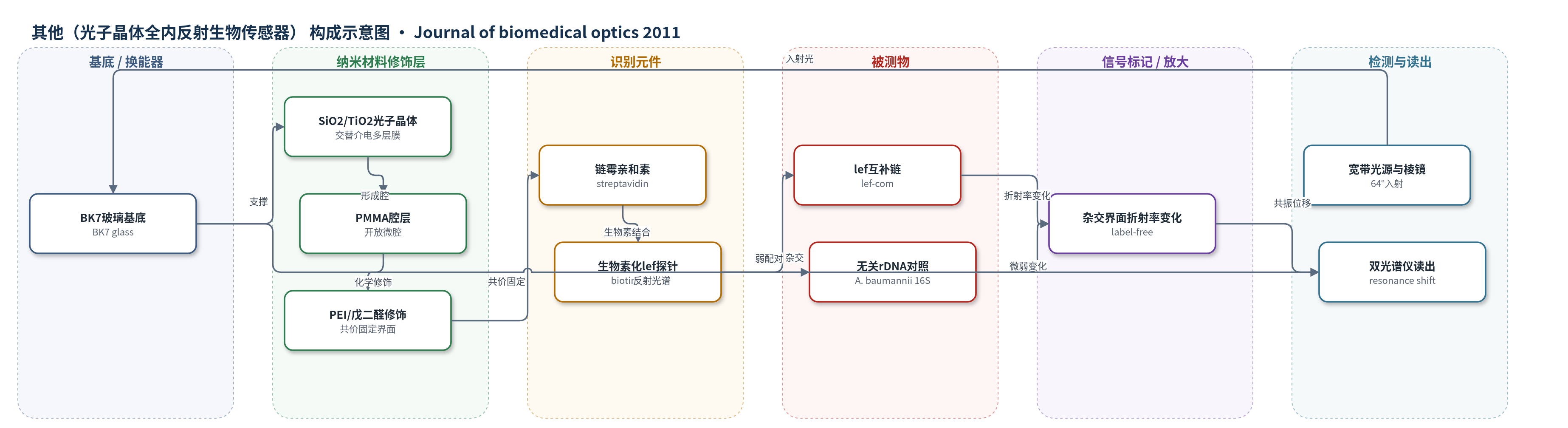
点击图片查看大图 · 依据论文自动绘制
传感器类型
其他(光子晶体全内反射生物传感器)
检测对象
炭疽杆菌 lef 基因互补单链 DNA(Bacillus anthracis lef-com, ssDNA);样品基质:PBS 缓冲液
检测原理
该传感器利用光子晶体全内反射结构形成开放微腔,共振波长对腔层附近折射率变化敏感。PMMA 腔层经 PEI 和戊二醛化学修饰后,链霉亲和素通过醛基与氨基共价固定;生物素化 lef 探针 DNA 再经生物素—链霉亲和素结合固定于表面。当靶标 lef-com 加入时,与固定探针发生互补杂交,使传感界面生物分子层厚度和局部折射率增加,导致共振波长红移。共振波长位移随 lef-com 浓度增加而增大,在 100 nM 时出现结合饱和趋势;无关 DNA 因碱基配对少仅产生微弱位移。系统采用双通道光谱仪,以参考通道补偿机械漂移和温度波动,实现无标记实时检测。
检测灵敏度
LOD: 0.1 nM
效应效果
该传感器对炭疽 lef 互补链具有明显选择性:100 nM lef-com 引起共振波长位移约 1.2 nm,而无关 16S rDNA 对照仅位移 0.2 nm,降低约 84%。探针固定阶段,洗涤后共振位移由 4.6 nm 降至 3.5 nm,表明非特异结合被有效去除。检测灵敏度可达 0.1 nM,100 nM 时响应趋于饱和,提示高浓度下结合位点饱和。作者认为该无标记光子晶体全内反射平台可快速、特异检测炭疽 DNA,适用于生物恐怖威胁下对环境中芽孢或体内营养体细胞的早期筛查,但文中未报告 RSD、实际样品回收率或与 ELISA/HPLC/qPCR 的定量对比。
传感器的构成
- 基底:BK7 玻璃基底,承载光子晶体并支撑全内反射光路
- 光子晶体层:SiO2/TiO2 交替介电多层膜,形成光子带隙与共振模式
- 腔层:PMMA 薄膜,构成开放微腔传感界面
- 化学修饰层:PEI 与戊二醛处理 PMMA,引入氨基/醛基以共价固定链霉亲和素
- 捕获层:链霉亲和素(streptavidin),共价固定于修饰表面并捕获生物素化探针
- 识别元件:生物素化 lef 探针 DNA(80-mer ssDNA),与 lef-com 互补杂交
- 样品池:PDMS 样品池,容纳 PBS 样品并实现双通道检测
- 信号标记物:无标记(label-free),依赖 DNA 杂交改变界面折射率
中文摘要
炭疽杆菌(Bacillus anthracis)因其质粒编码的毒力因子而具有生物武器威胁,其中 lef 基因编码致死因子。本文报道了一种基于光子晶体结构并采用全内反射(TIR)构型的快速、高灵敏炭疽 DNA 生物传感器。用于检测 lef 基因时,将单链 lef 探针 DNA 进行生物素化,并通过生物素—链霉亲和素相互作用固定于传感器表面。以探针互补链 lef-com 作为阳性对照,以来自鲍曼不动杆菌 16S rRNA 基因的无关单链 DNA 作为阴性对照。加入生物素化 lef 探针后,由于探针与表面链霉亲和素结合,传感器共振波长发生显著变化;加入 lef-com 后,因两条 DNA 链杂交,共振波长进一步显著增加。靶 DNA 的检测灵敏度可达 0.1 nM,而无关 DNA 未引起明显共振波长位移。结果表明,该光子晶体全内反射传感器检测炭疽 lef 基因具有高特异性和高灵敏度。
英文摘要
Bacillus anthracis has posed a threat of becoming biological weapons of mass destruction due to its virulence factors encoded by the plasmid-borne genes, such as lef for lethal factor. We report the development of a fast and sensitive anthrax DNA biosensor based on a photonic crystal structure used in a total-internal-reflection configuration. For the detection of the lef gene, a single-stranded DNA lef probe was biotinylated and immobilized onto the sensor via biotin-streptavidin interactions. A positive control, lef-com, was the complementary strand of the probe, while a negative control was an unrelated single-stranded DNA fragment from the 16S rRNA gene of Acinetobacter baumannii. After addition of the biotinylated lef probe onto the sensor, significant changes in the resonance wavelength of the sensor were observed, resulting from binding of the probe to streptavidin on the sensor. The addition of lef-com led to another significant increase as a result of hybridization between the two DNA strands. The detection sensitivity for the target DNA reached as low as 0.1 nM. In contrast, adding the unrelated DNAs did not cause an obvious shift in the resonant wavelength. These results demonstrate that detection of the anthrax lef by the photonic crystal structure in a total-internal-reflection sensor is highly specific and sensitive.