组成图示
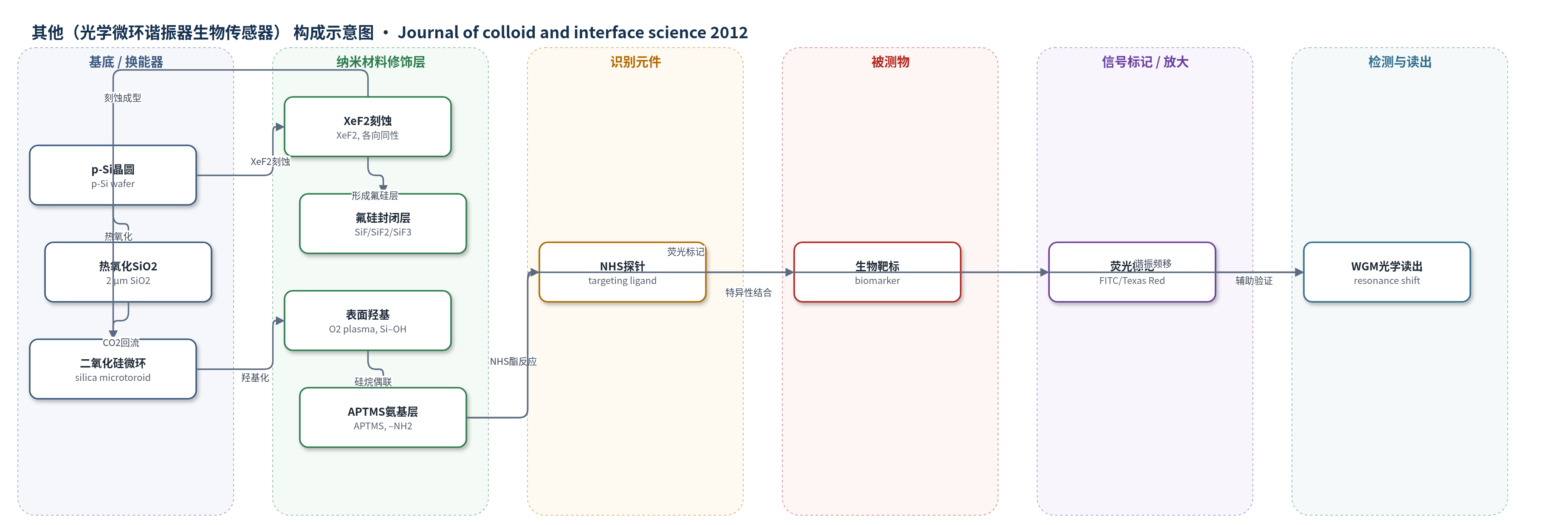
点击图片查看大图 · 依据论文自动绘制
传感器类型
其他(光学微环谐振器生物传感器)
检测对象
未指定(通用生物靶标 biomarker/antigen);样品基质未指定(缓冲液/生物流体)
检测原理
该器件为硅基二氧化硅微环WGM光学生物传感器。制造中XeF2各向同性刻蚀硅,在暴露硅表面留下10–20 Å氟硅层(SiF/SiF2/SiF3),该层阻碍O2等离子体羟基化和APTMS硅烷偶联,因此NHS酯探针主要共价固定于SiO2微环表面,形成选择性图案化。检测时,靶标生物分子与表面探针特异性结合,增加微环表面质量并改变局部折射率,使WGM谐振频率/波长发生偏移;通过监测谐振峰位移实现无标记定量。文中未采用HCR/RCA等放大策略,主要贡献是表面选择性功能化。
检测灵敏度
原文未报告LOD、线性范围、灵敏度斜率或R^2。
效应效果
本文未报告实际样品检测、加标回收率、RSD或与ELISA/qPCR等方法的对比。主要性能为表面选择性:KOH刻蚀的硅与二氧化硅样品FITC荧光强度几乎一致,排除硅对荧光的猝灭;XeF2刻蚀后硅表面结合极弱,而二氧化硅表面结合强,证实选择性图案化。AFM显示裸SiO2和Si的rms粗糙度分别为1.79 nm和1.58 nm;10 μm刻蚀深度下KOH和XeF2样品rms分别为8.765 nm和11.844 nm,差异不足以解释图案化。XPS显示XeF2刻蚀后存在氟峰,O2等离子体后暂时掩盖,氨基化后再次出现,且胺峰缺失或很弱,支持氟硅层阻碍羟基化/硅烷偶联。作者认为该方法简单、通用,可在制造阶段实现选择性生物偶联,提高硅基及非硅换能器生物传感器性能。
传感器的构成
- 基底/换能器:p型(100)硅晶圆(Si wafer)与2 μm热氧化SiO2,提供机械支撑和光学刻蚀模板。
- 光学谐振器:二氧化硅微环(silica microtoroid, WGM optical resonator),由SiO2 pad经XeF2刻蚀和CO2激光回流形成,作为无标记光学换能器。
- 表面活化层:O2 plasma处理在SiO2表面生成羟基(Si–OH),用于硅烷偶联。
- 偶联修饰层:氨基丙基三乙氧基硅烷(APTMS)通过水解缩合连接羟基并暴露伯胺(–NH2)。
- 识别元件:NHS酯标记探针分子/靶向配体(probe molecule/targeting ligand;文中示例为生物素化偶联 biotinylation),与伯胺形成酰胺键固定。
- 信号标记物:荧光染料FITC/Texas Red,与伯胺反应用于验证表面偶联位置(非最终传感信号)。
- 选择性图案化层:XeF2刻蚀在硅表面形成氟硅层(fluorosilyl layer, SiF/SiF2/SiF3),抑制硅烷偶联,使生物分子仅结合SiO2微环。
中文摘要
超灵敏无标记生物传感器有望在医学诊断等领域产生重大影响。对于大多数硅基集成器件,必须用靶向配体对表面进行功能化,才能实现特异性生物检测。通常采用硅烷偶联剂固定靶向配体,但该方法往往导致整个器件表面发生生物偶联,并不理想。为克服这一问题,研究者发展了多种复杂封闭策略,以实现传感器表面的选择性图案化。近期,硅烷偶联剂被用于将生物分子连接到硅晶圆上集成的二氧化硅环形生物传感器表面,有趣的是只有二氧化硅生物传感器表面被偶联。本文假设并解释了这种选择性图案化的原因:用于制造生物传感器的硅刻蚀剂二氟化氙(XeF2)似乎降低了硅烷偶联剂附着到底层硅晶圆上的效率。这些结果将有助于未来研究者更简单地控制传感器表面的生物偶联,从而提高生物传感器器件性能。
英文摘要
Ultra-sensitive, label-free biosensors have the potential to have a tremendous impact on fields like medical diagnostics. For the majority of these Si-based integrated devices, it is necessary to functionalize the surface with a targeting ligand in order to perform specific biodetection. To do this, silane coupling agents are commonly used to immobilize the targeting ligand. However, this method typically results in the bioconjugation of the entire device surface, which is undesirable. To compensate for this effect, researchers have developed complex blocking strategies that result in selective patterning of the sensor surface. Recently, silane coupling agents were used to attach biomolecules to the surface of silica toroidal biosensors integrated on a silicon wafer. Interestingly, only the silica biosensor surface was conjugated. Here, we hypothesize why this selective patterning occurred. Specifically, the silicon etchant (xenon difluoride), which is used in the fabrication of the biosensor, appears to reduce the efficiency of the silane coupling attachment to the underlying silicon wafer. These results will enable future researchers to more easily control the bioconjugation of their sensor surfaces, thus improving biosensor device performance.