组成图示
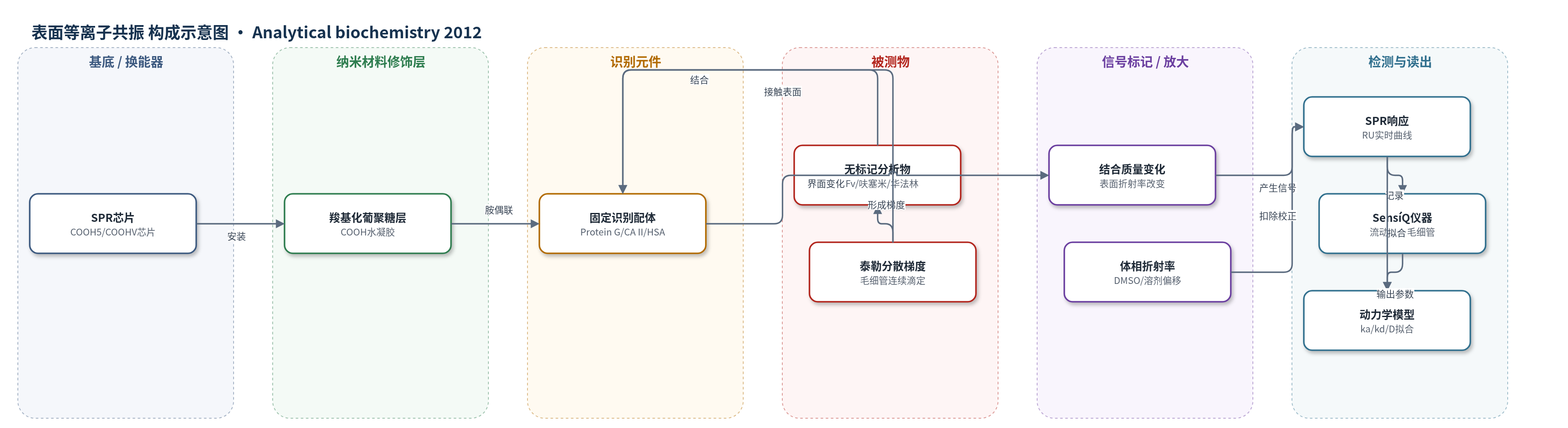
点击图片查看大图 · 依据论文自动绘制
传感器类型
表面等离子共振(SPR)生物传感器
检测对象
抗 ErbB2 单链可变片段(scFv,HBS-TE 缓冲液)、呋塞米(furosemide,HBS-T 缓冲液)、华法林(warfarin,HBS-TE/3% DMSO 缓冲液)
检测原理
Taylor dispersion 注入将分析物先载入长毛细管,在层流与扩散共同作用下形成随时间变化的连续浓度梯度 C(t)。分析物进入流动池后与固定于羧基化葡聚糖水凝胶表面的识别配体(Protein G 捕获的 rhErbB2/Fc、CA II 或 HSA)结合,使界面质量与折射率改变,SPR 换能器将其转换为响应单位(RU)信号。由于 C(t) 由 Taylor–Aris 分散理论给出,可代入两室 1:1 动力学模型或实时等温模型,同时拟合结合/解离速率常数 ka/kd、最大响应 Rmax、扩散系数 D 和质量传输常数 km。体相折射率与 DMSO/溶剂偏移通过双参考通道扣除。该方法无需外源标记或酶放大,依靠连续滴定提高浓度分辨率,使单次注入即可解析多位点结合。
检测灵敏度
相关系数: 0.995;R^2 = 0.999
效应效果
在 scFv–rhErbB2/Fc 体系中,TDi 与 FCI 全局拟合参数差异 <15%,残差 SD <0.20 RU;scFv 扩散系数为 8.878(2)×10^-11 m²/s,与预期差 <5%,局部拟合 D 的 CV 仅 0.5%。呋塞米–CA II 中,TDi 覆盖 1000 倍浓度范围(FCI 约 252 倍),ka 的标准误差比 FCI 低 20 倍;降解表面非特异结合约占 70% 总响应时,局部 ka CV 为 3.6%,D 校正后与预期差 <10%。华法林–HSA 的 36 条 PulseTDi 曲线基本重合,仅 1 条部分偏离;三位点实时等温拟合平均残差 SD 为 0.26 RU。扩散系数测量值与预期值相关系数 0.995、R²=0.999。作者认为 TDi 可简化样品准备与运行时间,适用于高通量片段筛选和复杂多位点结合分析。
传感器的构成
- 基底/换能器:SPR 传感器芯片(COOH5/COOHV)与流动池,提供表面等离子共振折射率检测
- 通道抗污涂层:0.1% Tyloxapol 涂覆流动通道,减少分析物非特异吸附
- 修饰层:羧基化葡聚糖水凝胶(carboxylated dextran hydrogel),通过胺偶联固定识别分子
- 识别元件:蛋白G(Protein G)捕获重组人 ErbB2/Fc(rhErbB2/Fc),或直接固定碳酸酐酶 II(CA II)/人血清白蛋白(HSA)
- 分析物:无标记 scFv、呋塞米(furosemide)、华法林(warfarin)等结合配体
- 分散模块:ETFE/PEEK 毛细管(tube A–E)产生 Taylor dispersion 连续浓度梯度
- 信号读出:SPR 响应单位(RU)实时记录表面结合与体相折射率变化
中文摘要
在无标记生物分子相互作用分析中,标准注入通常提供均匀的分析物浓度。利用泰勒分散(Taylor dispersion)的替代注入方式可在毛细管中形成连续的分析物浓度梯度,使单次注入即可记录完整的剂量响应曲线。本文使用商用表面等离子共振(SPR)生物传感器展示了该方法的增强生物物理表征能力。将动力学相互作用模型局部拟合泰勒分散曲线,除获得亲和常数和动力学常数外,还可同时估计分析物扩散系数。单次泰勒分散注入所得参数的统计置信度与多个标准注入进行全局分析相当;多位点相互作用的亲和常数也可在可接受的置信限内解析。更重要的是,单次分析物注入可被处理为高分辨率实时亲和等温线,并用华法林与人血清白蛋白的复杂两位点相互作用加以验证。在三种模型相互作用中,动力学/亲和常数与标准动力学分析结果一致,分析物扩散系数估计值与预期值良好吻合。
英文摘要
In label-free biomolecular interaction analysis, a standard injection provides an injection of uniform analyte concentration. An alternative approach exploiting Taylor dispersion produces a continuous analyte titration allowing a full analyte dose response to be recorded in a single injection. The enhanced biophysical characterization that is possible with this new technique is demonstrated using a commercially available surface plasmon resonance-based biosensor. A kinetic interaction model was fitted locally to Taylor dispersion curves for estimation of the analyte diffusion coefficient in addition to affinity/kinetic constants. Statistical confidence in the measured parameters from a single Taylor dispersion injection was comparable to that obtained for global analysis of multiple standard injections. The affinity constants for multisite interactions were resolved with acceptable confidence limits. Importantly, a single analyte injection could be treated as a high-resolution real-time affinity isotherm and was demonstrated using the complex two-site interaction of warfarin with human serum albumin. In all three model interactions tested, the kinetic/affinity constants compared favorably with those obtained from standard kinetic analysis and the estimates of analyte diffusion coefficients were in good agreement with the expected values.