组成图示
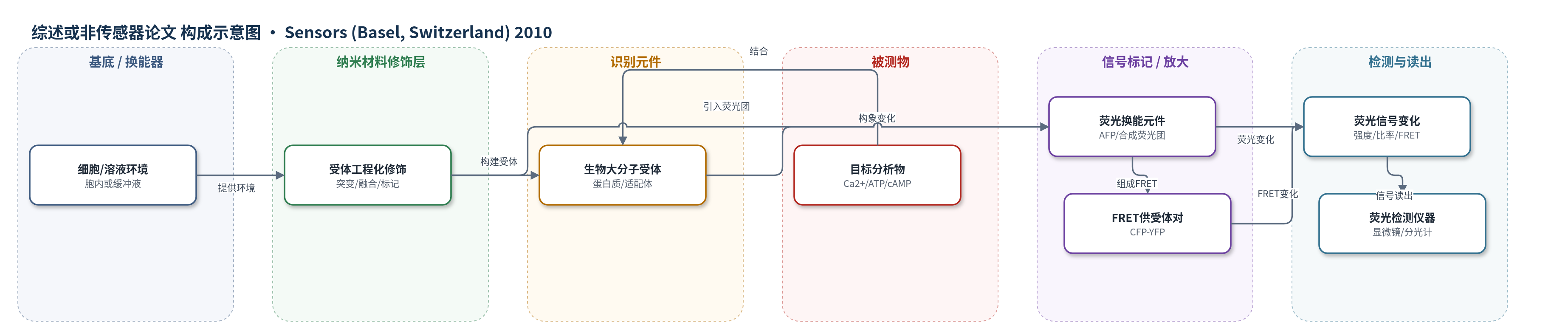
点击图片查看大图 · 依据论文自动绘制
传感器类型
综述或非传感器论文
检测对象
钙离子(Ca2+)、ATP、cAMP、cGMP、pH、卤素离子、Hg2+、Zn2+、肌醇磷酸酯(InsP3/InsP4)、葡萄糖、麦芽糖、β-内酰胺抗生素、糖类、DNA甲基化、mRNA、K+、组胺、磷酸酪氨酸(pY);样品基质:活细胞胞内、缓冲液/水溶液、复杂生物流体
检测原理
该类荧光生物传感器通常由生物大分子受体与荧光换能元件组成。目标分子与受体结合后,引起受体构象变化、亚基解离/组装或结合口袋微环境改变;这些变化改变荧光蛋白/合成荧光团的激发-发射特性、FRET 供受体距离或荧光团-淬灭剂距离,从而产生荧光强度、比率荧光或 FRET 信号变化。信号大小与目标分子浓度相关:结合比例越高,构象态或 FRET 效率变化越显著。文中策略包括双 AFP-FRET、单环化 GFP、split GFP 重组、化学修饰蛋白质、适配体信标和模块化 RNP 组合,主要依赖分子识别引起的结构/界面变化,而非酶催化或核酸扩增放大。
检测灵敏度
原文未报告具体 LOD、线性范围、灵敏度斜率或 R^2。
效应效果
作为综述,本文未给出统一 LOD、RSD、回收率或方法学对比数据。文中强调代表性传感器具有较高选择性和快速响应:Btk-cpGFP 保留原 PH 结构域对 Ins(1,3,4,5)P4 的亲和力和选择性;含 6MAP 的 thrombin 适配体显示 30 倍荧光增强;G-CaMP 具有高信噪比,可追踪胞内 Ca2+ 动态。比率荧光和 FRET 设计可抵消背景、表达量与光漂白波动;模块化 RNP 策略通过组合 RNA 受体库与荧光标记 Rev 肽库,高通量获得 ATP、GTP、组胺、pY 等传感器。作者主张该策略有助于在活细胞中实时、低扰动地监测生物分子。
传感器的构成
- 修饰/工程化层:受体突变、融合或化学标记(如 Cys 突变、SNAP-tag、P-PALM)用于引入荧光团
- 识别元件:生物大分子受体(蛋白质/适配体,如 CaM、PH、MBP、PBP、ConA、anti-ATP aptamer)负责特异性结合目标分子
- 信号换能元件:自荧光蛋白(AFP,GFP/CFP/YFP)或合成荧光团(coumarin、fluorescein、BODIPY、pyrene)将结合事件转换为荧光变化
- 信号读出:荧光强度、比率荧光或 FRET 信号,用于实时监测胞内分子
中文摘要
荧光生物传感器可在活细胞中实时检测重要生物分子的真实事件,已成为分子与细胞生物学研究的重要工具。近年来,荧光生物传感器的发展不仅有助于阐明单个生物分子的功能,也推动了人们对细胞内分子间动态关系的理解。然而,荧光生物传感器的理性设计策略尚未完全成熟,建立更通用、更灵活的设计方法仍是迫切需求。模块化策略通过受体与信号换能元件的简单组合,可方便地制备具有特定性能的传感器,成为有吸引力的替代方案。本综述概述了基于生物大分子受体的荧光生物传感器设计策略进展,包括自荧光蛋白(AFP)型传感器、共价修饰合成荧光团的蛋白质型传感器以及信号适配体,并重点讨论如何将特定受体转化为荧光生物传感器,同时阐明模块化策略在传感器设计中的意义。
英文摘要
Fluorescent biosensors to detect the bona fide events of biologically important molecules in living cells are increasingly demanded in the field of molecular cell biology. Recent advances in the development of fluorescent biosensors have made an outstanding contribution to elucidating not only the roles of individual biomolecules, but also the dynamic intracellular relationships between these molecules. However, rational design strategies of fluorescent biosensors are not as mature as they look. An insatiable request for the establishment of a more universal and versatile strategy continues to provide an attractive alternative, so-called modular strategy, which permits facile preparation of biosensors with tailored characteristics by a simple combination of a receptor and a signal transducer. This review describes an overview of the progress in design strategies of fluorescent biosensors, such as auto-fluorescent protein-based biosensors, protein-based biosensors covalently modified with synthetic fluorophores, and signaling aptamers, and highlights the insight into how a given receptor is converted to a fluorescent biosensor. Furthermore, we will demonstrate a significance of the modular strategy for the sensor design.