组成图示
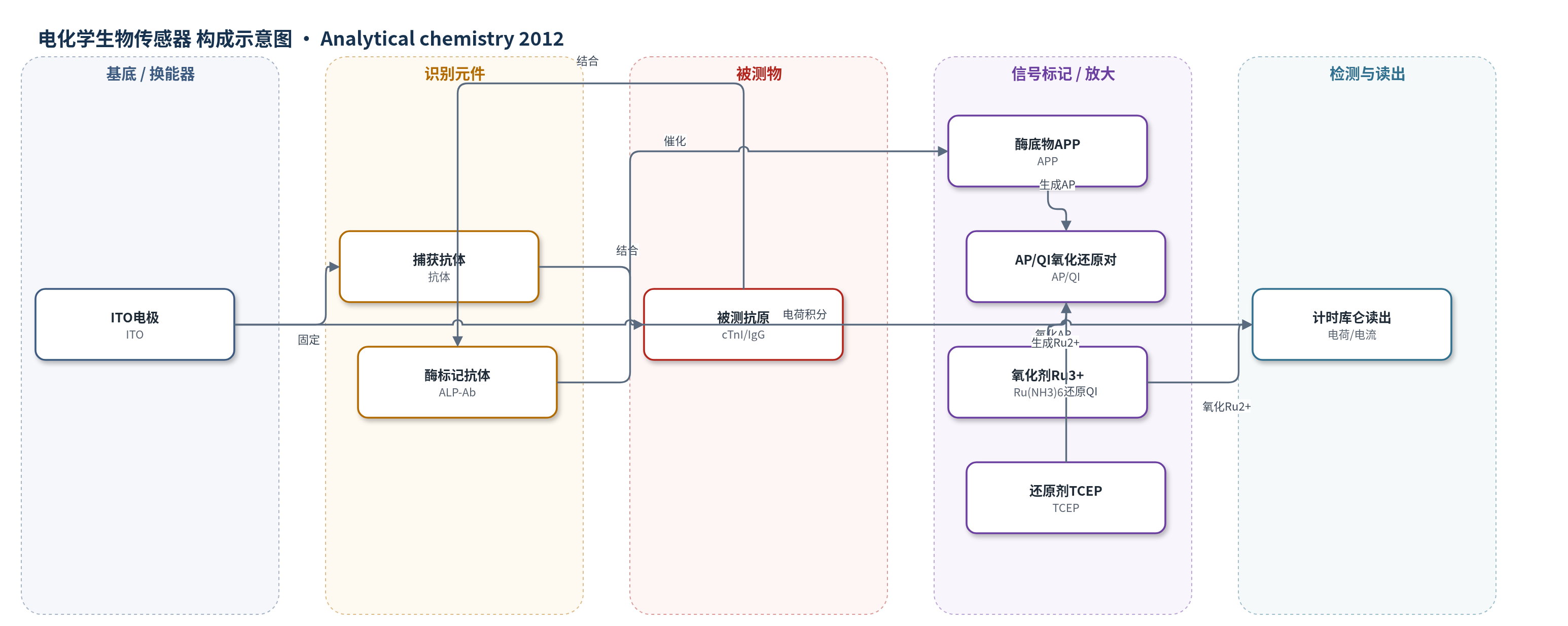
点击图片查看大图 · 依据论文自动绘制
传感器类型
电化学生物传感器
检测对象
小鼠IgG(mouse IgG)、心肌肌钙蛋白I(cardiac troponin I, cTnI);样品基质:缓冲液、人血清
检测原理
目标抗原与电极表面捕获抗体结合后,再结合ALP标记抗体。ALP催化APP生成AP,形成第一级放大。AP/QI氧化还原对兼具外球与内球反应亲和:高外球亲和的Ru(NH3)6^3+将AP氧化为QI并生成Ru(NH3)6^2+,高内球亲和的TCEP将QI还原为AP;由于TCEP/QI反应高度放能,通过耦合反应驱动热力学不利的Ru3+/AP反应,实现CC循环。随后在ITO电极上,Ru2+被电化学氧化为Ru3+,形成ECC循环,计时库仑法积分阳极电荷。ITO低电催化活性抑制TCEP和O2副反应,使信号随抗原浓度增加而放大。
检测灵敏度
LOD: ca. 10 fg/mL(肌钙蛋白I,人血清,计时库仑法);线性范围: 10 fg/mL–10 ng/mL;LOD: ca. 1 fg/mL(小鼠IgG,CC/ECC三重放大);LOD: ca. 10 fg/mL(小鼠IgG,仅EC循环);LOD: ca. 100 fg/mL(小鼠IgG,循环伏安法)
效应效果
该传感器在空气饱和溶液中稳定运行,无需氧化还原酶或电极电催化修饰。三重放大使小鼠IgG检出限由仅EC循环的约10 fg/mL降至约1 fg/mL,较循环伏安法约100 fg/mL低10倍;肌钙蛋白I检出限约10 fg/mL,低于其他电化学传感器的2和4 pg/mL。零浓度计时库仑电荷RSD为7%(肌钙蛋白I)和14%(小鼠IgG),仅EC方案为28%,循环伏安法为17%。AP信号放大因子约21(EC)和约240(ECC)。方法与传统酶免疫传感器流程相近,仅额外加入Ru(NH3)6^3+和TCEP,适合超灵敏蛋白检测。
传感器的构成
- 基底/换能器电极:ITO(氧化铟锡)电极,低电催化活性、高外球反应亲和,抑制TCEP和O2副反应并支持ECC电子转移
- 识别元件:抗原–抗体结合体系(捕获抗体与酶标记抗体,具体抗体名称未在正文给出),实现IgG或肌钙蛋白I特异性识别
- 酶标记物:碱性磷酸酶(ALP),作为免疫标记酶,催化APP生成AP,提供第一级化学放大
- 酶底物:4-氨基苯基磷酸盐(APP),ALP底物,被转化为AP
- 氧化剂:六氨合钌(III) Ru(NH3)6^3+,高外球反应亲和,与AP发生CC循环生成Ru(NH3)6^2+
- 还原剂:三(2-羧乙基)膦(TCEP),高内球反应亲和,还原QI并驱动循环
- 信号中间体:4-氨基酚(AP)/4-醌亚胺(QI)氧化还原对,兼具外球与内球反应亲和,连接酶反应与钌/膦循环
- 读出介质:空气饱和Tris缓冲液(pH 8.9),维持反应稳定与可重复性
中文摘要
本文报道了用于超灵敏生物传感的化学–化学(CC)和电化学–化学–化学(ECC)氧化还原循环方法。作者将酶促反应、CC氧化还原循环和ECC氧化还原循环三重化学放大策略应用于心肌肌钙蛋白I的电化学免疫传感器。碱性磷酸酶将4-氨基苯基磷酸盐转化为4-氨基酚(AP),在氧化剂和还原剂存在下触发CC循环;随后在空气饱和溶液中孵育,通过ECC循环测量电化学信号。为避免使用氧化还原酶并抑制氧化剂与还原剂之间的副反应,选择高外球反应亲和的Ru(NH3)6^3+为氧化剂、高内球反应亲和的三(2-羧乙基)膦(TCEP)为还原剂;AP/QI氧化还原对可同时与两者快速反应。高外球亲和的ITO电极抑制内球物种的副反应。计时库仑法比循环伏安法获得更低检出限,血清中肌钙蛋白I免疫传感器的检出限约为10 fg/mL。
英文摘要
This paper reports chemical-chemical (CC) and electrochemical-chemical-chemical (ECC) redox cycling, for use in ultrasensitive biosensor applications. A triple chemical amplification approach using an enzymatic reaction, CC redox cycling, and ECC redox cycling is applied toward electrochemical immunosensors of cardiac troponin I. An enzymatic reaction, in which alkaline phosphatase converts 4-aminophenyl phosphate to 4-aminophenol (AP), triggers CC redox cycling in the presence of an oxidant and a reductant, and electrochemical signals are measured with ECC redox cycling after an incubation period of time in an air-saturated solution. To obtain high, selective, and reproducible redox cycling without using redox enzymes, two redox reactions [the reaction between AP and the oxidant and the reaction between the oxidized form of AP (4-quinone imine, QI) and the reductant] should be fast, but an unwanted reaction between the oxidant and reductant should be very slow. Because species that undergo outer-sphere reactions (OSR-philic species) react slowly with species that undergo inner-sphere reactions (ISR-philic species), highly OSR-philic Ru(NH(3))(6)(3+) and highly ISR-philic tris(2-carboxyethyl)phosphine (TCEP) are chosen as the oxidant and reductant, respectively. The OSR- and ISR-philic QI/AP couple allows fast redox reactions with both the OSR-philic Ru(NH(3))(6)(3+) and the ISR-philic TCEP. Highly OSR-philic indium-tin oxide (ITO) electrodes minimize unwanted electrochemical reactions with highly ISR-philic species. Although the formal potential of the Ru(NH(3))(6)(3+)/Ru(NH(3))(6)(2+) couple is lower than that of the QI/AP couple, the endergonic reaction between Ru(NH(3))(6)(3+) and AP is driven by the highly exergonic reaction between TCEP and QI (via a coupled reaction mechanism). Overall, the "outer-sphere to inner-sphere" redox cycling in the order of highly OSR-philic ITO, highly OSR-philic Ru(NH(3))(6)(3+)/Ru(NH(3))(6)(2+) couple, OSR- and ISR-philic QI/AP couple, and highly ISR-philic TCEP allows high, selective, and reproducible signal amplification. The electrochemical data obtained by chronocoulometry permit a lower detection limits than those obtained by cyclic voltammetry. The detection limit of an immunosensor for troponin I in serum, calculated from the anodic charges in chronocoulometry, is ca. 10 fg/mL.