组成图示
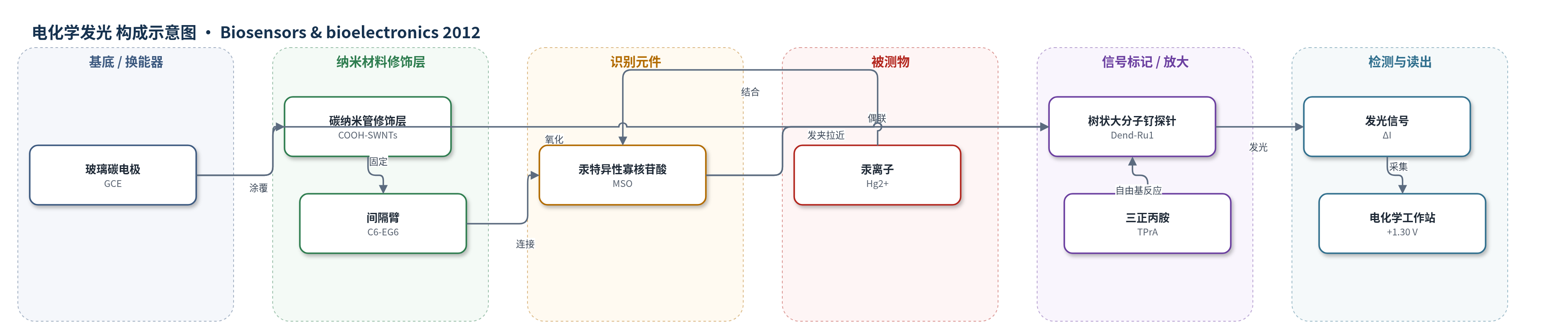
点击图片查看大图 · 依据论文自动绘制
传感器类型
电化学发光(ECL)生物传感器
检测对象
汞离子(Hg2+,mercury ion);样品基质:水样(实际水样)
检测原理
传感器以GCE/COOH-SWNTs为基底,共价固定NH2-C6-(EG)6-MSO↔Dend-Ru1探针。MSO为富含胸腺嘧啶的汞特异性寡核苷酸,Hg2+与T碱基特异性配位形成T–Hg–T结构,使线性MSO折叠为发夹构象,从而将负载35个Ru1的G4 PAMAM树状大分子(Dend-Ru1)拉近电极表面。在含TPrA的HEPES缓冲液中施加+1.30 V阳极电位,Ru1被氧化并与TPrA氧化产生的自由基反应生成激发态Ru1*,退激发出ECL光。Hg2+浓度越高,发夹形成越多,Dend-Ru1靠近电极越多,ECL峰强变化ΔI越大。Dend-Ru1多钌负载和SWNTs增大活性面积共同实现信号放大。
检测灵敏度
LOD: 2.4 pM;线性范围: 7.0 pM–50 nM(7.0 × 10⁻¹²–5.0 × 10⁻⁸ M)
效应效果
选择性良好:2.0 μM Cu2+、Zn2+、Cd2+、Pb2+、Fe2+、Co2+、Ni2+、Ca2+、Ba2+响应低于10.0 nM Hg2+的9%;10 mM Cl−、SO42−、CO32−对1.0 nM Hg2+无影响;1000 nM CH3Hg+干扰<−6%;500 μg/L腐殖酸不干扰5 nM Hg2+。RSD为5.2%(单电极)和4.0%(批间,0.1 nM,n=7);60次循环RSD 2.3%;4 ℃储存21 d、30 d保留96.8%、92.3%;再生6次变化<±3%。实际水样与CVAFS偏差4.3%、3.1%。LOD低于EPA限值10 nM,较已有ECL方法低8–97倍。
传感器的构成
- 基底/换能器电极:玻璃碳电极(GCE),直径2 mm,提供电子传导与ECL换能界面
- 纳米材料修饰层:羧基化单壁碳纳米管(COOH-SWNTs),滴涂于GCE,增大活性面积并承载探针
- 探针连接层:NH2-(CH2)6-oligo(ethylene oxide)6-MSO↔Dend-Ru1,共价固定于SWNTs,连接识别元件与ECL标记
- 间隔臂:NH2-(CH2)6-oligo(ethylene oxide)6(C6-EG6),调节MSO与电极距离并降低空间位阻
- 识别元件:汞特异性寡核苷酸(MSO,22-mer),通过T–Hg–T配位识别Hg2+
- 信号标记/放大元件:第4代PAMAM树状大分子负载Ru1(Dend-Ru1,每个Dend含35个Ru1),作为ECL发光体并放大信号
- 电子供体/共反应剂:三正丙胺(TPrA),氧化产生自由基,与氧化态Ru1反应生成激发态发光
- 封闭剂:乙醇胺(ethanolamine),封闭未反应活化位点,降低背景信号
中文摘要
本文报道了一种基于汞特异性寡核苷酸(MSO)和钌(II)配合物(Ru1)的电化学发光(ECL)生物传感器,用于高灵敏、高选择性地检测汞离子。传感器以涂覆单层壁碳纳米管的玻璃碳电极为基底,共价固定ECL探针NH2-(CH2)6-oligo(ethylene oxide)6-MSO↔Dend-Ru1。Dend-Ru1由Ru1与第4代聚酰胺胺(PAMAM)树状大分子共价偶联制备,每个树状大分子负载35个Ru1单元,从而实现ECL信号放大。当Hg2+与MSO中的胸腺嘧啶(T)碱基结合形成T–Hg–T结构时,MSO由线性构象转变为发夹构象,使Dend-Ru1靠近电极表面,在三正丙胺(TPrA)存在下阳极ECL信号增强。该传感器重现性好,30 d储存后保留92.3%初始ECL信号,检出限为2.4 pM,动态范围为7.0 pM–50 nM。基于扩展Langmuir等温线估算Hg2+与MSO的表观结合常数为1.6×10^9 M−1。实际水样检测结果与冷蒸气原子荧光光谱法一致。
英文摘要
A novel electrogenerated chemiluminescence (ECL) biosensor for highly sensitive and selective detection of mercury ion was developed on the basis of mercury-specific oligonucleotide (MSO) served as a molecular recognition element and the ruthenium(II) complex (Ru1) as an ECL emitting species. The biosensor was fabricated on a glassy carbon electrode coated with a thin layer of single wall carbon nanotubes, where the ECL probe, NH(2)-(CH(2))(6)-oligo(ethylene oxide)(6)-MSO↔Dend-Ru1, was covalently attached. The Dend-Ru1 pendant was prepared by covalent coupling Ru1 with the 4th generation polyamidoamine dendrimer (Dend), in which each dendrimer contained 35 Ru1 units so that a large amplification of ECL signal was obtained. Upon binding of Hg(2+) to thymine (T) bases of the MSO, the T-Hg-T structure was formed, and the MSO changed from its linear shape to a "hairpin" configuration. Consequently, the Dend-Ru1 approached the electrode surface resulting in the increase of anodic ECL signal in the presence of the ECL coreactant tri-n-propylamine. The reported biosensor showed a high reproducibility and possessed long-term storage stability (92.3% initial ECL recovery over 30 day's storage). An extremely low detection limit of 2.4 pM and a large dynamic range of 7.0 pM to 50 nM Hg(2+) were obtained. An apparent binding constant of 1.6 × 10(9)M(-1) between Hg(2+) and the MSO was estimated using an ECL based extended Langmuir isotherm approach involving multilayer adsorption. Determination of Hg(2+) contents in real water samples was conducted and the data were consistent with the results from cold vapor atomic fluorescence spectroscopy.