组成图示
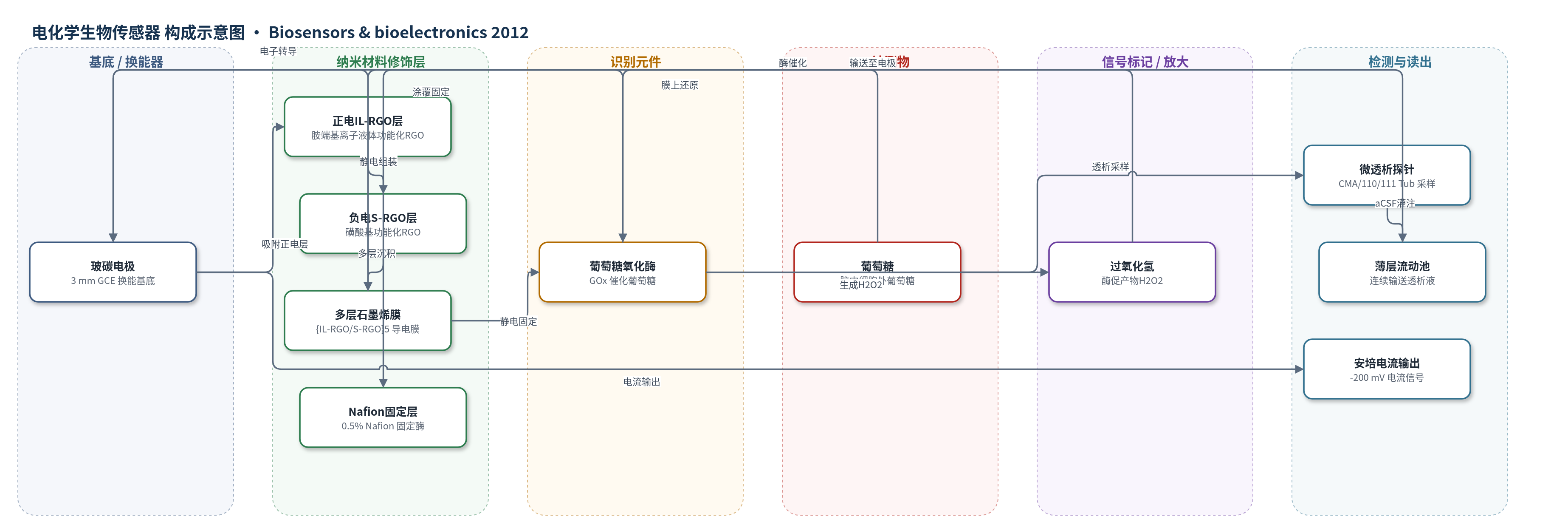
点击图片查看大图 · 依据论文自动绘制
传感器类型
电化学生物传感器
检测对象
葡萄糖(glucose);样品基质:大鼠纹状体脑内细胞外液(在线微透析采样)、体外标准溶液
检测原理
该传感器为第三代无中介体葡萄糖生物传感器。GOx作为识别元件,催化葡萄糖氧化并生成H2O2;{IL-RGO/S-RGO}5多层膜由正负电荷功能化石墨烯静电自组装而成,兼具高导电性和连续π电子结构,可在−200 mV下直接电催化还原H2O2,产生与H2O2浓度成正比的阴极电流。由于葡萄糖浓度决定H2O2生成量,最终安培电流随葡萄糖浓度升高而增大。低工作电位结合Nafion固定层可抑制抗坏血酸、多巴胺和尿酸等电活性干扰物。在线微透析将脑内细胞外葡萄糖采样至薄层流动池,实现连续体内检测。
检测灵敏度
LOD: 3.33 μM (S/N = 3);线性范围: 10 μM–500 μM;灵敏度: 0.0718 ± 0.00648 nA μM−1;r = 0.9922;I(nA)=0.0718C(μM)+0.9875
效应效果
选择性方面,0.1 mM抗坏血酸、10 μM多巴胺和50 μM尿酸在−200 mV下无可测电流响应,表明抗干扰能力强。重现性方面,100 μM葡萄糖连续5次测量RSD为3.9%;稳定性方面,连续使用至少6天(每天5–6 h)电流响应RSD约4.8%,4℃保存两周保留约83%初始活性。微透析相对回收率为24%(2.0 μL/min)。体内实验中,大鼠纹状体基础葡萄糖为0.376±0.028 mM(n=3);腹腔注射30 μL胰岛素后,平均34.68 min开始下降,持续约25 min,最低降至基础水平的52.75±8.6%(n=3)。作者认为该方法灵敏、可重复,适用于神经生理和病理研究。
传感器的构成
- 基底/换能器电极:玻碳电极(GCE,3 mm),抛光清洗后作为电子转导基底
- 正电修饰层:胺端基离子液体功能化还原氧化石墨烯(IL-RGO,5 mg/mL),提供正电荷与导电通道
- 负电修饰层:磺酸基功能化还原氧化石墨烯(S-RGO,2 mg/mL),与IL-RGO静电自组装形成多层膜
- 多层导电膜:{IL-RGO/S-RGO}n(优选n=5),增强电子转移并固定酶
- 识别元件:葡萄糖氧化酶(GOx,10 mg/mL,PBS pH 7.4),催化葡萄糖氧化生成H2O2
- 封闭/固定层:Nafion(0.5%溶液),涂覆固定GOx并提高选择性
中文摘要
本文通过胺端基离子液体(IL-NH2)和磺酸基(SO3−)共价修饰石墨烯,利用静电相互作用将带正电的IL-RGO与带负电的S-RGO层层自组装,形成{IL-RGO/S-RGO}n多层膜,并进一步固定葡萄糖氧化酶(GOx),构建{IL-RGO/S-RGO}n/GOx/Nafion葡萄糖生物传感器。该传感器在−200 mV下对葡萄糖具有良好安培响应。结合在线微透析系统,体外检测葡萄糖的线性范围为10 μM–500 μM,检出限为3.33 μM(S/N=3)。将其用于麻醉大鼠纹状体葡萄糖基础水平测定,结果为0.376±0.028 mM(mean±s.d., n=3)。腹腔注射30 μL胰岛素后,细胞外葡萄糖浓度在30 min内明显下降。该方法灵敏、可重复,具有在生理和病理研究中应用的前景。
英文摘要
In this work, a novel amperometric biosensor for hydrogen peroxide was fabricated through the layer-by-layer (LBL) self-assembling of amine-terminated ionic liquid (IL-NH(2)), and sulfonic acid (SO(3)(-)) functionalized graphene by covalent bonding. The modification of the two functionalities introduced positive and negative charge onto the surface of graphene respectively, thus facilitating the formation of a multilayer film denoted with {IL-RGO/S-RGO}(n) through electrostatic interaction and further immobilization of glucose oxidase (GOx). The resulting {IL-RGO/S-RGO}(n)/GOx/Nafion biosensor displayed an excellent response to glucose at a potential of -200 mV. Combined with on-line microdialysis system, the glucose biosensor in the on-line system showed good linear range from 10 μM to 500 μM with the detection limit of 3.33 μM (S/N=3). Consequently, the basal level of glucose in the striatum of anesthetic rats was calculated to be 0.376 ± 0.028 mM (mean ± s.d., n=3). The {IL-RGO/S-RGO}(n)/GOx/Nafion biosensor was further applied for in vivo sensing of the glucose level in the striatum when rats received intraperitoneal (i.p.) injection of 30 μL insulin, which resulted in an obvious decrease in the extracellular concentration of glucose within 30 min. The method was proved to be sensitive and reproducible, which enabled its promising application in physiology and pathology.