组成图示
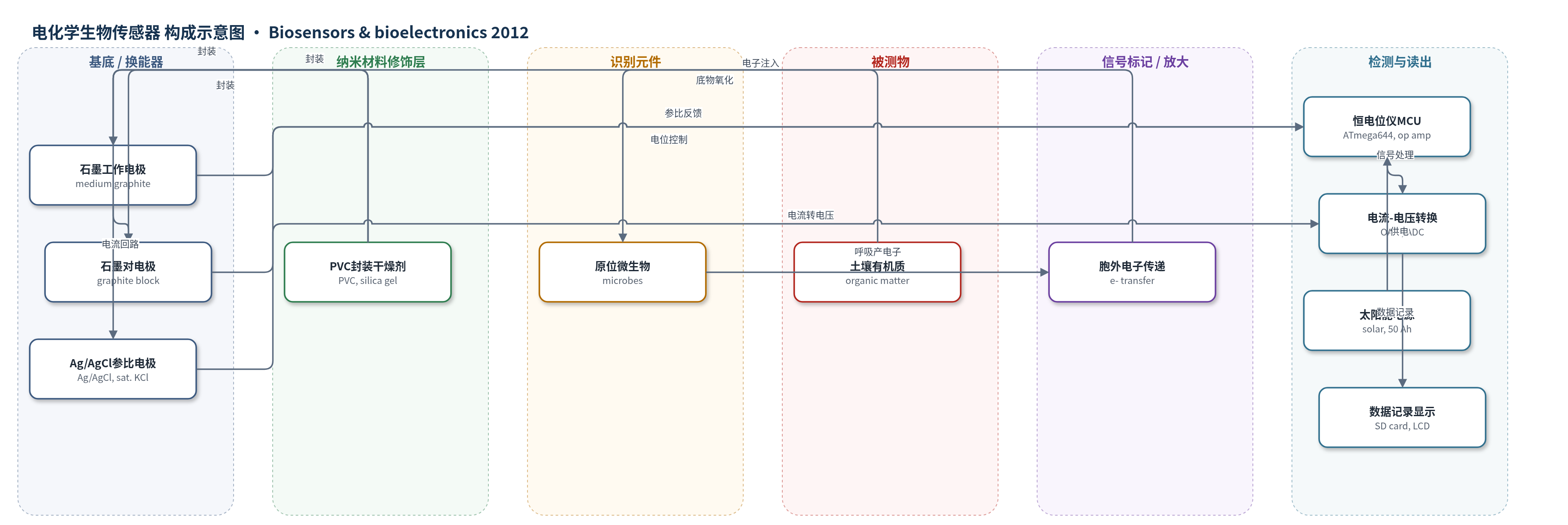
点击图片查看大图 · 依据论文自动绘制
传感器类型
电化学生物传感器
检测对象
微生物呼吸/代谢活性(microbial respiration / metabolic activity);样品基质:阿拉斯加排水解冻湖盆地北极泥炭土(drained thaw lake basin peat soils)
检测原理
恒电位仪将石墨工作电极(WE)固定在+0.1 VSHE,使其模拟铁(III)化合物和腐殖酸等电子受体。土壤中可生物降解有机质被原位微生物氧化,微生物通过胞外电子传递将电子转移到WE。为维持WE电位,恒电位仪通过参比电极(RE)反馈调节电位,并在对电极(CE)产生等量反向电流;该电流经OA-4电流-电压转换、ADC数字化后记录。微生物呼吸/代谢活性越高,电子供体氧化和电子传递速率越高,WE电流越大。夏季融化使土壤温度升高,微生物生长和代谢增强,因此电流出现日周期,并在中深层随温度升高而增强。系统未使用酶或核酸放大,主要依靠原位微生物电子传递产生电流。
检测灵敏度
未报告LOD、线性范围、灵敏度斜率或相关系数。
效应效果
实验室中,该MCU恒电位仪与商业Biologic VSP在RC测试电路上比较,在微安量级、1 V范围(VWE = −0.5至0.5 VREF)内精度为0.95±0.58%(95%置信限)。系统成本约600美元,可耐受-30℃,在4个排水解冻湖盆地部署24个三电极系统,运行5–7周;3个无电网站点由20 W太阳能板和50 Ah电池供电。古老盆地前2–3周浅、中、深层电流分别约100、80、70 µA;第3周中层约120 µA、深层约90 µA,土壤温度由3.66±0.81℃升至5.44±0.71℃。电流出现日周期,峰值15:00–18:00、谷值6:00–9:00。作者认为其适合偏远地区原位实时监测,但尚不能区分生物与非生物电流。
传感器的构成
- 工作电极(WE):medium-extruded graphite plate blocks(8 cm × 2.7 cm × 0.6 cm),插入1.628 mm copper wire并用urethane adhesive密封;功能面积41.2 cm²,作为电子受体接受胞外电子。
- 对电极(CE):medium-extruded graphite plate blocks,插入copper wire并用urethane adhesive密封;完成电流回路。
- 参比电极(RE):Ag/AgCl saturated KCl reference electrode,连接copper wire;提供稳定电位基准。
- 电极封装层:5.1 cm PVC piping、1.3 cm PVC piping、silica gel desiccant、urethane adhesive和hose clamp;垂直安装、防潮并固定三电极。
- 识别元件:土壤原位微生物(dissimilatory metal-reducing bacteria / electrode-respiring bacteria);利用WE作为电子受体进行呼吸。
- 电子供体:土壤可生物降解有机质/有机基质(biodegradable organic matter / organic substrates);被微生物氧化并提供电子。
- 恒电位仪电子层:MCU ATmega644、op amp circuitry(OA-1、OA-3、OA-4、OA-6)、ADC、SD card和LCD;控制WE电位并记录电流。
- 电源层:20 W solar panel、50 Ah deep cycle gel battery和solar controller;为野外系统独立供电。
中文摘要
本文提出一种地下生物电化学系统(BES)生物传感器的概念验证,用于监测通过胞外电子传递发生的微生物呼吸。系统包含开源三通道微控制器单元(MCU)恒电位仪,可进行时电流法测量;实验室测试显示其精度在0.95±0.58%(95%置信限)内与商业恒电位仪相当。该恒电位仪可耐受-30℃,成本约600美元,适合野外大规模部署。MCU恒电位仪与电极及太阳能供电系统集成后,部署于阿拉斯加巴罗附近排水解冻湖盆地,监测微生物呼吸。在三个深度,微生物三电极系统(M3C)工作电极维持在对应铁(III)化合物和腐殖酸还原的电位,模拟电子受体并被微生物利用。传感器揭示微生物呼吸日周期;中深层电极的周期出现伴随整体活性显著增加,对应夏季融化使土壤达到适宜微生物活性的温度。该BES生物传感器可用于偏远环境原位微生物活性研究,低成本设计利于广泛部署。
英文摘要
Here, we present the proof-of-concept for a subsurface bioelectrochemical system (BES)-based biosensor capable of monitoring microbial respiration that occurs through exocellular electron transfer. This system includes our open-source design of a three-channel microcontroller-unit (MCU)-based potentiostat that is capable of chronoamperometry, which laboratory tests showed to be accurate within 0.95 ± 0.58% (95% Confidence Limit) of a commercial potentiostat. The potentiostat design is freely available online: http://angenent.bee.cornell.edu/potentiostat.html. This robust and field-ready potentiostat, which can withstand temperatures of -30°C, can be manufactured at relatively low cost ($600), thus, allowing for en-masse deployment at field sites. The MCU-based potentiostat was integrated with electrodes and a solar panel-based power system, and deployed as a biosensor to monitor microbial respiration in drained thaw lake basins outside Barrow, AK. At three different depths, the working electrode of a microbial three-electrode system (M3C) was maintained at potentials corresponding to the microbial reduction of iron(III) compounds and humic acids. Thereby, the working electrode mimics these compounds and is used by certain microbes as an electron acceptor. The sensors revealed daily cycles in microbial respiration. In the medium- and deep-depth electrodes the onset of these cycles followed a considerable increase in overall activity that corresponded to those soils reaching temperatures conducive to microbial activity as the summer thaw progressed. The BES biosensor is a valuable tool for studying microbial activity in situ in remote environments, and the cost-efficient design of the potentiostat allows for wide-scale use in remote areas.