组成图示
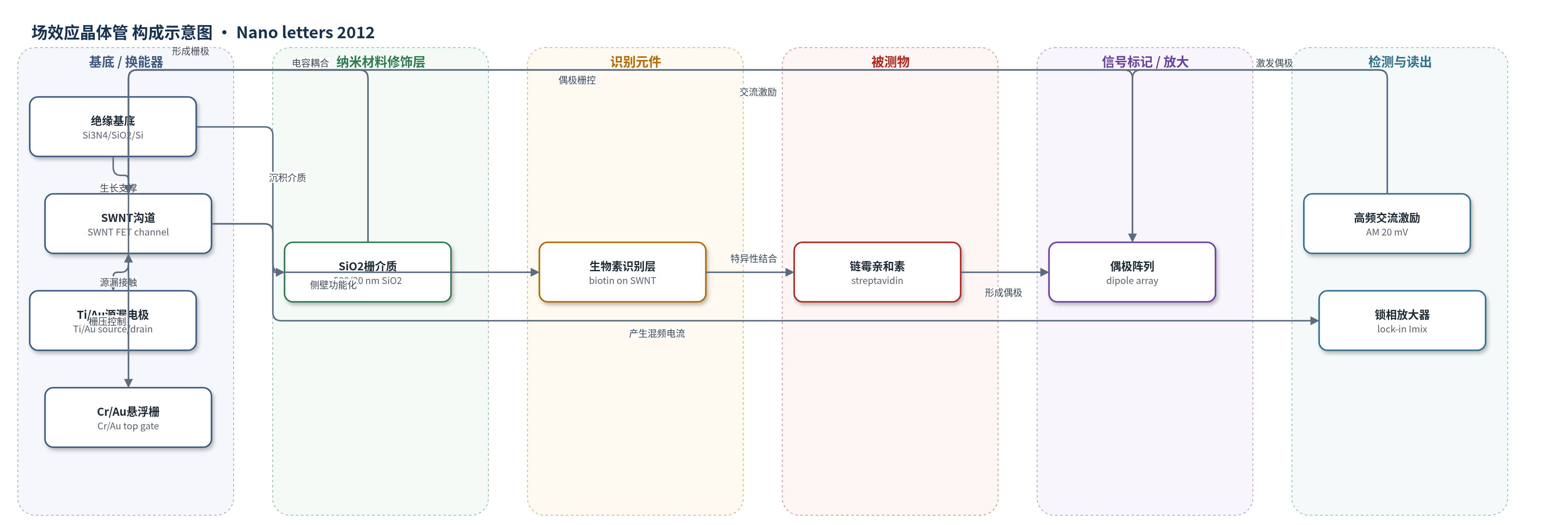
点击图片查看大图 · 依据论文自动绘制
传感器类型
场效应晶体管(FET)生物传感器
检测对象
链霉亲和素(streptavidin);样品基质:去离子水及 1 mM、10 mM、100 mM NaCl 缓冲液。
检测原理
生物素非共价修饰在 SWNT 侧壁,链霉亲和素结合后在纳米管表面形成偶极阵列。低频下,溶液中离子形成双电层,表面偶极被 Debye 屏蔽,直流/低频电导变化消失;高频(>1 MHz)下,离子迁移滞后,双电层被削弱,交流场可穿透至分子偶极。源端施加 20 mV 高频交流电压,经 1.43 kHz 参考信号 AM 调制,激发表面偶极振荡;偶极作为局部栅极调制 SWNT 沟道载流子。由于 SWNT FET 非线性 I–Vg 特性,高频源极信号与栅压/偶极栅控发生频率混频,在调制频率产生混频电流 Imix。Imix 与 FET 跨导成正比,器件在峰值跨导工作实现本征放大,锁相放大器提取低频 Imix。链霉亲和素结合量增加时,表面偶极密度增大,Imix 变化相应增强,从而实现无标记检测。
检测灵敏度
—
效应效果
在去离子水、1 mM、10 mM 和 100 mM NaCl 中,低频(200 kHz–1 MHz)响应随离子强度升高而减弱,100 mM 下 500 kHz 无法分辨链霉亲和素结合;提高至 10 MHz 后灵敏度恢复,相对灵敏度 ΔImix/Imix 最大约 25%,且高频响应基本不依赖背景离子浓度。完全钝化器件在去离子水中无显著混频电流变化,说明信号来自生物素–链霉亲和素结合。热噪声底约 0.4 pA,模型预测 5 nm 处单层复合物可产生约 35% 相对信号变化。约 30 MHz 处信号下降源于测量装置谐振损失。作者认为该平台可在生理相关离子强度下直接工作,适用于即时检测。
传感器的构成
- 基底与换能器:Si3N4/SiO2/Si 基底及 Fe 催化 CVD 生长的单壁碳纳米管(SWNT)沟道,构成场效应晶体管换能器。
- 源漏电极:Ti/Au(0.5 nm/50 nm)源漏接触金属,用于载流子注入和电流读出。
- 栅介质:500 nm SiO2 层,形成栅极电容并控制 SWNT 沟道。
- 栅电极:Cr/Au(50 nm/50 nm)悬浮顶栅,施加栅压并参与高频混频。
- 钝化层:20 nm SiO2 层,覆盖电极并防止栅漏电流。
- 识别元件:非共价功能化的生物素(biotin)修饰 SWNT 侧壁,作为配体捕获链霉亲和素。
中文摘要
基于纳米管和纳米线独特电子特性的纳米传感器具有高灵敏度,有望革新即时医疗诊断(POC)。虽然已在这类器件上实现多种有机和无机分子的直流检测,但基于直流电导变化的传感机制在高背景盐浓度下会因溶液中移动离子的屏蔽而失效。本文证明,将单壁碳纳米管场效应晶体管作为高频生物传感器工作,可缓解基本离子屏蔽效应。交流激励场与表面结合生物分子偶极场之间的非线性混频可产生对表面结合生物分子敏感的混频电流。在100 mM缓冲液中,于超过1 MHz的频率实现了单层链霉亲和素与生物素结合的电学检测。理论建模证实,高频下通过削弱离子屏蔽效应可提高灵敏度。该结果有望为即时检测提供新的生物传感平台,尤其适用于需要在生理相关条件下直接工作的生物传感器。
英文摘要
Nanosensors based on the unique electronic properties of nanotubes and nanowires offer high sensitivity and have the potential to revolutionize the field of Point-of-Care (POC) medical diagnosis. The direct current (dc) detection of a wide array of organic and inorganic molecules has been demonstrated on these devices. However, sensing mechanism based on measuring changes in dc conductance fails at high background salt concentrations, where the sensitivity of the devices suffers from the ionic screening due to mobile ions present in the solution. Here, we successfully demonstrate that the fundamental ionic screening effect can be mitigated by operating single-walled carbon nanotube field effect transistor as a high-frequency biosensor. The nonlinear mixing between the alternating current excitation field and the molecular dipole field can generate mixing current sensitive to the surface-bound biomolecules. Electrical detection of monolayer streptavidin binding to biotin in 100 mM buffer solution is achieved at a frequency beyond 1 MHz. Theoretical modeling confirms improved sensitivity at high frequency through mitigation of the ionic screening effect. The results should promise a new biosensing platform for POC detection, where biosensors functioning directly in physiologically relevant condition are desired.