组成图示
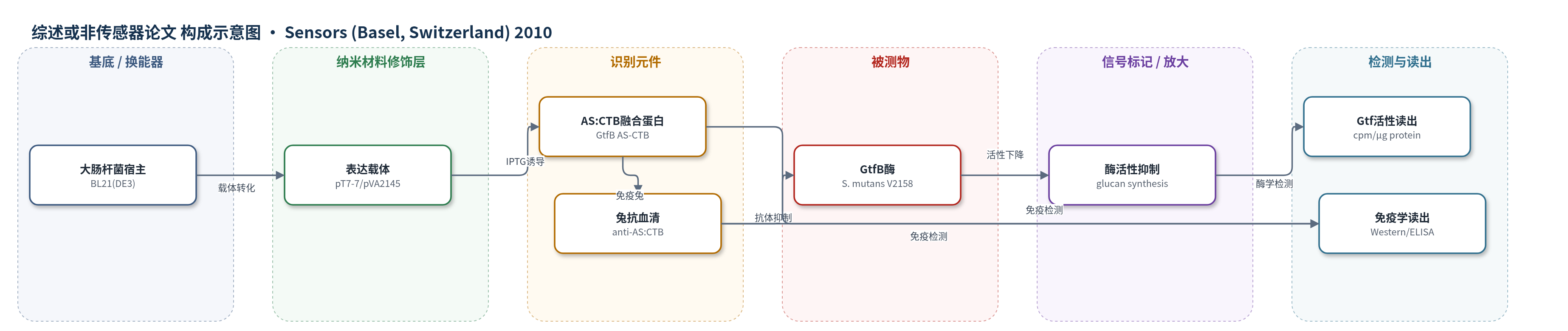
点击图片查看大图 · 依据论文自动绘制
传感器类型
综述或非传感器论文
检测对象
GtfB 酶活性(glucosyltransferase B, GtfB)、AS:CTB 融合蛋白(active-site:CTB);样品基质:S. mutans V2158 胞外蛋白提取物(含蔗糖底物)、兔血清、大肠杆菌裂解液
检测原理
本文并非传感检测,而是免疫抑制机制研究。将 GtfB 活性位点肽(AS)与 CTB 融合表达为 AS:CTB,免疫兔获得多克隆抗血清。抗血清中的抗体可识别 AS 肽表位并作用于 S. mutans V2158 胞外 GtfB,阻碍其催化蔗糖合成水不溶性葡聚糖。酶活性以 [U-14C]蔗糖掺入葡聚糖的 cpm/μg 蛋白或甲醇沉淀/水不溶性葡聚糖量表示;抗体效价越高,GtfB 活性下降越明显。Western blot 与 ELISA 分别验证融合蛋白表达、抗体特异性和 GM1 神经节苷脂结合能力。
检测灵敏度
未报告 LOD、线性范围、灵敏度斜率或相关系数。
效应效果
纯化获得 40 mg AS:CTB,SDS-PAGE 显示约 15 kDa 单体,凝胶过滤约 75 kDa,提示五聚体;等电点 6.1,N端序列 Ala-Arg-Ile-Pro-Asp。兔抗血清经 CTB 亲和吸附后仍结合 AS:CTB 而不结合 CTB,证明产生抗 AS 肽抗体;抗 CTB 组分可结合 CTB 与 AS:CTB。酶抑制实验中,免疫前血清平均 Gtf 活性 925.21(SE 96.32)cpm/μg,anti-AS:CTB 为 511.48(99.49),抑制 45%,P=0.0006;anti-GtfB 抑制 51%,anti-GtfB.1:CTB 抑制 66%。AS:CTB 在 ELISA 中结合 GM1,保留 CTB 黏膜佐剂特性。未报告 RSD、稳定性或实际样品回收率。作者认为其可作为抗龋疫苗候选。
传感器的构成
- 非传感器论文:未报道传感器基底或换能器电极
- 表达载体:pT7-7/pVA2145,携带 as:ctxB 融合基因,T7/lac 诱导表达
- 融合蛋白:AS:CTB,GtfB 活性位点肽(AS)融合至霍乱毒素 B 亚基(CTB)N端
- 识别/免疫元件:兔抗 AS:CTB 多克隆血清,含抗 AS 肽与抗 CTB 抗体
- 功能验证酶:S. mutans V2158 胞外 GtfB,仅表达 GtfB,用于抗体抑制检测
- 读出方式:Gtf 酶活性(cpm/μg protein)、Western blot、ELISA 检测 GM1 结合
中文摘要
变形链球菌产生的葡聚糖转移酶(Gtfs)是龋病毒力因子,分泌型免疫球蛋白A(sIgA)抑制 Gtfs 被认为可预防龋病。黏膜免疫的关键在于可靠诱导针对 Gtfs 的 sIgA 产生。本研究将 S. mutans GS5 gtfB 推导的活性位点(AS)肽 DANFDSIRVDAVDNVDADLLQIA 融合至霍乱毒素 B 亚基(CTB)N端,构建 AS:CTB 嵌合基因,并在大肠杆菌中经 lac 启动子诱导表达、纯化。该蛋白在兔中具有免疫原性,产生针对 Gtf 肽和 CTB 的特异性血清抗体。用仅表达 GtfB 的 S. mutans 突变体胞外酶进行抑制实验,抗 AS:CTB 血清约抑制 50% GtfB 活性,提示该活性位点可被抗体识别,可作为疫苗设计靶点。ELISA 显示 AS:CTB 仍结合 GM1 神经节苷脂,保留 CTB 黏膜佐剂特性,可能作为抗龋疫苗候选。
英文摘要
The ultimate goal in any biosensor development project is its use for actual sample detection. Recently, there has been an interest in biosensors with aptamers as bio-recognition elements, but reported examples all deal with standards, not human serum. In order to verify the differences of aptamer-based biosensor and antibody-based biosensor in clinical detection, a comparison of the performance of aptamer-based and antibody-based quartz crystal microbalance (QCM) biosensors for the detection of immunoglobulin E (IgE) in human serum was carried out. Aptamers (or antibodies) specific to IgE were immobilized on the gold surface of a quartz crystal. The frequency shifts of the QCM were measured. The linear range with the antibody (10-240 μg/L) compared to that of the aptamer (2.5-200 μg/L), but a lower detection limit could be observed in the aptamer-based biosensor. The reproducibility of the two biosensors was comparable. The aptamers were equivalent or superior to antibodies in terms of specificity and sensitivity. In addition, the aptamer receptors could tolerate repeated affine layer regeneration after ligand binding and recycling of the biosensor with little loss of sensitivity. When stored for three weeks, the frequency shifts of the aptamer-coated crystals were all greater than 90% of those on the response at the first day.