组成图示
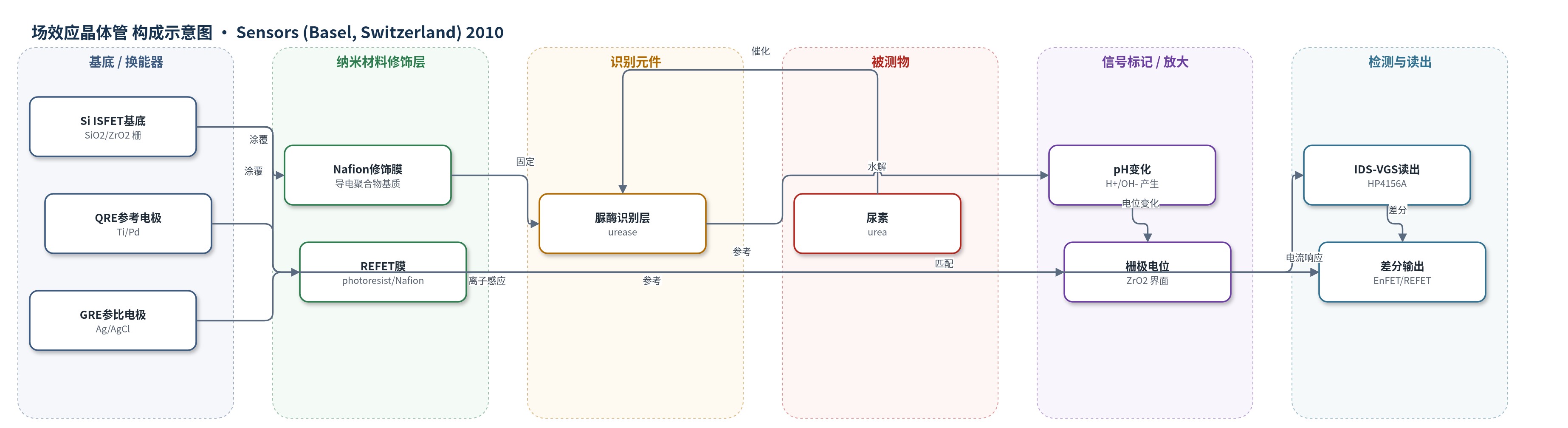
点击图片查看大图 · 依据论文自动绘制
传感器类型
场效应晶体管(FET)生物传感器
检测对象
尿素(urea);样品基质:磷酸盐缓冲液(PBS)溶液(模拟生物样品)
检测原理
脲酶固定在 Nafion 膜中,作为识别元件催化尿素水解,生成 NH4+、HCO3- 和 OH-,使门区局部 pH 升高。ZrO2 栅介质对 H+ 敏感,局部 pH 变化改变 ZrO2/溶液界面电位,等效为栅极偏置变化;在固定漏源电压 VDS=2 V 下,ISFET 漏极电流 IDS 随尿素浓度变化。差分结构中,EnFET 与 REFET 通过 photoresist/Nafion 膜组成跨导匹配,QRE 提供稳定参考,抑制共模噪声。信号经 IDS-VGS 或跨导 gm 读出,尿素浓度越高,pH 变化越大,响应电压/电流越大。
检测灵敏度
LOD: 8 mg/dL(脲酶/Nafion=5:1);线性范围: 8~240 mg/dL;灵敏度: 0.64 mV/(mg/dL);响应: 12.9~198.1 mV(8~240 mg/dL)。另 20:1 时 LOD: 1.25 mg/dL,线性范围: 1.25~240 mg/dL,灵敏度: 1.33 mV/(mg/dL)。
效应效果
脲酶/Nafion=5:1 的 EnFET 在 8~240 mg/dL 尿素范围内响应 12.9~198.1 mV,响应时间约 25 s(表 1 为 25~60 s),4 ℃ 避光保存 1 周后,高浓度响应保持 92%~99%,1.25 mg/dL 保持 68%、10 mg/dL 保持 45%。REFET 对尿素本底灵敏度约 0.01 mV/mg/dL,SRE/REFET 零尿素响应,说明参考系统稳定。QRE/EnFET/REFET 差分组合与 GRE/EnFET、GRE/EnFET/REFET 性能相当,未报告实际样品回收率与 RSD,作者认为可实现微型化 ISFET 尿素传感器。
传感器的构成
- 基底/换能器:Si MOSFET/ISFET,含 SiO2 栅介质,提供场效应电流换能
- 离子敏感层:30 nm ZrO2,DC 溅射沉积,感应 H+ 引起栅极电位变化
- 修饰基质:Nafion 导电聚合物膜,固定脲酶并允许离子传输
- 识别元件:脲酶(urease, EC 3.5.1.5),催化尿素水解
- 参考电极:Ti/Pd 准参考电极(QRE)或 Ag/AgCl 玻璃参比电极(GRE),提供稳定偏置
- 参考晶体管:REFET,ISFET 上涂覆 photoresist/Nafion 膜,用于差分匹配
- 封装样品池:环氧树脂封装容器,限定门区电解液环境
- 读出系统:HP4156A 半导体参数分析仪,测量 IDS-VGS 与跨导 gm
中文摘要
本文研究了基于离子敏感场效应晶体管(ISFET)的脲酶生物传感器及其固态参考系统,用于单端和双端差分读出电路。生物传感器的传感膜由脲酶固定在导电聚合物基 Nafion 基质中制备。在 8~240 mg/dL 尿素浓度范围内,传感器响应为 12.9~198.1 mV,表明固定化脲酶活性未显著下降。作者进一步制备了结合固态参考系统的生物传感器,评估结果证明其微型化可行性。对于差分系统,通过调节参考场效应晶体管(REFET)和酶场效应晶体管(EnFET)的膜组成,确定了最优跨导匹配。结果表明,通过调节光刻胶/Nafion 比例,可使聚合物基 REFET 的跨导曲线与 EnFET 匹配。差分对的跨导匹配可提供较宽动态测量范围。因此,微型化准参考电极(QRE)/REFET/EnFET 差分组合获得了与传统大型分立传感器相似的尿素响应曲线。
英文摘要
Ion sensitive field-effect transistor (ISFET) based urease biosensors with solid state reference systems for single-ended and two-ended differential readout electronics were investigated. The sensing membranes of the biosensors were fabricated with urease immobilized in a conducting polymer-based matrix. The responses of 12.9∼198.1 mV for the urea concentrations of 8∼240 mg/dL reveal that the activity of the enzyme was not significantly decreased. Biosensors combined with solid state reference systems were fabricated, and the evaluation results demonstrated the feasibility of miniaturization. For the differential system, the optimal transconductance match for biosensor and reference field-effect transistors (REFET) pair was determined through the modification of the membranes of the REFETs and enzyme field-effect transistors (EnFETs). The results show that the transconductance curve of polymer based REFET can match with that of the EnFET by adjusting the photoresist/Nafion™ ratio. The match of the transconductance curves for the differential pairs provides a wide dynamic operating measurement range. Accordingly, the miniaturized quasi-reference electrode (QRE)/REFET/EnFET combination with differential arrangement achieved similar urea response curves as those measured by a conventional large sized discrete sensor.