组成图示
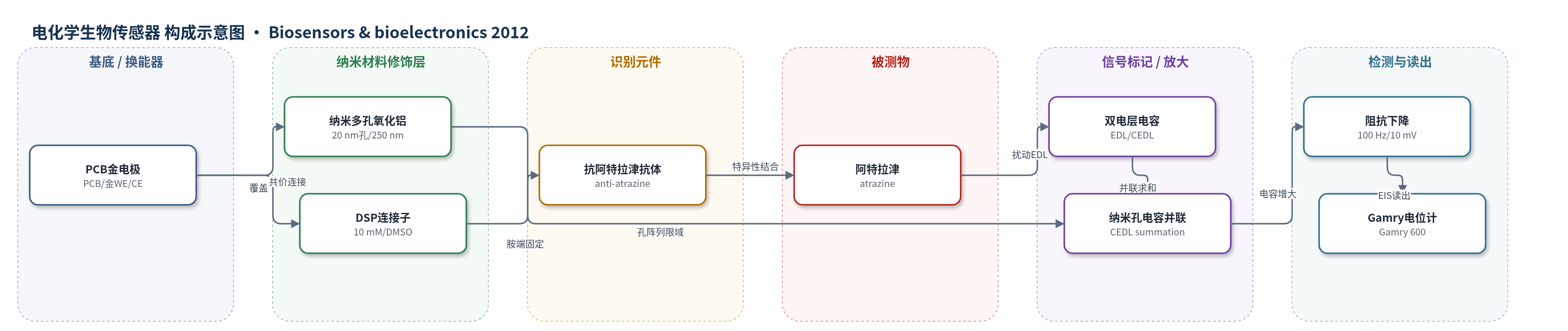
点击图片查看大图 · 依据论文自动绘制
传感器类型
电化学生物传感器
检测对象
阿特拉津(atrazine);样品基质:磷酸盐缓冲液(PBS)、河水(river water)、瓶装饮用水(drinking water)
检测原理
该传感器采用无标记电化学阻抗谱(EIS)检测。抗阿特拉津抗体经DSP连接子定向固定于金电极表面,并被纳米多孔氧化铝膜的20 nm孔道限域。当水样中的阿特拉津与抗体特异性结合时,生物识别事件改变固/液界面附近约50 nm双电层(EDL)的电荷分布,使双电层电容(CEDL)增加;在100 Hz、10 mV低频交流激励下,双电层阻抗主导,电容增加表现为总阻抗下降。约200万个纳米孔的CEDL并联求和,同时纳米限域模拟大分子拥挤效应,提高抗体构象稳定性与结合概率,从而放大信号。阿特拉津浓度越高,结合事件越多,阻抗下降越大。
检测灵敏度
LOD: 10 fg/mL (0.01 ppt);线性范围: 10 fg/mL–1 ng/mL (0.01 ppt–1 ppm);R^2 = 0.97 (PBS), 0.96 (river water), 0.93 (drinking water)
效应效果
该器件在PBS、河水和瓶装饮用水中均实现10 fg/mL(0.01 ppt)检出,各剂量误差<1%。选择性方面,PBS中阿特拉津阻抗变化35%–95%,马拉硫磷5%–30%;河水26%–62%对14%–25%;饮用水37%–96%对28%–38%,非特异信号低于特异信号1/3,特异信号≥1.5倍非特异信号。河水与饮用水中可在100 fg/mL–1 ng/mL和1 pg/mL–1 ng/mL区分阿特拉津。相比色谱、毛细管电泳、ELISA,该传感器无标记、无氧化还原探针和电活性聚合物,基于低成本PCB,适合便携式水样痕量农药监测。
传感器的构成
- 基底/换能器电极:印刷电路板(PCB,19 mm×30 mm)上铜层(1.4 milli-inches)、镍层(125 μin)和同心分支金电极(2–5 μin,WE/CE),用于EIS换能。
- 纳米材料修饰层:纳米多孔氧化铝膜(nanoporous alumina membrane,孔径20 nm、长度250 nm,约200万孔),覆盖金电极形成纳米受限空间并放大双电层信号。
- 连接/固定层:双硫代琥珀酰亚胺丙酸酯(DSP,10 mM,DMSO),硫醇端与金表面共价结合,胺端连接抗体,实现定向固定。
- 识别元件:抗阿特拉津抗体(anti-atrazine antibody,Abcam ab30533,25 μg/mL饱和剂量),特异性结合阿特拉津小分子。
- 封闭剂:Superblock(Pierce 37515),封闭未结合表面,降低非特异性结合。
- 流体约束层:聚二甲基硅氧烷(PDMS)manifold(15 mm×15 mm,150 μL固定体积),约束样品并固定氧化铝膜。
- 屏蔽/读出接口:金属校准屏蔽(metallic calibration shield)与Gamry Reference 600电位计,减少杂散电场并采集EIS阻抗。
中文摘要
自高土壤迁移性农药引入以来,地下水痕量污染一直是问题,阿特拉津即为一例。本文提出一种新型纳米孔便携式生物传感器件,可通过无标记检测识别阿特拉津痕量污染。该农药传感器由纳米多孔氧化铝膜与印刷电路板(PCB)平台集成构成;纳米多孔氧化铝在器件中形成高密度纳米受限空间。作者利用基于尺寸的阿特拉津小分子固定策略,设计了基于电化学阻抗谱(EIS)的生物传感器,用于检测痕量阿特拉津。传感器在磷酸盐缓冲液(PBS)中完成校准,并展示了从河水和瓶装饮用水中的痕量检测。三种情况下检出限均处于飞克/毫升(fg/mL,ppt)水平,动态范围从10 fg/mL到1 ng/mL(0.01 ppt到1 ppm)。器件选择性使用竞争性农药马拉硫磷测试,在三种情况下均于fg/mL水平观察到选择性。
英文摘要
Trace contamination of ground water sources has been a problem ever since the introduction of high-soil-mobility pesticides, one such example is atrazine. In this paper we present a novel nanoporous portable bio-sensing device that can identify trace contamination of atrazine through a label-free assay. We have designed a pesticide sensor comprising of a nanoporous alumina membrane integrated with printed circuit board platform. Nanoporous alumina in the biosensor device generates a high density array of nanoscale confined spaces. By leveraging the size based immobilization of atrazine small molecules we have designed electrochemical impedance spectroscopy based biosensor to detect trace amounts of atrazine. We have calibrated the sensor using phosphate buffered saline and demonstrated trace detection from river and bottled drinking water samples. The limit of detection in all the three cases was in the femtogram/mL (fg/mL) (parts-per-trillion) regime with a dynamic range of detection spanning from 10 fg/mL to 1 ng/mL (0.01 ppt to 1 ppm). The selectivity of the device was tested using a competing pesticide; malathion and selectivity in detection was observed in the fg/mL regime in all the three cases.