组成图示
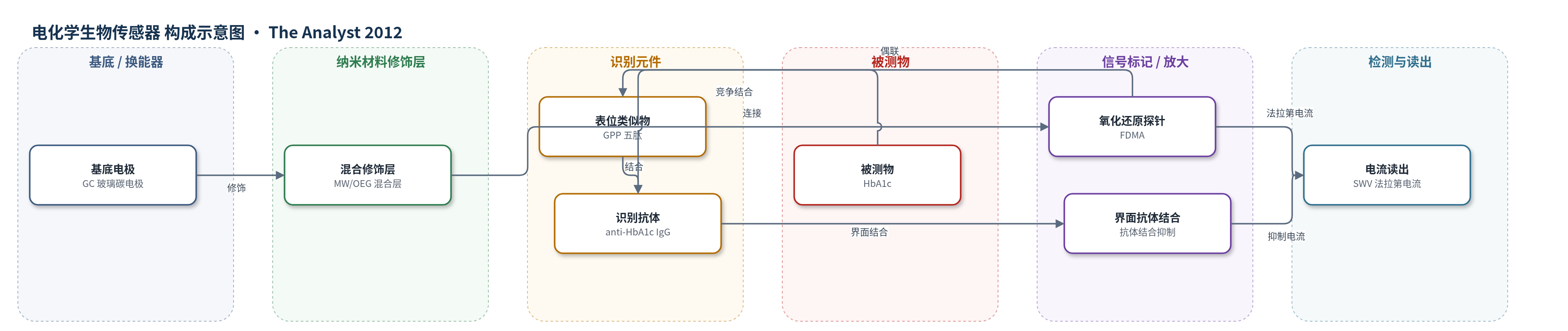
点击图片查看大图 · 依据论文自动绘制
传感器类型
电化学生物传感器
检测对象
糖化血红蛋白(HbA1c,glycosylated haemoglobin),样品基质:人血清(human serum)
检测原理
该传感器在玻璃碳电极上构建 MW/OEG 混合层,MW 末端连接 FDMA 氧化还原探针,FDMA 末端连接 GPP 表位类似物。抗 HbA1c IgG 可特异性结合 GPP。检测时,将抗体与含 HbA1c 的人血清混合,HbA1c 与 GPP 竞争结合抗体。若 HbA1c 浓度高,更多抗体被 HbA1c 占据,游离抗体减少,结合到电极 GPP 的抗体减少,FDMA 暴露于溶液,法拉第电流较高;若 HbA1c 浓度低,更多游离抗体结合 GPP,抗体蛋白环境屏蔽或阻碍 FDMA 电子转移,法拉第电流降低。通过方波伏安法测量 FDMA 相对法拉第电流,电流随 HbA1c 浓度升高而升高,实现竞争抑制检测,无需洗涤步骤。
检测灵敏度
线性范围: 4.5%–15.1%(HbA1c 占总血红蛋白百分比,人血清)
效应效果
该传感器特异性良好:抗 HbA1c IgG 单独结合 GPP 界面时,FDMA 电流衰减 67%±4%(95% 置信度,n=6);GPP 未偶联、抗体被过量 GPP 预饱和、错误 IgG 或牛血清白蛋白对照中电流仅下降约 5%。人血清中 2 µg mL−1 抗体与 13.5% HbA1c 混合后电流衰减 29%±2%(95% 置信度,n=6),表明 HbA1c 有效竞争抗体。校准曲线在 4.5%–15.1% HbA1c(占总血红蛋白)内线性,总血红蛋白约 15 g dL−1,每点为 6 个 GC 电极平均值,无需洗涤或冲洗。作者认为适用于未稀释人血清临床范围(约 5%–20%)检测。
传感器的构成
- 基底电极:玻璃碳电极(GC),作为电化学换能基底
- 混合修饰层:聚苯乙炔分子导线(MW)/聚乙二醇(OEG)混合层,由原位芳基重氮盐形成,MW 提供连接位点,OEG 抗非特异吸附
- 氧化还原探针:1,1’-双(甲氨基)环戊二烯基铁(FDMA),连接于 MW 远端,提供可测法拉第电流
- 表位识别元件:N-糖基化五肽(GPP,glycolysated-VHLTP),共价连接于 FDMA 远端,模拟 HbA1c 表位
- 识别抗体:抗 HbA1c 单克隆 IgG 抗体(anti-HbA1c IgG),与 GPP 或 HbA1c 竞争结合,结合后抑制 FDMA 信号
- 信号读出:方波伏安法(SWV),检测 FDMA 相对法拉第电流变化
中文摘要
本文报道了一种用于检测糖化血红蛋白(HbA1c)的电化学免疫生物传感器。该传感器以玻璃碳(GC)电极为基底,利用原位生成的芳基重氮盐构建聚苯乙炔分子导线(MW)与聚乙二醇(OEG)混合自组装层。在 MW 远端共价连接氧化还原探针 1,1’-双(甲氨基)环戊二烯基铁(FDMA),随后通过碳二亚胺偶联在 FDMA 远端连接 N-糖基化五肽(GPP)作为 HbA1c 表位类似物,可被抗 HbA1c 单克隆 IgG 抗体特异性识别。检测采用竞争抑制法:溶液中的 HbA1c 与固定于电极表面的 GPP 竞争结合抗 HbA1c IgG;当 GPP 修饰界面接触抗体与 HbA1c 混合物时,未结合 HbA1c 的游离抗体结合界面,使 FDMA 的法拉第电流衰减。HbA1c 浓度越高,结合界面的抗体越少,法拉第电流越高。在无需洗涤或冲洗步骤的条件下,FDMA 相对法拉第电流与血清中 HbA1c 占总血红蛋白的百分比在 4.5%–15.1% 范围内呈良好线性关系。
英文摘要
An electrochemical immuno-biosensor for detecting glycosylated haemoglobin (HbA1c) is reported based on glassy carbon (GC) electrodes with a mixed layer of an oligo(phenylethynylene) molecular wire (MW) and an oligo(ethylene glycol) (OEG). The mixed layer is formed from in situ-generated aryl diazonium cations. To the distal end of the MW, a redox probe 1,1'-di(aminomethyl)ferrocene (FDMA) was attached followed by the covalent attachment of an epitope N-glycosylated pentapeptide (GPP), an analogon to HbA1c, to which an anti-HbA1c monocolonal antibody IgG can selectively bind. HbA1c was detected by a competitive inhibition assay based on the competition for binding to anti-HbA1c IgG antibodies between the analyte in solution, HbA1c, and the surface bound epitope GPP. Exposure of the GPP modified sensing interface to the mixture of anti-HbA1c IgG antibody and HbA1c results in the attenuation of ferrocene electrochemistry due to free antibody binding to the interface. Higher concentrations of analyte led to higher Faradaic currents as less anti-HbA1c IgG is available to bind to the electrode surface. It was observed that there is a good linear relationship between the relative Faradaic current of FDMA and the concentration of HbA1c from 4.5% to 15.1% of total haemoglobin in serum without the need for washing or rinsing steps.