组成图示
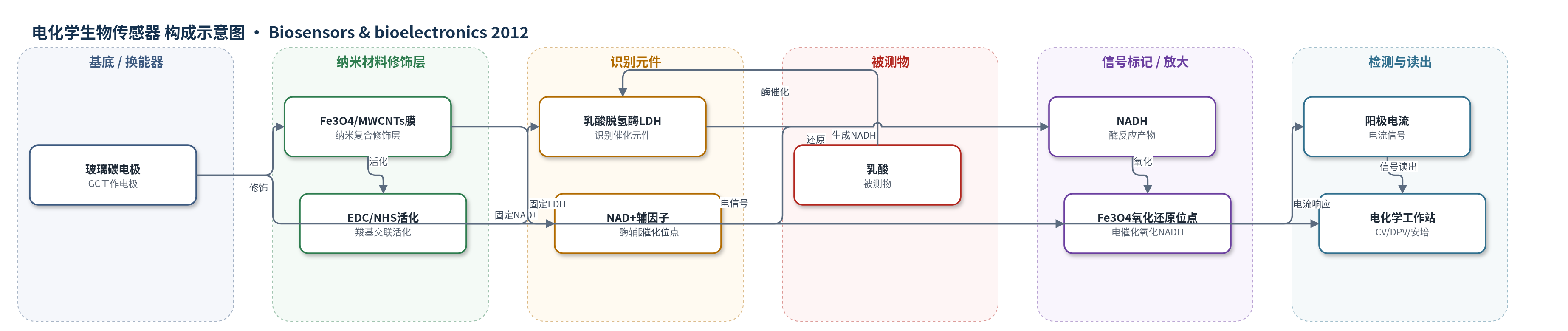
点击图片查看大图 · 依据论文自动绘制
传感器类型
电化学生物传感器
检测对象
乳酸(lactate,样品基质:人血浆/血清)、NADH(烟酰胺腺嘌呤二核苷酸还原型,样品基质:PBS缓冲液)
检测原理
该传感器以 Fe3O4/MWCNTs 修饰玻璃碳电极为换能器。LDH 识别并催化乳酸氧化:乳酸 + NAD+ → 丙酮酸 + NADH + H+。生成的 NADH 扩散至电极表面,在 0.0 mV(vs. Ag/AgCl)低电位下被 Fe3O4 氧化还原位点催化氧化,MWCNTs 提供电子传导通道。NADH 氧化遵循 ECE 机制,先发生不可逆电子转移生成 NADH•+,随后去质子化并再失电子生成 NAD+。由于 NAD+ 和电极表面氧化还原位点浓度基本恒定,阳极电流随 NADH 浓度增加而增加,从而间接反映乳酸浓度。低电位操作减少尿酸、多巴胺、葡萄糖、对乙酰氨基酚等干扰。
检测灵敏度
NADH:LOD: 0.3 μM;LOD: 300 nM (S/N = 3);线性范围: 1.0–70 μM(R^2 = 0.9975,灵敏度 0.070 μA μM−1 cm−2)、70–300 μM(R^2 = 0.9964,灵敏度 0.035 μA μM−1 cm−2);CV 线性至 500 μM(R^2 = 0.9929,Ip(μA)=0.0018[NADH](μM)+0.0404 μA)。乳酸:LOD: 5 μM;线性范围: 50–500 μM(R^2 = 0.9929,灵敏度 7.67 μA mM−1);CV 线性至 2.3 mM(灵敏度 1.065 μA mM−1)。
效应效果
NADH 传感器在 0.0 mV 下,0.1 mM 尿酸、多巴胺、葡萄糖和对乙酰氨基酚几乎无干扰,0.1 mM 抗坏血酸有正干扰。连续 2000 s 检测 50 μM NADH 电流仅降约 10%;10 和 100 μM NADH 五次测量 RSD 为 4.5% 和 4.7%。修饰电极 300 次循环稳定,室温保存 2 周保留 96% 活性。乳酸传感器 DPV 线性 50–500 μM,LOD 5 μM,灵敏度 7.67 μA mM−1,与文献相当或更优。人血浆标准加入法与分光光度法一致,6 次平均回收率 101.9%,RSD 2.1–5.1%。
传感器的构成
- 基底电极:玻璃碳电极(GC),经氧化铝抛光和超声清洗,作为工作电极与电子换能基底
- 纳米复合修饰层:Fe3O4/MWCNTs 纳米复合膜,由 Fe3O4 磁性纳米颗粒共沉淀负载于羧基化多壁碳纳米管(MWCNTs)表面,提供 NADH 电催化氧化位点和电子传导通道
- 交联活化层:EDC/NHS 处理层,活化 Fe3O4/MWCNTs 膜表面羧基,用于与 LDH 和 NAD+ 的氨基形成酰胺键
- 识别元件:乳酸脱氢酶(LDH),催化乳酸氧化为丙酮酸并生成 NADH
- 辅因子层:NAD+,作为 LDH 辅因子,被还原为 NADH 后在修饰电极表面氧化
- 信号转换元件:NADH/Fe3O4 氧化还原体系,NADH 在 Fe3O4/MWCNTs 表面发生 ECE 氧化,产生与乳酸浓度相关的阳极电流
- 电化学检测系统:三电极体系(GC 工作电极、铂丝对电极、Ag/AgCl/KCl 参比电极)与电化学工作站,用于 CV、DPV 和安培检测
中文摘要
本文通过简单共沉淀法将四氧化三铁(Fe3O4)磁性纳米颗粒原位负载于羧基化多壁碳纳米管(MWCNTs)表面,制备 Fe3O4/MWCNTs 纳米复合修饰玻璃碳电极。该复合材料兼具 Fe3O4 的氧化还原特性和 MWCNTs 的导电性,可在 0.0 mV(vs. Ag/AgCl)极低电位下催化氧化 NADH,较裸玻璃碳电极降低约 650 mV 过电位。安培检测 NADH 的检出限为 0.3 μM,线性响应可达 300 μM。进一步利用 EDC/NHS 将乳酸脱氢酶(LDH)和 NAD+ 共价固定于复合膜上,构建一体化乳酸生物传感器。差分脉冲伏安法检测乳酸在 50–500 μM 范围内线性,检出限 5 μM,灵敏度 7.67 μA mM−1,并成功用于人血清/血浆样品中乳酸浓度的测定。
英文摘要
Fe(3)O(4) magnetic nanoparticles were in situ loaded on the surface of multiwalled carbon nanotubes (MWCNTs) by a simple coprecipitation procedure. The resulting Fe(3)O(4)/MWCNTs nanocomposite brings new capabilities for electrochemical sensing by combining the advantages of Fe(3)O(4) magnetic nanoparticles and MWCNTs. It was found that Fe(3)O(4) has redox properties similar to those of frequently used mediators used for electron transfer between NADH and electrode. The cyclic voltammetric results indicated the ability of Fe(3)O(4)/MWCNTs modified GC electrode to catalyze the oxidation of NADH at a very low potential (0.0 mV vs. Ag/AgCl) and subsequently, a substantial decrease in the overpotential by about 650 mV compared with the bare GC electrode. The catalytic oxidation current allows the stable and selective amperometric detection of NADH at an applied potential of 0.0 mV (Ag/AgCl) with a detection limit of 0.3 μM and linear response up to 300 μM. This modified electrode can be used as an efficient transducer in the design of biosensors based on coupled dehydrogenase enzymes. Lactate dehydrogenase (LDH) and NAD(+) were subsequently immobilized onto the Fe(3)O(4)/MWCNTs nanocomposite film by covalent bond formation between the amine groups of enzyme or NAD(+) and the carboxylic acid groups of the Fe(3)O(4)/MWCNT film. Differential pulse voltammetric detection of lactate on Fe(3)O(4)/MWCNT/LDH/NAD(+) modified GC electrode gives linear responses over the concentration range of 50-500 μM with the detection limit of 5 μM and sensitivity of 7.67 μA mM(-1). Furthermore, the applicability of the sensor for the analysis of lactate concentration in human serum samples has been successfully demonstrated.