组成图示
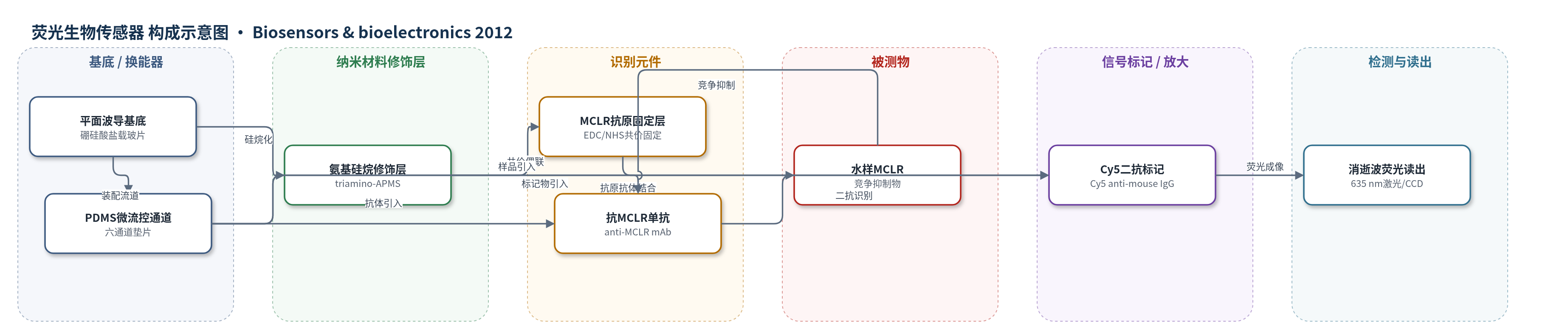
点击图片查看大图 · 依据论文自动绘制
传感器类型
荧光生物传感器
检测对象
微囊藻毒素-亮氨酸-精氨酸(microcystin-leucine-arginine, MCLR)、微囊藻毒素(microcystins, MCs,含 MCRR、dm-MCRR、MCYR);样品基质:地表淡水(河流、湖泊、水库水样)
检测原理
该传感器采用竞争荧光免疫分析。MCLR 通过 EDC/NHS 共价固定于氨基硅烷化平面波导表面,形成抗原识别位点;样品中的 MCLR 与加入的 anti-MCLR 单克隆抗体竞争结合固定 MCLR。当样品 MCLR 浓度升高时,结合到表面的抗体减少,随后 Cy5 标记兔抗小鼠 IgG 与结合抗体结合,形成荧光标记复合物。635 nm 激光在波导边缘激发消逝波,选择性激发表面 Cy5 荧光,CCD 相机采集荧光阵列图像。净荧光强度与表面结合抗体量成正比,因此与样品 MCLR 浓度呈反比。方法通过四参数 logistic 方程拟合竞争抑制曲线,以 IC50 和 10% 抑制浓度分别表征灵敏度和检出限;荧光二抗提供信号放大,脱脂奶粉封闭降低非特异性背景。
检测灵敏度
LOD: 16 ± 3 ng/L;动态范围: 0.06–1.5 μg/L;IC50: 0.34 ± 0.01 μg/L
效应效果
传感器对 MCRR、dm-MCRR、MCYR 交叉反应分别为 90%、95%、91%,可定量常见 MCs 总量;对莠草津、西维因、恩诺沙星、氯霉素等无关污染物 CR<0.002%。片内 RSD 4–9%,片间 RSD 4–21%,校准范围平均 RSD 13%。50 mM NaOH 再生后同一芯片至少 15 个循环无明显信号损失。加标水样(0–100 μg/L)曲线与 Milli-Q 水无显著差异,基质效应可忽略。直接分析地表水并与在线 SPE-LC–MS/MS 比较,95% 置信水平无显著差异,如样品 3 为 0.24±0.02 对 0.23±0.03 μg/L,样品 4 为 0.55±0.06 对 0.64±0.05 μg/L。系统可 6 样品并行、约 60 min 完成,LOD 低于 WHO 1 μg/L 指南,适合现场监测。
传感器的构成
- 基底/换能器:硼硅酸盐显微镜载玻片(borosilicate microscope slides)作为平面光波导(planar waveguide),承载消逝波激发与荧光成像。
- 硅烷修饰层:2% 三氨基-APMS(triamino-APMS)甲苯溶液处理,提供氨基表面用于共价偶联。
- 抗原固定层:MCLR(microcystin-leucine-arginine)经 EDC/NHS 共价固定于氨基表面,作为竞争免疫分析抗原;同时图案化 biotin 阳性对照和 MES 阴性对照。
- 封闭层:3% 脱脂奶粉(non-fat milk)PBS 溶液封闭,降低非特异性结合;载体缓冲液 PBSTM 含 0.3% 脱脂奶粉和 0.05% Tween 20。
- 识别元件:anti-MCLR 单克隆抗体(mouse IgG,MC10E7)与固定 MCLR 结合,被样品中 MCLR 竞争抑制。
- 信号标记物:Cy5 标记兔抗小鼠 IgG(Cy5-labeled rabbit anti-mouse IgG)识别结合抗体并产生荧光。
- 微流控流路:PDMS(poly(dimethylsiloxane))六通道垫片形成六个分析流道,连接蠕动泵与阀门,实现多样品并行流动和静态孵育。
- 读出系统:635 nm 二极管激光、长通/带通滤光片和 CCD 相机(Retiga 1300)采集荧光阵列图像。
中文摘要
本研究开发了一种基于消逝波激发的自动化阵列生物传感器,用于检测淡水样品中的微囊藻毒素(MCs)。传感表面为共价固定于平面光波导(显微镜载玻片)上的微囊藻毒素-亮氨酸-精氨酸(MCLR)。样品中加入的抗MCLR单克隆抗体与固定MCLR的结合会被溶液中的MCLR竞争性抑制,随后用Cy5标记兔抗小鼠IgG显示结合抗体量。通过优化表面化学,提高了灵敏度、再生能力并降低非特异性结合。优化后IC50为0.34±0.01 μg/L,检出限为16±3 ng/L,动态范围为0.06–1.5 μg/L MCLR,优于此前报道器件。对MCRR、dm-MCRR和MCYR的交叉反应分别为90%、95%和91%。该微阵列可并行检测最多6个样品,总分析时间约60 min。表面用50 mM NaOH再生,每片芯片至少可重复15个检测-再生循环而无明显结合能力损失。该免疫传感器已成功直接分析地表水样品,结果与LC–MS/MS高度一致。
英文摘要
An automated array biosensor based on evanescent-wave excitation has been developed for the detection of microcystins (MCs) in freshwater samples. The sensing surface consisted of microcystin-leucine-arginine (MCLR) covalently immobilized onto a planar waveguide (microscope slide). The binding of anti-MCLR monoclonal antibodies, spiked in the sample, to the immobilized MCLR was competitively inhibited by MCLR in solution and the amount of antibody bound to the patterned antigens was revealed using Cy5-labeled rabbit anti-mouse IgG. Surface chemistry has been optimized to improve biosensor performance in terms of sensitivity, regeneration ability and to avoid non specific binding for further application to environmental monitoring. The optimized biosensor assay presents an IC(50) value of 0.34 ± 0.01 μg/L, a detection limit of 16 ± 3 ng/L and a dynamic range from 0.06 to 1.5 μg/L MCLR, improving the performance of previously reported devices. Cross-reactivity to other related MCs, such as microcystin-RR (MCRR, 90%), microcystin-RR desmethylated (dm-MCRR, 95%) and microcystin-YR (MCYR, 91%), was also evaluated. The automated microarray can assay up to six different samples in parallel, with a total analysis time of about 60 min. The sensing surface was regenerated with 50mM NaOH and each chip was reused for, at least, 15 assay-regeneration cycles without significant binding capacity loss. The immunosensor has been successfully applied to the direct analysis of MCs in surface water samples and the results were in close agreement with those provided by LC-MS/MS.