组成图示
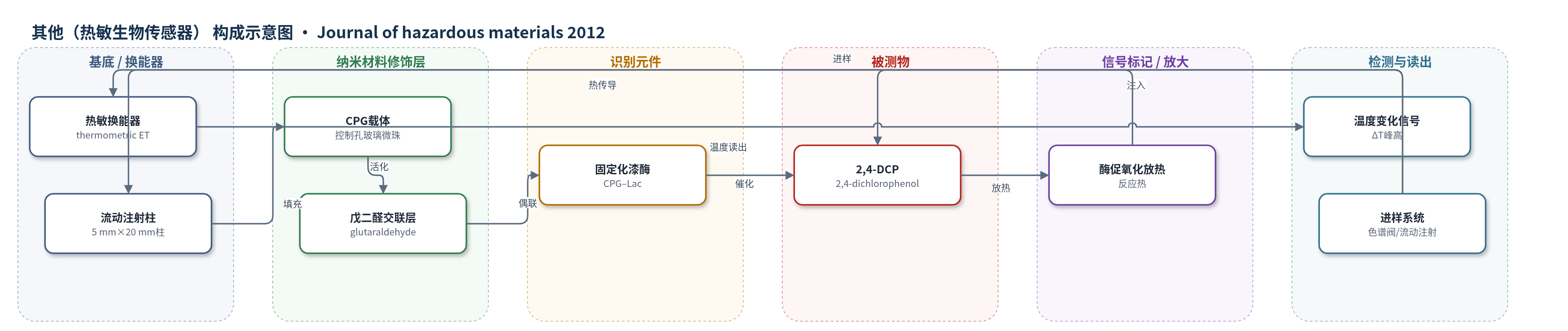
点击图片查看大图 · 依据论文自动绘制
传感器类型
其他(热敏生物传感器)
检测对象
2,4-二氯酚(2,4-dichlorophenol, 2,4-DCP);样品基质:0.1 M pH 4.5醋酸钠缓冲液/降解反应液
检测原理
该传感器为酶热敏(enzyme thermistor, ET)流动注射生物传感器。固定化漆酶(CPG–Lac)作为识别元件,在0.1 M pH 4.5醋酸钠缓冲液中催化氧化2,4-DCP。漆酶作为多铜氧化酶使酚羟基氧化生成苯氧自由基,并发生氧化偶联、脱氯和聚合,反应释放热量。反应热通过填充柱传导至热敏换能器,引起局部温度变化;温度变化峰高与进入柱内的2,4-DCP浓度成正比,从而实现浓度定量。该过程无需外加电子供体或光学标记,信号直接来源于酶促反应热,因此不受电化学或光学干扰,适合在线连续监测。
检测灵敏度
LOD: 0.05 mM;线性范围: 0–1 mM(0–0.5 mM与0.5–1 mM分段线性);灵敏度斜率: 3.514(0–0.5 mM)、2.151(0.5–1 mM);R^2 = 0.991(0–0.5 mM)、0.998(0.5–1 mM)
效应效果
固定化漆酶显著提高了对TiO2/UV诱导失活的稳定性:UV照射6 h后仍保留约40%活性,在TiO2/UV体系中稳定性相近;操作稳定性方面,9次重复使用后2,4-DCP去除率约60%,保留超过70%初始活性。热敏传感器在0–1 mM范围内呈分段线性,LOD为0.05 mM,斜率分别为3.514和2.151。用ET与HPLC同步监测5 mM 2,4-DCP在TiO2/UV下的降解,两者结果一致,表明传感器精确、灵敏。作者认为该传感器无电化学或光学干扰、响应快、可自动流动注射,适合2,4-DCP降解过程的快速在线监测。
传感器的构成
- 换能器:热敏检测系统(thermometric system/ET),将酶反应放热转换为温度变化信号
- 检测柱:5 mm×20 mm柱体,填充CPG–Lac并连接流动注射系统
- 载体:控制孔玻璃微珠(CPG,Trisoperl,粒径125–140 μm,孔径54.3 nm,比表面积73.28 m2/g),提供固定化载体
- 交联层:戊二醛(glutaraldehyde)活化CPG氨基并共价偶联漆酶
- 封闭剂:乙醇胺(ethanolamine)封闭未反应基团
- 识别元件:漆酶(laccase,Trametes versicolor,EC 1.10.3.2),固定化后为CPG–Lac,催化氧化2,4-DCP
- 流动相:0.1 M pH 4.5醋酸钠缓冲液,0.5 mL/min流动注射
中文摘要
本文研究了TiO2/UV光催化、漆酶以及同时光催化–酶法对2,4-二氯酚(2,4-DCP)的去除。天然漆酶与TiO2/UV直接耦合时,由于漆酶在光催化体系中快速失活,表现出负协同效应。将漆酶通过戊二醛共价固定到含氨基控制孔玻璃(CPG)上,可显著提高其对TiO2/UV诱导失活的稳定性。CPG–漆酶与TiO2/UV耦合后,2,4-DCP降解效率明显高于单独使用固定化漆酶或TiO2/UV;对5 mM 2,4-DCP,2 h去除率达90%,而单独TiO2/UV和CPG–漆酶分别为26.5%和78.1%。作者采用考虑中间体的动力学模型分析降解过程,表明该耦合工艺尤其适用于高浓度2,4-DCP处理。此外,以固定化漆酶为生物识别元件构建了热敏生物传感器,用于在线监测2,4-DCP降解,结果显示该传感器精确、灵敏。
英文摘要
Removal of 2,4-dichlorophenol (2,4-DCP) by TiO2/UV photocatalytic, laccase, and simultaneous photocatalytic-enzymatic treatments were investigated. Coupling of native laccase with TiO2/UV showed a negative synergetic effect due to the rapid inactivation of laccase. Immobilizing laccase covalently to controlled porous glass (CPG) effectively enhanced the stability of laccase against TiO2/UV induced inactivation. By coupling CPG-laccase with the TiO2/UV the degradation efficiency of 2,4-DCP was significantly increased as compared with the results obtained when immobilized laccase or TiO2/UV were separately used. Moreover, the enhancement was more remarkable for the degradation of 2,4-DCP with high concentration, such that for the degradation of 5mM 2,4-DCP, 90% removal percentage was achieved within 2h with the coupled degradation process. While for the TiO2/UV and CPG-laccase process, the removal percentage of 2,4-DCP at 2h were only 26.5% and 78.1%, respectively. The degradation kinetics were analyzed using a intermediate model by taking into account of the intermediates formed during the degradation of 2,4-DCP. The high efficiency of the coupled degradation process therefore provided a novel strategy for degradation of concentrated 2,4-DCP. Furthermore, a thermometric biosensor using the immobilized laccase as biorecognition element was constructed for monitoring the degradation of 2,4-DCP, the result indicated that the biosensor was precise and sensitive.