组成图示
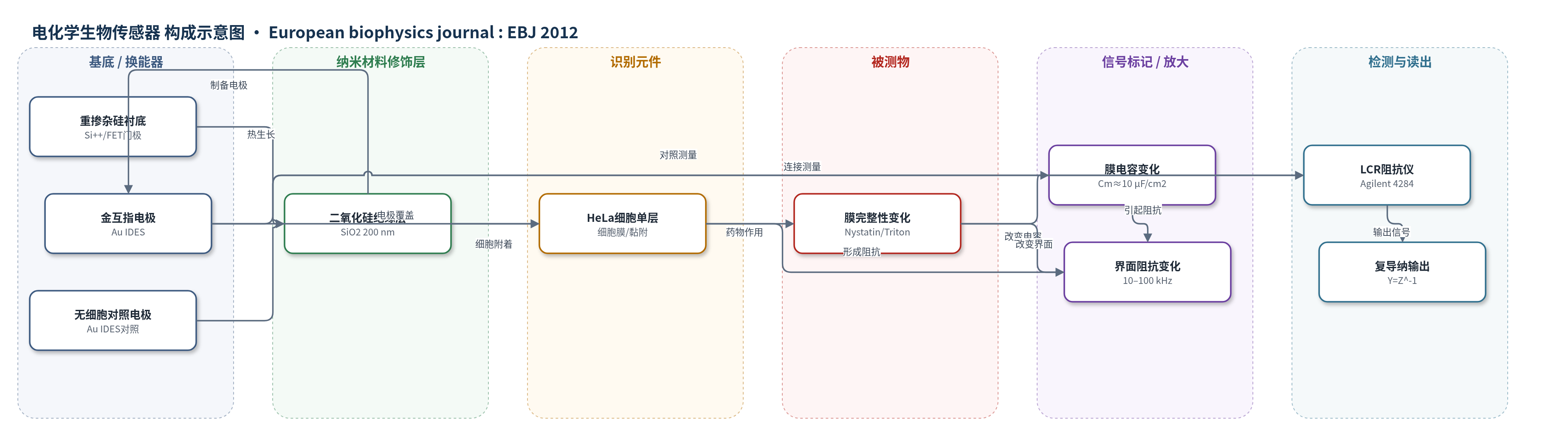
点击图片查看大图 · 依据论文自动绘制
传感器类型
电化学生物传感器
检测对象
HeLa 人上皮细胞(HeLa cells)、细胞膜完整性(cell membrane integrity);样品基质:normal Krebs(NK)溶液/细胞培养液
检测原理
器件在互指金电极上施加 100 mV 交流小信号,通过 LCR 表测量 100 Hz–100 kHz 的复阻抗/导纳。HeLa 细胞单层覆盖电极后,细胞膜脂质双分子层形成界面电容,细胞与 SiO2 之间的间隙及细胞间接触影响电流路径,使有细胞电极在 10–100 kHz 的导纳明显不同于无细胞电极。Nystatin 在膜上形成选择性通道,增加离子通透,导致实部和虚部导纳下降;Triton X-100 溶解膜,使细胞内外液体连通,导纳接近无细胞介质。作者采用 Grosse–Schwan 模型拟合频率响应,提取膜特异电容 Cm、细胞间隙/黏附参数 Gb 和 a,从而将阻抗变化关联到膜完整性与细胞黏附状态。无细胞对照电极用于扣除介质温度、pH 和化学漂移。
检测灵敏度
原文未报告 LOD、线性范围、灵敏度斜率或相关系数。
效应效果
该器件通过同一芯片上的有细胞与无细胞 Au IDES 阵列实现实时内部对照,可区分细胞响应与介质漂移。加入 Nystatin(120–240 μg/ml)后,30 kHz 处实部和虚部导纳迅速下降,表明系统对膜通道形成敏感;加入 0.2% Triton X-100 后,导纳接近无细胞介质,说明信号依赖细胞膜完整性与电极黏附。拟合得到 Cm≈10 μF/cm2、a≈5 Ω^-1/2 cm、Gb≈10^-2 Ω^-1 cm^-2,估算细胞–基底间隙 h≈10 nm;按细胞直径约 10 μm 计算膜电容约 50 pF,高于 patch clamp 值,可能反映核膜或内质网等额外脂质膜贡献。原文未报告 RSD、回收率或与 ELISA/HPLC/qPCR 的定量对比。作者认为该 IDES 阻抗平台可发展为无标记、非侵入的细胞行为与药物效应监测工具,并可进一步用于膜电位测量。
传感器的构成
- 基底/换能器:重掺杂 n 型硅(Si++)衬底,作为 FET 门极/衬底,提供电学控制与阻抗测量基础
- 绝缘层:热生长二氧化硅(SiO2,200 nm),隔离 Si++ 与介质,支撑细胞附着
- 电极层:互指金电极(Au IDES),形成源漏接触,采集细胞层与介质界面阻抗
- 生物响应层:HeLa 人上皮细胞单层,直接生长在 SiO2 上,细胞膜脂质双分子层产生界面电容与黏附阻抗
- 对照电极:无细胞 Au IDES 阵列,暴露于同一 normal Krebs(NK)介质,用于扣除温度/pH/化学漂移
- 样品介质:normal Krebs(NK)溶液,50 μL,提供离子导电环境并承载药物刺激
- 信号读出:Agilent 4284 LCR 表,施加 100 mV 交流信号,记录 100 Hz–100 kHz 复导纳/阻抗
中文摘要
阻抗谱(IS)是一种分析复杂生物系统复电阻抗的强有力技术,对表面现象和体性质变化均敏感。本文描述了一种基于互指电极(IDES)的简单、便捷的细胞特性阻抗分析方法,用于评估其作为无标记生物传感器的适用性。将人上皮细胞培养在器件表面,测量频率依赖的复介电响应,以考察器件对细胞膜电学特性的响应能力。为检验器件检测细胞膜通道变化的能力,作者进一步研究了已知影响膜完整性的药物作用。导纳的频率响应可用基于细胞覆盖器件表面及电流路径简单假设的模型拟合,由拟合可推断膜特异电容和细胞黏附信息。结果表明,该 IDES 配置能够区分有细胞与无细胞电极的阻抗差异,并在药物加入后快速响应膜通透性或膜溶解变化。初步结果说明,该器件有望发展为无标记、非侵入的生物传感与细胞行为监测平台,可用于研究细胞基本电学性质及药物对细胞膜的影响。
英文摘要
Impedance spectroscopy (IS) is a powerful technique for analysis of the complex electrical impedance of a large variety of biological systems, because it is sensitive both to surface phenomena and to changes of bulk properties. A simple and convenient method of analysis of cell properties by IS is described. An interdigitated electrodes configuration was used for the measurements; human epithelial cells were grown on the device to investigate the complex dielectric response as a function of frequency, in order to test the suitability of the device for use as a label-free biosensor. To test the ability of the device to detect channels in the cell membrane, the effect of drugs known to affect membrane integrity was also investigated. The frequency response of the admittance (i.e. the reciprocal of the impedance) can be well fitted by a model based on very simple assumptions about the cells coating the device surface and the current flow; from the calculations, membrane-specific capacitance and information about cell adhesion can be inferred. These preliminary efforts have shown that our configuration could lead to a label-free non-invasive technique for biosensing and cellular behavior monitoring which might prove useful in investigation of the basic properties of cells and the effect of drugs by estimation of some fundamental properties and modification of the electrical characteristics of the device.