组成图示
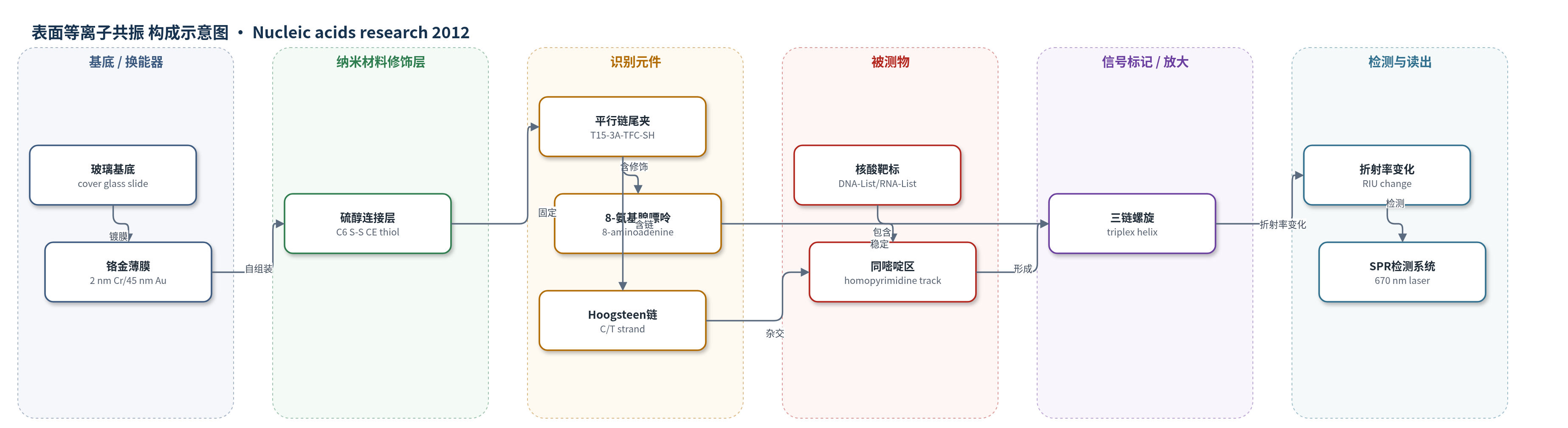
点击图片查看大图 · 依据论文自动绘制
传感器类型
表面等离子共振(SPR)生物传感器
检测对象
李斯特菌iap毒力基因短DNA靶标(DNA-List, 32-mer)、李斯特菌iap mRNA纯化RNA靶标(RNA-List, 103-mer);样品基质为纯化核酸/5×SSC缓冲液
检测原理
金表面通过硫醇自组装固定8-氨基腺嘌呤修饰的平行链DNA尾夹。尾夹的Hoogsteen链与靶标核酸中的同嘌呤-同嘧啶区互补配对,Watson-Crick链和尾序列形成夹持结构,使靶标在表面形成三链螺旋。8-氨基腺嘌呤增强Hoogsteen配对稳定性,使三链在中性pH下稳定;T15胸腺嘧啶垂直间隔降低受体与金表面静电吸附并提高靶标可及性。靶标结合量随浓度增加,引起金表面局部折射率升高,SPR反射角/反射率发生实时变化,以RIU读出。该方法无标记、无扩增,信号直接来自生物分子结合质量。
检测灵敏度
LOD: 50 fmol(RNA-List,200 pM,5.5 pg/mL);LOD: 0.8 nM(200 fmol,DNA-List,T15-3A-TFC-SH);LOD: 0.85 nM(212 fmol,DNA-List,3A-TFC-SH);LOD: 1.5 nM(375 fmol,DNA-List,TFC-SH);LOD: 0.9 nM(225 fmol,DNA-List,DFO-SH);LOD: 1.24 nM(310 fmol,DNA-List,3A-DFO-SH)
效应效果
特异性:200 nM DNA阴性对照平均信号5.4±1.2×10^-6 RIU,相当于基线噪声;RNA阴性对照低浓度仅最小信号。重现性:5 nM DNA-List在T15-3A-TFC-SH上片内误差≤15%,片间P=0.2,两套SPR平均信号5.1±0.6×10^-5 RIU和5±0.7×10^-5 RIU。与双链法相比,短DNA饱和信号提高18%或27%,T15间隔使饱和捕获提高37.5%;RNA信号8.3±1×10^-5 RIU,比双链3.8±0.7×10^-5 RIU高54.2%。相比放射性标记25 fmol和磁珠RT-qPCR 150 fmol,本方法无标记达50 fmol,可快速检测具二级结构RNA。
传感器的构成
- 基底/换能器:显微镜盖玻片(microscope cover glass slide)镀2 nm铬(Cr)和45 nm金(Au),作为SPR换能表面
- 自组装连接层:5'-硫醇修饰寡核苷酸(thiolated oligonucleotide,C6 S-S CE linker)通过Au-S键将受体固定于金表面
- 识别元件:8-氨基腺嘌呤修饰平行链DNA尾夹(8-aminoadenine-modified parallel-stranded DNA tail-clamp,T15-3A-TFC-SH),含Watson-Crick链、Hoogsteen链、尾序列和T15垂直间隔
- 识别界面:靶标同嘌呤-同嘧啶区(homopurine-homopyrimidine track)与Hoogsteen链形成Hoogsteen碱基配对,生成三链螺旋(triplex helix)
- 信号读出:无标记SPR反射率/折射率变化(RIU),无需荧光、酶或纳米颗粒标记
中文摘要
本文报道了一种用于无标记检测短链和长链核酸序列的新型生物传感方法,尤其适用于具有预测二级结构的RNA。该方法选用8-氨基腺嘌呤修饰的平行链DNA尾夹作为亲和生物受体,使其在中性pH下与含同嘌呤-同嘧啶区的核酸靶标杂交时形成稳定三链螺旋。作者利用自制表面等离子共振(SPR)传感器实时监测金表面折射率变化,无需标记或扩增。结果显示,该方法可在数分钟内以飞摩尔水平检测32-mer短DNA和103-mer纯化RNA,对具有二级结构的RNA达到50 fmol检出限。与传统双链杂交方法相比,短DNA检测效率提高18%,RNA检测效率提高54%,表明三链亲和捕获策略可克服RNA二级结构对杂交的阻碍,在RNA分析中具有应用潜力。
英文摘要
A novel biosensing approach for the label-free detection of nucleic acid sequences of short and large lengths has been implemented, with special emphasis on targeting RNA sequences with secondary structures. The approach is based on selecting 8-aminoadenine-modified parallel-stranded DNA tail-clamps as affinity bioreceptors. These receptors have the ability of creating a stable triplex-stranded helix at neutral pH upon hybridization with the nucleic acid target. A surface plasmon resonance biosensor has been used for the detection. With this strategy, we have detected short DNA sequences (32-mer) and purified RNA (103-mer) at the femtomol level in a few minutes in an easy and level-free way. This approach is particularly suitable for the detection of RNA molecules with predicted secondary structures, reaching a limit of detection of 50 fmol without any label or amplification steps. Our methodology has shown a marked enhancement for the detection (18% for short DNA and 54% for RNA), when compared with the conventional duplex approach, highlighting the large difficulty of the duplex approach to detect nucleic acid sequences, especially those exhibiting stable secondary structures. We believe that our strategy could be of great interest to the RNA field.