组成图示
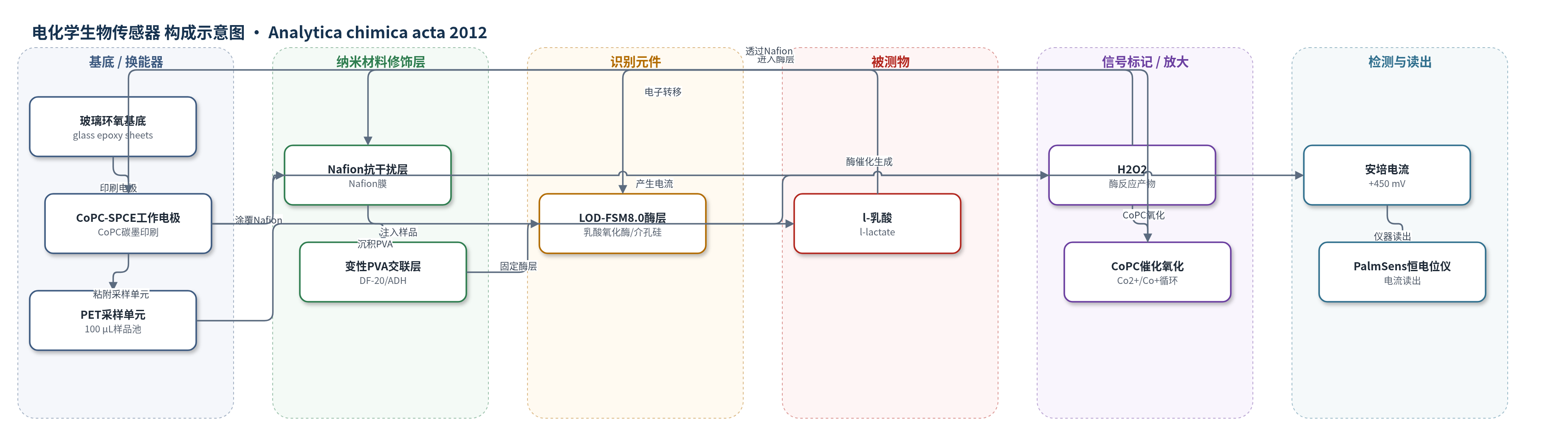
点击图片查看大图 · 依据论文自动绘制
传感器类型
电化学生物传感器
检测对象
l-乳酸(l-lactate),样品基质:磷酸盐缓冲液(pH 7.4)标准溶液;文中亦提及可应用于血液、食品等基质。
检测原理
该传感器为安培型电化学检测。固定于介孔硅 FSM8.0 中的乳酸氧化酶(LOD)催化 l-乳酸与氧气反应生成丙酮酸和过氧化氢(H2O2)。生成的 H2O2 从酶层扩散穿过 Nafion 抗干扰膜,到达含钴酞菁(CoPC)的丝网印刷碳电极表面。CoPC 作为电催化介体,将 H2O2 氧化为氧气和质子,同时 Co2+PC 被还原为 Co+PC;随后 Co+PC 在工作电极上被氧化回 Co2+PC 并释放电子。在 +450 mV 恒定电位下,电子流形成与 l-乳酸浓度成正比的安培电流。Nafion 层阻挡抗坏血酸、尿酸等电活性干扰物,FSM8.0 包埋酶提高稳定性,DF-20/ADH 交联层增强固定。
检测灵敏度
LOD: 18.3 µM (S/N = 3);线性范围: 18.3 µM–1.5 mM;R^2 = 0.999;灵敏度: 4.54 µA cm−2 mM−1;响应时间: 约90 s;表观 Michaelis–Menten 常数: 0.86 mM
效应效果
传感器在 pH 7.4、+450 mV 下表现最佳,采样体积仅 100 µL。选择性方面,200 µM 干扰物中抗坏血酸相对响应为 6.4%,尿酸为 2.3%,胆固醇、半胱氨酸、葡萄糖、谷氨酰胺酸和尿素未检出。重复性 RSD 为 2.5%(10 次连续测量),重现性 RSD 为 5.3%(5 个独立传感器)。4 ℃干燥储存 9 个月后仍保留 98% 初始电流响应。与文献中基于丝网印刷电极和乳酸氧化酶的 l-乳酸传感器相比,其线性范围更好,检出限与文献 [20] 相当并优于 [22],储存稳定性更长。作者认为该器件简单、低成本、高性能,适用于临床血液、食品发酵和运动医学等 l-乳酸检测。
传感器的构成
- 基底/换能器电极:玻璃环氧片(glass epoxy sheets)上丝网印刷碳电极(SPCE),工作电极为含钴酞菁(CoPC)碳墨(C2030408P3)印刷的 CoPC-SPCE,辅助电极为碳墨(C2030519P4),参比电极为 Ag/AgCl 墨(C61003P7),绝缘墨(D2081009D6)定义工作区。
- 抗干扰膜:Nafion 层(2.5% Nafion,由 10% Nafion 稀释并用 25% 氨中和),涂覆于 CoPC-SPCE 表面,阻挡电活性干扰物并允许 H2O2 透过。
- 酶固定层:乳酸氧化酶(LOD)–介孔硅(FSM8.0)共轭物,LOD 吸附/包埋于孔径 8.0 nm 的 FSM8.0 孔道中,催化 l-乳酸氧化生成 H2O2。
- 聚合物基质/交联层:变性聚乙烯醇(D-polymer, DF-20)与己二酰二肼(ADH)交联,将 LOD-FSM8.0 沉积并固定在 Nafion 层上,形成传感层。
- 采样单元:白色 PET 圆形容器(∅9.0 mm,12 mm × 12 mm × 1.6 mm)粘附于 SPCE 上,定义工作电极面积并容纳 100 µL 样品。
中文摘要
本文报道了一种用于测定 l-乳酸的新型安培型生物传感器。该器件以含钴酞菁(CoPC)的丝网印刷碳电极(CoPC-SPCE)为换能器,工作电极表面先涂覆 Nafion 层作为抗干扰膜,再沉积由变性聚乙烯醇(DF-20)和己二酰二肼(ADH)交联固定的乳酸氧化酶(LOD)–介孔硅(FSM8.0)共轭层。采样单元仅需 100 µL 样品。检测基于 LOD 催化 l-乳酸氧化生成过氧化氢(H2O2),H2O2 在 CoPC 催化下于电极表面氧化产生安培电流。研究考察了 pH、施加电位、灵敏度、工作范围、选择性和储存稳定性。传感器在 pH 7.4、+450 mV 下响应最佳,l-乳酸检测范围为 18.3 µM 至 1.5 mM,响应时间约 90 s,对常见电活性干扰物具有高选择性,并在 4 ℃干燥储存 9 个月后仍保持初始响应。结果表明该方法可制备简单、低成本、高性能的 l-乳酸生物传感器。
英文摘要
A novel amperometric biosensor for the measurement of L-lactate has been developed. The device comprises a screen-printed carbon electrode containing cobalt phthalocyanine (CoPC-SPCE), coated with lactate oxidase (LOD) that is immobilized in mesoporous silica (FSM8.0) using a polymer matrix of denatured polyvinyl alcohol; a Nafion layer on the electrode surface acts as a barrier to interferents. The sampling unit attached to the SPCE requires only a small sample volume of 100 μL for each measurement. The measurement of l-lactate is based on the signal produced by hydrogen peroxide, the product of the enzymatic reaction. The behavior of the biosensor, LOD-FSM8.0/Naf/CoPC-SPCE, was examined in terms of pH, applied potential, sensitivity and operational range, selectivity, and storage stability. The sensor showed an optimum response at a pH of 7.4 and an applied potential of +450 mV. The determination range and the response time for L-lactate were 18.3 μM to 1.5 mM and approximately 90s, respectively. In addition, the sensor exhibited high selectivity for L-lactate and was quite stable in storage, showing no noticeable change in its initial response after being stored for over 9 months. These results indicate that our method provides a simple, cost-effective, high-performance biosensor for l-lactate.