组成图示
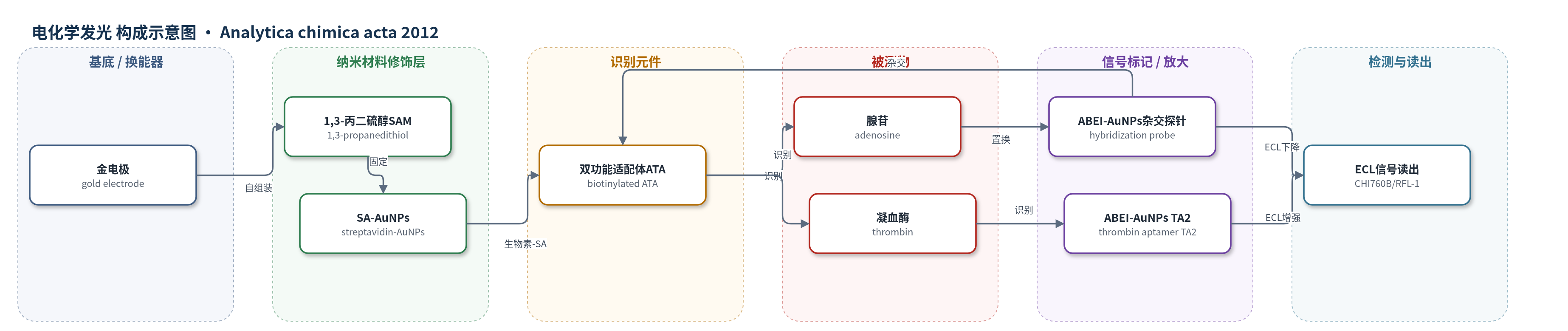
点击图片查看大图 · 依据论文自动绘制
传感器类型
电化学发光(ECL)生物传感器
检测对象
腺苷(adenosine)、凝血酶(thrombin);样品基质:人血浆(human plasma,1000倍稀释)及组装缓冲液标准样品
检测原理
传感器以金电极为换能器,1,3-丙二硫醇SAM和SA-AuNPs构建界面,生物素化ATA经生物素—SA固定。腺苷通道中,ABEI-AuNPs标记杂交探针先与ATA杂交,使电极表面富集ABEI;施加双步脉冲电位时,ABEI在H2O2/CBS中共反应产生ECL。腺苷与ATA结合后,因适配体—靶标三元复合物稳定性高于DNA双链,杂交探针被置换,ABEI-AuNPs减少,ECL信号下降,ΔI随腺苷浓度增加而增大。凝血酶通道中,凝血酶结合ATA后,ABEI-AuNPs标记TA2再结合凝血酶另一位点,形成适配体/蛋白/适配体复合物,电极表面ABEI富集,ECL强度随凝血酶浓度增加而升高。AuNPs富集ABEI并增强ECL,实现信号放大。
检测灵敏度
腺苷:LOD: 2.2 × 10⁻¹² M;线性范围: 5.0 × 10⁻¹²–5.0 × 10⁻⁹ M;灵敏度斜率: 810(ΔI = −258 + 810 × log C,C以pM计);R = 0.998。凝血酶:LOD: 1.2 × 10⁻¹⁴ M;线性范围: 5.0 × 10⁻¹⁴–5.0 × 10⁻¹⁰ M;灵敏度斜率: 696(I3 = 1374 + 696 × log C,C以pM计);R = 0.999。
效应效果
传感器选择性良好:0.1 nM鸟嘌呤、胸腺嘧啶、尿苷对腺苷ΔI响应仅为27.2%、−5.1%、−20.7%;1.0 pM Hb、PDGF-BB、GOx、hIgG对凝血酶I3响应仅为18.8%、18.3%、16.5%、10.1%。两靶标共存时交叉干扰小,ΔI变化0.2%–2.3%,I3变化0.1%–1.5%。脉冲ECL信号连续5次以上稳定;1.0×10⁻¹⁰ M腺苷和1.0×10⁻¹² M凝血酶重复测量RSD为2.1%和4.5%。人血浆1000倍稀释后,腺苷57.9–97.7 nM、凝血酶3.3–5.2 nM,与HPLC相对偏差<5.5%,与ELISA≤9.1%;加标回收率腺苷98%–105%、凝血酶98%–103%。作者认为适用于临床和研究中多分析物检测。
传感器的构成
- 基底/换能器电极:金电极(gold electrode,Ø 3.0 mm),作为工作电极和ECL换能器
- 自组装单分子层:1,3-丙二硫醇(1,3-propanedithiol)SAM,降低接触电阻并提供锚定位点
- 纳米材料修饰层:链霉亲和素包覆金纳米粒子(SA-coated AuNPs),固定于SAM上并提供生物素结合位点
- 识别元件:生物素化双功能适配体(biotinylated ATA,含腺苷适配体与凝血酶适配体),经生物素—SA结合固定,识别腺苷和凝血酶
- 封闭剂:1% BSA(牛血清白蛋白),封闭电极和AuNPs非特异结合位点
- 信号标记物(腺苷通道):ABEI-AuNPs标记杂交探针(ABEI-AuNPs-labeled hybridization probe),与ATA部分互补序列杂交,提供ABEI ECL信号
- 信号标记物(凝血酶通道):ABEI-AuNPs标记TA2探针(ABEI-AuNPs-labeled TA2,另一凝血酶适配体),结合凝血酶另一位点产生ECL信号
- ECL共反应剂:0.02 M碳酸盐缓冲液(CBS,pH 10.2)含1.75 mM H2O2,参与ABEI的电化学发光反应
中文摘要
本文报道了一种基于双功能适配体和N-(氨基丁基)-N-(乙基异鲁米诺)功能化金纳米粒子(ABEI-AuNPs)的电化学发光(ECL)生物传感器,用于在同一份样品中同时检测腺苷和凝血酶。以链霉亲和素包覆金纳米粒子修饰电极,通过生物素—链霉亲和素作用固定生物素化双功能适配体(ATA),ATA由腺苷适配体和凝血酶适配体组成,作为捕获探针识别元件。检测腺苷时,ABEI-AuNPs标记的杂交探针与ATA部分互补序列杂交,产生强ECL信号;腺苷结合后置换杂交探针,使ECL信号下降,信号下降量与腺苷浓度在5.0×10⁻¹²–5.0×10⁻⁹ M范围内成正比,检出限为2.2×10⁻¹² M。检测凝血酶时,凝血酶与ATA结合后,另一标记ABEI-AuNPs的凝血酶适配体结合凝血酶另一活性位点,产生ECL信号,信号强度与凝血酶浓度在5×10⁻¹⁴–5×10⁻¹⁰ M范围内线性相关,检出限为1.2×10⁻¹⁴ M。该传感器可实现腺苷与凝血酶共存检测,灵敏度和选择性良好,适用于真实血浆样品中小分子和蛋白质的多分析物检测。
英文摘要
An electrochemiluminescence (ECL) biosensor for simultaneous detection of adenosine and thrombin in one sample based on bifunctional aptamer and N-(aminobutyl)-N-(ethylisoluminol) functionalized gold nanoparticles (ABEI-AuNPs) was developed. A streptavidin coated gold nanoparticles modified electrode was utilized to immobilize biotinylated bifunctional aptamer (ATA), which consisted of adenosine and thrombin aptamer. The ATA performed as recognition element of capture probe. For adenosine detection, ABEI-AuNPs labeled hybridization probe with a partial complementary sequence of ATA reacted with ATA, leading to a strong ECL response of N-(aminobutyl)-N-(ethylisoluminol) enriched on ABEI-AuNPs. After recognition of adenosine, the hybridization probe was displaced by adenosine and ECL signal declined. The decrease of ECL signal was in proportion to the concentration of adenosine over the range of 5.0×10(-12)-5.0×10(-9) M with a detection limit of 2.2×10(-12) M. For thrombin detection, thrombin was assembled on ATA modified electrode via aptamer-target recognition, another aptamer of thrombin tagged with ABEI-AuNPs was bounded to another reactive site of thrombin, producing ECL signals. The ECL intensity was linearly with the concentration of thrombin from 5×10(-14)M to 5×10(-10) M with a detection limit of 1.2×10(-14) M. In the ECL biosensor, adenosine and thrombin can be detected when they coexisted in one sample and a multi-analytes assay was established. The sensitivity of the present biosensor is superior to most available aptasensors for adenosine and thrombin. The biosensor also showed good selectivity towards the targets. Being challenged in real plasma sample, the biosensor was confirmed to be a good prospect for multi-analytes assay of small molecules and proteins in biological samples.