组成图示
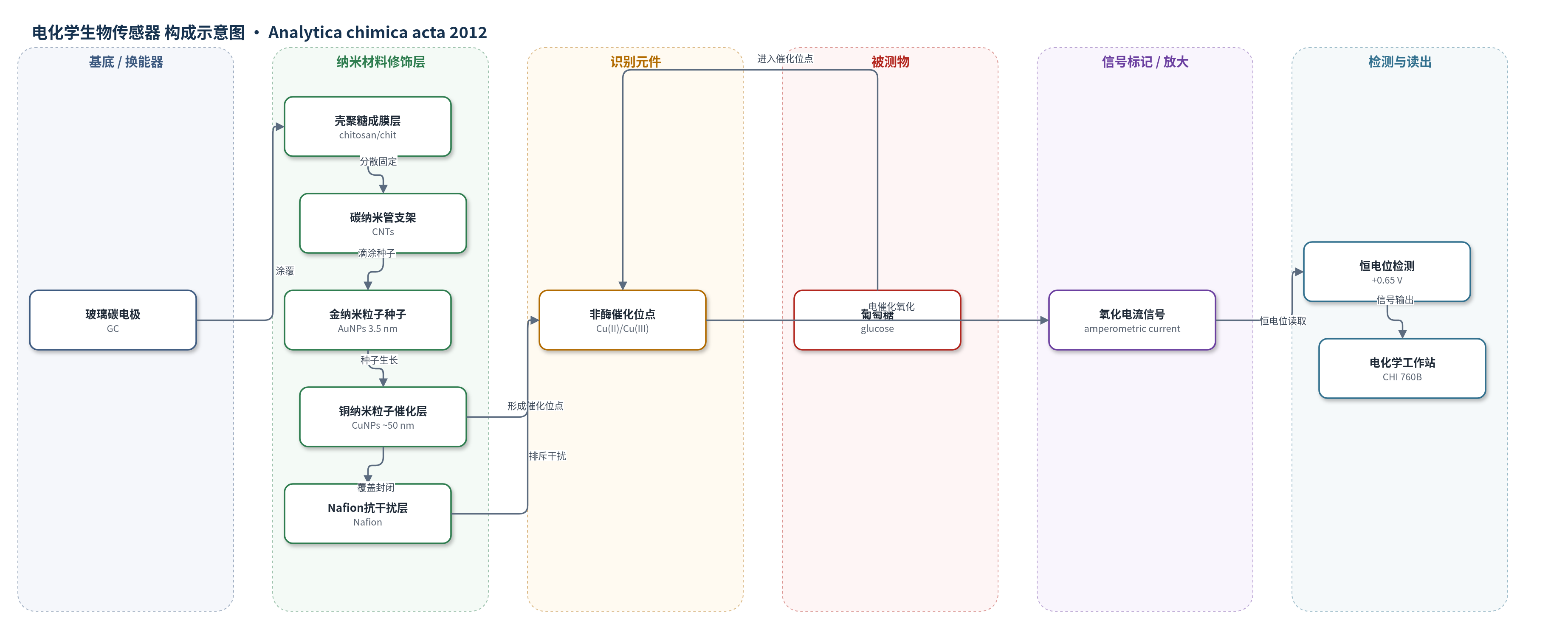
点击图片查看大图 · 依据论文自动绘制
传感器类型
电化学生物传感器
检测对象
葡萄糖(glucose, d-glucose);样品基质:0.1 M NaOH 溶液、人血清(human blood serum)
检测原理
该传感器为非酶电化学传感器。葡萄糖在碱性介质中到达CuNPs表面后,被Cu(II)/Cu(III)氧化还原对电催化氧化为葡萄糖内酯,同时Cu表面发生氧化还原循环,电子经CNTs和AuNPs快速传递至GC电极,在+0.65 V恒电位下产生阳极电流。CNTs提高导电性和传质,AuNPs作为种子使CuNPs均匀生长并增加活性位点,Nafion层排斥带负电的抗坏血酸和尿酸,降低背景干扰。随着葡萄糖浓度升高,参与电催化氧化的分子数增加,稳态电流增大,在1×10⁻⁷至5×10⁻³ M范围内与浓度呈线性关系。
检测灵敏度
LOD: 3 × 10⁻⁸ M;线性范围: 1.0 × 10⁻⁷ M–5 × 10⁻³ M;R^2 = 0.999
效应效果
传感器7 s内达到稳态电流的95%,快于CuO纳米棒(10 s)和PtPb/MWCNT(12 s)等报道电极。对1 mM葡萄糖响应为60.38 μA,0.1 mM抗坏血酸和尿酸分别仅1.81 μA和1.15 μA,选择性良好。10个电极对0.2 mM葡萄糖RSD为4.5%,单电极重复RSD为3.4%;空气保存65天后响应下降8%。人血清加标回收率为97%和103%,RSD为2.9%和3.1%。作者认为可用于人血清葡萄糖常规分析。
传感器的构成
- 基底电极:玻璃碳电极(GC),作为导电基底与电化学换能器
- 成膜介质:壳聚糖(chitosan, chit),用于分散CNTs并固定修饰层
- 导电支架:碳纳米管(CNTs),增强导电性、提供高比表面积和CuNPs生长支架
- 种子层:金纳米粒子(AuNPs, 3.5 nm),作为CuNPs成核种子
- 催化层:铜纳米粒子(CuNPs, ~50 nm),原位生长于CNTs表面,催化葡萄糖氧化
- 封闭层:Nafion,覆盖电极表面,排斥负电荷干扰物并稳定修饰层
中文摘要
本文首次采用种子介导生长法制备铜纳米粒子(CuNPs),以3.5 nm金纳米粒子(AuNPs)作为种子,碳纳米管(CNTs)作为生长支架。先将CNTs和AuNPs滴涂于玻璃碳(GC)电极表面,再将电极浸入含硫酸铜(CuSO4)和肼(N2H4·H2O)的生长液中,使CuNPs在CNTs表面原位生长。所得修饰电极在碱性介质中对葡萄糖的电催化氧化表现出很高的电化学活性,并据此构建了用于葡萄糖电化学检测的非酶生物传感器。该传感器可用于葡萄糖定量分析,线性范围为1.0×10⁻⁷至5×10⁻³ M,检出限为3×10⁻⁸ M。实验结果表明,该传感器具有良好的重现性和长期稳定性,且对其他可氧化物质无明显干扰,选择性高。
英文摘要
In this paper, for the first time, Cu nanoparticles (CuNPs) were prepared by seed-mediated growth method with Au nanoparticles (AuNPs) playing the role of seeds. Carbon nanotubes (CNTs) and AuNPs were first dropped on the surface of glassy carbon (GC) electrode, and then the electrode was immersed into growth solution that contained CuSO(4) and hydrazine. CuNPs were successfully grown on the surface of the CNTs. The modified electrode showed a very high electrochemical activity for electrocatalytic oxidation of glucose in alkaline medium, which was utilized as the basis of the fabrication of a nonenzymatic biosensor for electrochemical detection of glucose. The biosensor can be applied to the quantification of glucose with a linear range covering from 1.0×10(-7) to 5×10(-3)M and a low detection limit of 3×10(-8)M. Furthermore, the experiment results also showed that the biosensor exhibited good reproducibility and long-term stability, as well as high selectivity with no interference from other oxidable species.