组成图示
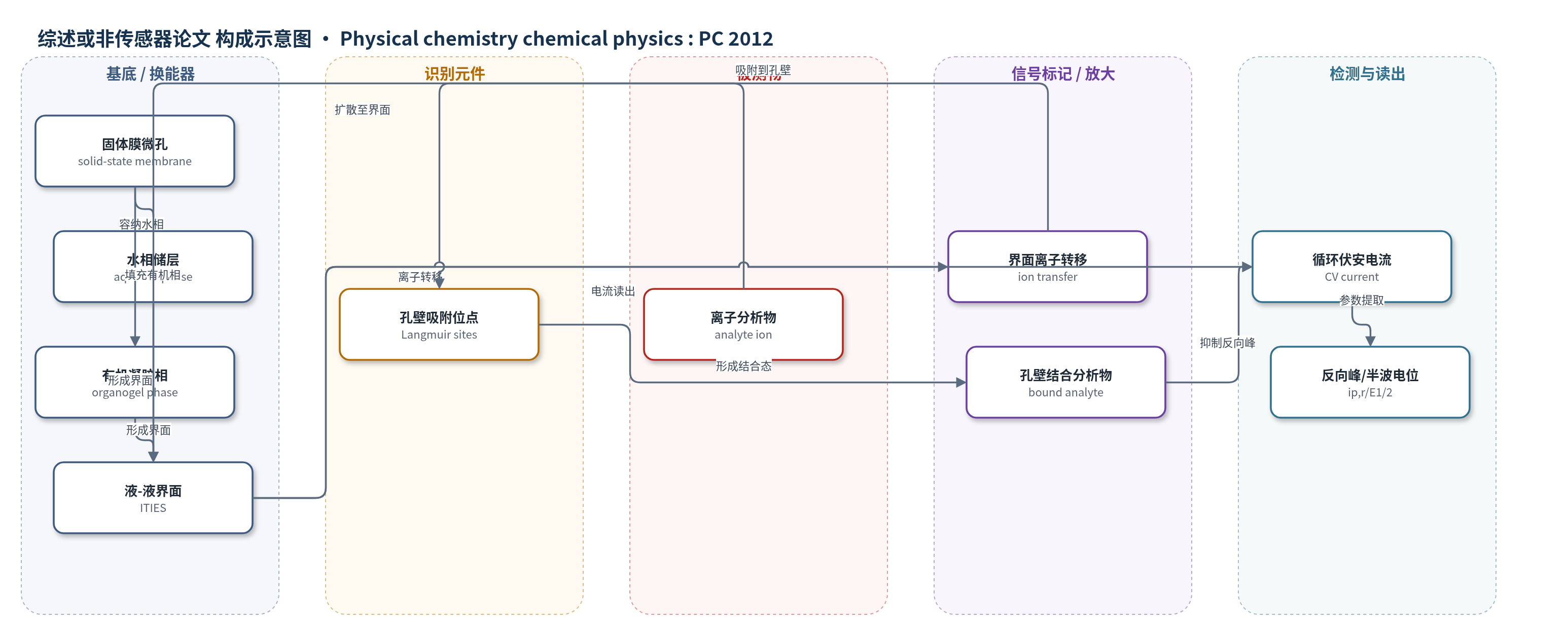
点击图片查看大图 · 依据论文自动绘制
传感器类型
综述或非传感器论文
检测对象
离子分析物(analyte ions);样品基质:水相(aqueous phase)
检测原理
在固体膜微孔中形成水相与有机凝胶相的液-液界面(ITIES),施加循环伏安电位。水相中的离子分析物在电位驱动下经 Butler-Volmer 动力学跨界面进入有机相,界面质量通量产生电流。若孔壁存在 Langmuir 吸附位点,转移后的离子会被孔壁捕获,形成结合态,减少反向扫描时可回传水相的离子量,因此反向峰电流降低;吸附还降低界面附近离子浓度,增大浓度梯度,使半波电位负移。扫描速率升高时扩散层未充满微孔,更多离子停留在孔内并被吸附,反向峰可消失。信号通过 CV 电流、反向峰电流和半波电位读出,微孔边缘效应和微界面阵列可增强通量。
检测灵敏度
原文未报告 LOD、线性范围、灵敏度斜率或相关系数。
效应效果
该文为计算模拟研究,未提供实验选择性、抗干扰、稳定性、重现性(RSD)、实际样品加标回收率或与 ELISA/HPLC/qPCR 等方法的对比数据。模拟结果显示,在给定参数下孔壁吸附使反向峰电流减小约 400 pA;孔半径越小(如 1 μm)吸附对半波电位和反向峰的影响越明显;扫描速率高于 15 mV/s 时反向峰消失(摘要表述为 50 mV/s 及以上)。作者指出单个 20 μm 直径界面在 100 mM 分析物下极限电流约 40 pA,可通过微界面阵列放大信号,并认为该策略可用于无标记电化学生物传感、酶-辅因子结合和吸附动力学研究。
传感器的构成
- 基底/换能器:固体膜微孔(solid-state membrane micropore),限定水相与有机相接触并形成 micro-ITIES
- 换能界面:水相/有机凝胶相液-液界面(ITIES),发生离子转移并产生 CV 电流
- 有机相:有机凝胶相(organogel phase),填充微孔并稳定界面,扩散系数约为水相 10%
- 识别/吸附层:孔壁 Langmuir 吸附位点(Langmuir adsorption sites),可代表生物受体或非特异位点,捕获转移离子
- 被测物:水相中的离子分析物(analyte ions),从水相跨 ITIES 转移至有机相
- 信号读出:循环伏安电流(CV current),通过反向峰电流 ip,r 和半波电位 E1/2 变化反映吸附
中文摘要
本文通过有限元计算模拟研究了微孔孔壁吸附对液-液界面离子转移循环伏安行为的影响。模拟对象为位于固体膜微孔处的水相与有机相/有机凝胶相界面(micro-ITIES),模型耦合了微孔内扩散、液-液界面 Butler-Volmer 离子转移动力学以及孔壁 Langmuir 型吸附。研究考察了孔半径、吸附/解吸速率常数、表面吸附位点密度和扫描速率等参数的影响。结果表明,转移离子在孔壁吸附会使反向峰电流减小,且扫描速率越高该效应越明显;同时半波电位向更低电位移动,说明孔壁吸附为离子跨界面转移提供了额外驱动力。与无吸附时反向峰随扫描速率增大而增大不同,存在吸附时较高扫描速率下反向峰消失。作者认为这些伏安特征可用于基于微孔 ITIES 的无标记生物传感应用。
英文摘要
Adsorption onto the walls of micropores was explored by computational simulations involving cyclic voltammetry of ion transfer across an interface between aqueous and organic phases located at the micropore. Micro-interfaces between two immiscible electrolyte solutions (micro-ITIES) have been of particular research interest in recent years and show promise for biosensor and biomedical applications. The simulation model combines diffusion to and within the micropore, Butler-Volmer kinetics for ion transfer at the liquid-liquid interface, and Langmuir-style adsorption on the pore wall. Effects due to pore radius, adsorption and desorption rates, surface adsorption site density, and scan rates were examined. It was found that the magnitude of the reverse peak current decreased due to adsorption of the transferring ion on the pore wall; this decrease was more marked as the scan rate was increased. There was also a shift in the half-wave potential to lower values following adsorption, consistent with a wall adsorption process which provides a further driving force to transfer ions across the ITIES. Of particular interest was the disappearance of the reverse peak from the cyclic voltammogram at higher scan rates, compared to the increase in the reverse peak size in the absence of wall adsorption. This occurred for scan rates of 50 mV s(-1) and above and may be useful in biosensor applications using micropore-based ITIES.