组成图示
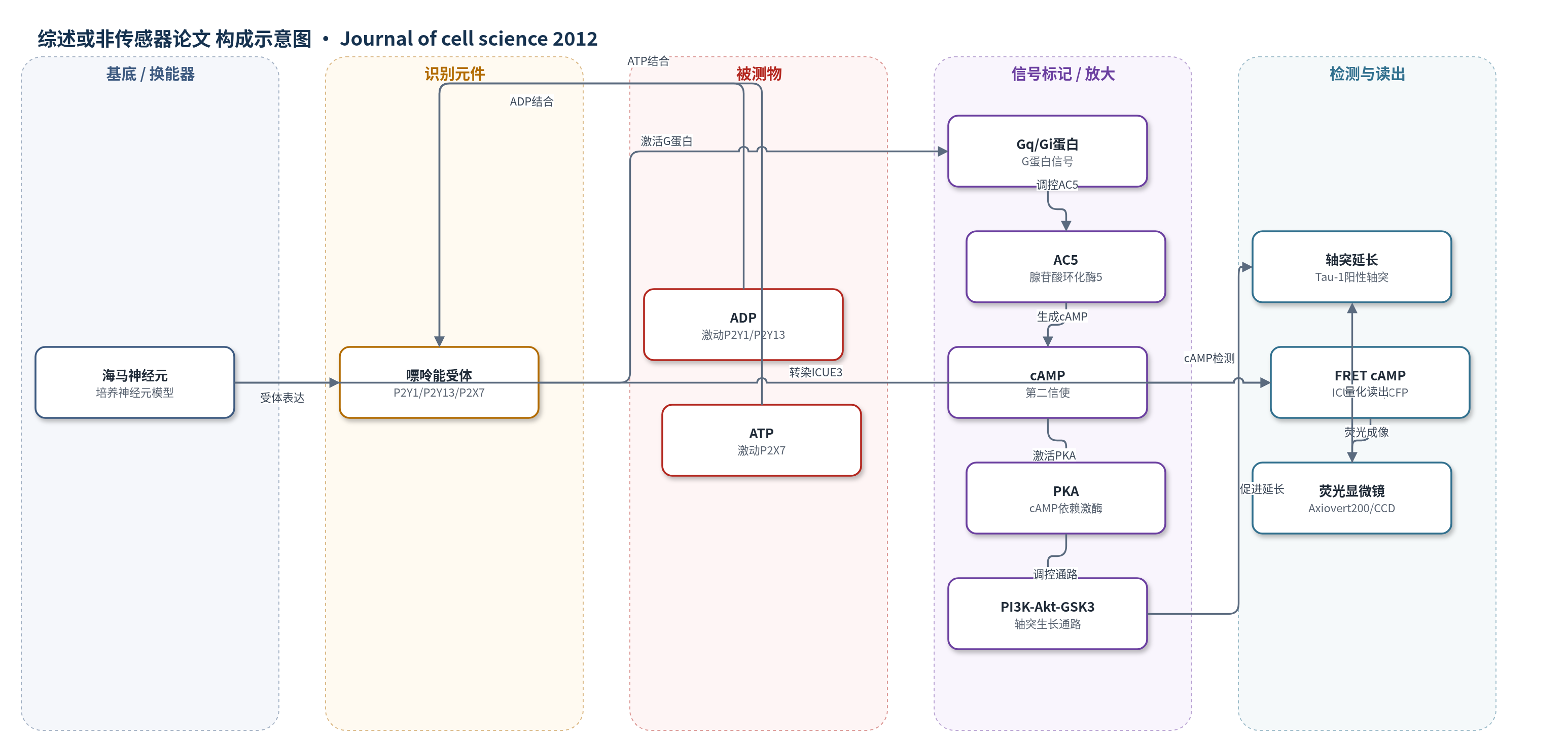
点击图片查看大图 · 依据论文自动绘制
传感器类型
综述或非传感器论文
检测对象
ADP(adenosine diphosphate)、ATP(adenosine triphosphate);样品基质:体外培养小鼠海马神经元培养液及细胞内 cAMP 微区室
检测原理
本研究的“检测”并非体外传感器件,而是细胞内嘌呤能信号读出。ADP 作为激动剂结合 P2Y1 和 P2Y13;ATP 结合 P2X7。P2Y1 主要偶联 Gq,经 PLC/PKCζ 激活 AC5;P2Y13 偶联 Gi,抑制 AC5;P2X7 开放阳离子通道引起 Ca2+ 内流,亚微米 Ca2+ 抑制 AC5。AC5 位于轴突远端,其活性决定局部 cAMP 生成。cAMP 激活 PKA,并影响 PI3K–Akt–GSK3 通路,从而改变轴突延长速率。FRET 生物传感器 ICUE3 通过 CFP/YFP 比值报告 cAMP 变化,ADP 或 P2X7 拮抗剂使轴突远端 cAMP 升高,AC5 抑制剂 NKY80 消除该变化,说明信号随嘌呤配体浓度和受体状态改变。
检测灵敏度
原文未报告 LOD、线性范围、灵敏度斜率或相关系数。
效应效果
研究在三次独立实验中重复,每条件分析约100个神经元,结果以均值±标准误和箱线图呈现。ADP 5 μM 使轴突长度由对照约150.47±3.42 μm 增至347.70±11.12 μm,最高5 μM ADP 可达433.55±18.69 μm;ATP 1 mM 则使轴突缩短至114.12±4.97 μm。P2Y1拮抗剂 MRS-2179 抑制轴突延长,P2Y13拮抗剂 MRS-2211 和 P2X7拮抗剂 BBG 促进轴突延长。AC5 抑制剂 NKY80 或 AC5 shRNA 消除 ADP、MRS-2211 和 BBG 的促延长效应。FRET 显示 ADP 或 BBG 使轴突远端 cAMP 升高20–30%,NKY80 消除。作者认为 P2Y1 激动剂联合 P2X7/P2Y13 拮抗剂可能促进轴突再生。
传感器的构成
- 换能器/电极:原文未报道电极或换能器材料,仅以培养海马神经元为细胞模型
- 识别元件:P2Y1、P2Y13、P2X7 嘌呤能受体,识别 ADP 或 ATP 并启动 Gq/Gi 或 Ca2+ 信号
- 信号读出:FRET cAMP 生物传感器 ICUE3(CFP/YFP)与荧光显微镜,检测轴突远端 cAMP 变化
中文摘要
在成年脑中,离子型或代谢型嘌呤能受体广泛表达于神经元和胶质细胞,并在炎症与神经递质传递中发挥重要作用。近期研究提示嘌呤能受体参与神经干细胞增殖与分化,但其对早期神经元发育和轴突延长的作用尚不清楚。本研究旨在探讨 ADP 或 ATP 激活的 P2Y1、P2Y13 和 P2X7 受体在轴突延长中的作用及相互协调机制。作者利用特异性激动剂、拮抗剂以及表达或 shRNA 质粒电转处理培养海马神经元。结果显示,ADP 和 P2Y1–GFP 表达促进轴突延长;相反,P2Y13 和 ATP 门控 P2X7 受体抑制轴突延长。上述受体信号由腺苷酸环化酶 5(AC5)协调。在转染 cAMP FRET 生物传感器 ICUE3 的神经元中,加入 ADP 或 P2X7 拮抗剂 Blue Brilliant G 可使轴突远端 cAMP 水平升高;抑制或敲低 AC5 则削弱该升高。结论表明,两种代谢型受体与一种离子型嘌呤能受体之间存在串扰,通过 AC5 调控 cAMP 水平,并调节由神经营养因子及 PI3K–Akt–GSK3 通路介导的轴突延长。
英文摘要
In adult brains, ionotropic or metabotropic purinergic receptors are widely expressed in neurons and glial cells. They play an essential role in inflammation and neurotransmission in response to purines secreted to the extracellular medium. Recent studies have demonstrated a role for purinergic receptors in proliferation and differentiation of neural stem cells although little is known about their role in regulating the initial neuronal development and axon elongation. The objective of our study was to investigate the role of some different types of purinergic receptors, P2Y1, P2Y13 and P2X7, which are activated by ADP or ATP. To study the role and crosstalk of P2Y1, P2Y13 and P2X7 purinergic receptors in axonal elongation, we treated neurons with specific agonists and antagonists, and we nucleofected neurons with expression or shRNA plasmids. ADP and P2Y1-GFP expression improved axonal elongation; conversely, P2Y13 and ATP-gated P2X7 receptors halted axonal elongation. Signaling through each of these receptor types was coordinated by adenylate cyclase 5. In neurons nucleofected with a cAMP FRET biosensor (ICUE3), addition of ADP or Blue Brilliant G, a P2X7 antagonist, increased cAMP levels in the distal region of the axon. Adenylate cyclase 5 inhibition or suppression impaired these cAMP increments. In conclusion, our results demonstrate a crosstalk between two metabotropic and one ionotropic purinergic receptor that regulates cAMP levels through adenylate cyclase 5 and modulates axonal elongation triggered by neurotropic factors and the PI3K-Akt-GSK3 pathway.